

Nothing brings the comforting flavors of the holidays to your table quite like a homemade Turkey Stuffing Recipe. With golden, buttery bread cubes, tender sautéed onions, crisp celery, fragrant herbs, and savory turkey or chicken broth, this traditional side dish delivers everything you love about Thanksgiving dinner. Every bite is wonderfully moist in the center, lightly crisp around the edges, and filled with the irresistible aroma of sage, thyme, and freshly baked bread.
The beauty of this easy Turkey Stuffing Recipe is that it transforms simple pantry ingredients into a delicious holiday favorite. Whether you’re preparing your first Thanksgiving feast or continuing a cherished family tradition, this homemade stuffing is straightforward, customizable, and packed with classic flavor. Unlike boxed stuffing mixes, making turkey stuffing from scratch lets you control the seasonings, moisture, and texture for a result that tastes genuinely homemade.
You can bake this stuffing separately in a casserole dish for beautifully golden edges and easier preparation. It pairs perfectly with roasted turkey, creamy mashed potatoes, homemade gravy, and cranberry sauce, making it an essential addition to your Thanksgiving or Christmas menu.
Best of all, this old-fashioned turkey stuffing recipe can be partially prepared ahead of time, helping make busy holiday cooking more manageable.
In this OoohDelish guide, you’ll discover how to make turkey stuffing from scratch, choose the best bread, balance the herbs and broth, and achieve that perfect combination of fluffy, moist centers and irresistibly crispy edges.
Whether it’s a holiday celebration or a comforting Sunday dinner, this homemade Turkey Stuffing Recipe is destined to become a family favorite.
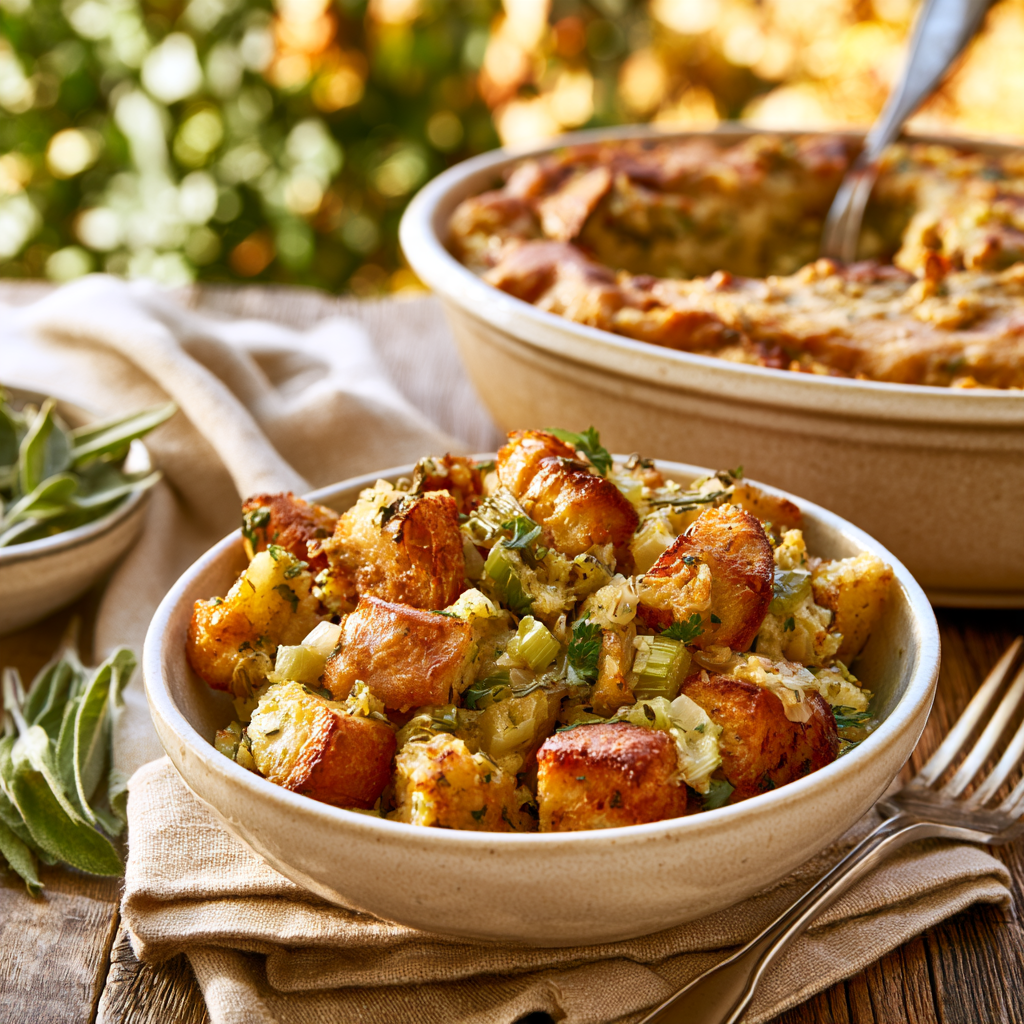
Turkey Stuffing Recipe
Equipment
- Large mixing bowl
- Large skillet or sauté pan
- 9 × 13-inch (23 × 33 cm) baking dish
- Rimmed baking sheets
- Parchment paper (optional)
- Wooden spoon or silicone spatula
- Sharp knife and cutting board
- Measuring cups and spoons
- Digital kitchen scale
- Aluminum foil
- Instant-read food thermometer
- Serving Spoon
Ingredients
- For the Homemade Turkey Stuffing
- 10 servings | 9 × 13-inch casserole
- Copy Ingredients
- 12 cups approximately 420 g dried white country bread cubes, cut into ¾–1-inch pieces
- ½ cup 113 g unsalted butter, divided
- 2 medium yellow onions approximately 300 g, finely diced
- 4 medium celery stalks approximately 200 g, finely diced
- 3 garlic cloves minced
- 2 tablespoons fresh sage finely chopped (or 2 teaspoons dried rubbed sage)
- 1 tablespoon fresh thyme leaves or 1 teaspoon dried thyme
- ¼ cup fresh flat-leaf parsley chopped
- ½ teaspoon freshly ground black pepper
- ½ teaspoon fine salt plus more to taste depending on broth
- 2½ cups 600 ml reduced-sodium turkey or chicken broth, warmed
- Up to ½ cup 120 ml additional warm broth, only if needed
- 1 tablespoon unsalted butter for greasing the baking dish (optional; included in recipe cost/nutrition)
- Ingredient consistency notes:
- – The 12 cups of bread are measured after drying. The approximate weight depends on bread density so use the volume as the primary guide for the recipe.
- – The recipe is intentionally egg-free. A moist spoonable texture is achieved with bread, butter, vegetables, and broth rather than an egg binder.
- – Start with 2½ cups of broth and reserve the additional ½ cup for adjustment. Do not add all 3 cups automatically.
- – This stuffing is baked separately not inside the turkey. That helps create a golden top and makes doneness easier to check.
Instructions
- Step 1: Prepare the Bread for Homemade Turkey Stuffing. Begin by cutting enough white country bread into evenly sized ¾–1-inch cubes to obtain approximately 12 cups after drying. For the best texture, choose sturdy bread that can absorb flavorful broth without completely breaking down. If the bread is already thoroughly dried and safe to use, you can proceed directly to the next preparation stage. If you’re working with fresh bread, arrange the cubes in an even layer on rimmed baking sheets, avoiding overcrowding. Consistently sized cubes are important because they absorb liquid and bake more evenly, helping the finished Turkey Stuffing Recipe develop tender centers without turning into a dense, pasty mixture.
- Step 2: Dry the Bread Cubes in the Oven. Preheat the oven to 275°F (135°C) and spread the bread cubes in a single layer over two large baking sheets. Place them in the oven for approximately 20–25 minutes, stirring or turning halfway through, until the pieces feel dry throughout but remain pale or only lightly toasted. The objective is to remove moisture rather than develop a deeply browned crust, since the stuffing will brown again during the final baking stage. Remove the trays and allow the bread to cool briefly while preparing the vegetables. Measure approximately 12 cups of the dried cubes and transfer them to a large mixing bowl. Once the bread is finished drying, increase the oven temperature to 350°F (175°C) for baking the assembled stuffing.
- Step 3: Prepare the Onions, Celery, Garlic, and Fresh Herbs. Finely dice 2 medium yellow onions and 4 medium celery stalks into small, relatively even pieces so they soften uniformly during cooking and distribute throughout the bread mixture. Mince 3 garlic cloves, finely chop 2 tablespoons of fresh sage, remove and measure 1 tablespoon of fresh thyme leaves, and chop ¼ cup of flat-leaf parsley. Keep the garlic and herbs separate from the onions and celery because they require less cooking time. If using dried sage or thyme, measure the specified substitutions rather than using the same volume as fresh herbs. Prepare 2½ cups of reduced-sodium turkey or chicken broth and warm it gently so it can be absorbed more evenly by the dried bread.
- Step 4: Sauté the Onions and Celery in Butter. Place a large skillet over medium heat and add ½ cup (113 g) of unsalted butter, allowing it to melt gently without browning. Add the diced onions and celery, then cook for approximately 8–10 minutes, stirring frequently, until the onions become translucent and lightly sweet and the celery begins to soften. Avoid cooking over excessively high heat, which can burn the butter or brown the vegetables before they become tender. This slow sautéing step is important because the softened vegetables create the savory foundation of the stuffing and prevent large, crunchy pieces of onion or celery from interrupting its tender texture.
- Step 5: Add Garlic and Aromatic Thanksgiving Herbs. Stir the minced garlic into the softened onion-and-celery mixture and cook for approximately 30–60 seconds, just until fragrant. Add the chopped sage, thyme leaves, ½ teaspoon of black pepper, and ½ teaspoon of fine salt, then stir gently for another 30 seconds to distribute the seasonings through the melted butter and vegetables. Remove the skillet from the heat and fold in most of the chopped parsley, reserving a small amount for the finished dish if desired. The herbs should smell fragrant and savory without becoming scorched. If your broth is already well seasoned, you can reduce the added salt and adjust later after tasting the fully cooked stuffing.
- Step 6: Combine the Seasoned Vegetables With the Dried Bread. Pour the warm butter, onion, celery, garlic, and herb mixture over the 12 cups of dried bread cubes in the large mixing bowl. Use a broad wooden spoon or silicone spatula to fold everything together gently, lifting the bread from the bottom of the bowl so the flavorful butter and vegetables are distributed throughout. Avoid stirring aggressively or pressing the cubes into a compact mass because the goal is to preserve recognizable bread pieces rather than create a mashed mixture. Continue folding until the bread looks lightly coated and the vegetables and herbs appear evenly distributed, creating an aromatic base ready to absorb the warm poultry broth.
- Step 7: Add Warm Turkey or Chicken Broth Gradually. Begin by pouring approximately 1½ cups (360 ml) of warm reduced-sodium turkey or chicken broth evenly over the seasoned bread mixture, then fold gently to distribute the moisture. Allow the bread to stand briefly for a minute or two, then add the remaining 1 cup (240 ml) of the initial broth in smaller additions while checking the texture. The cubes should become pleasantly moist, tender, and flexible while still maintaining their shape, with no large pool of liquid forming at the bottom of the bowl. Depending on the dryness and density of your bread, you may need some or all of the additional reserved ½ cup (120 ml) of broth. Stop adding liquid as soon as the mixture is evenly moistened, since too much broth can make the finished turkey stuffing soggy.
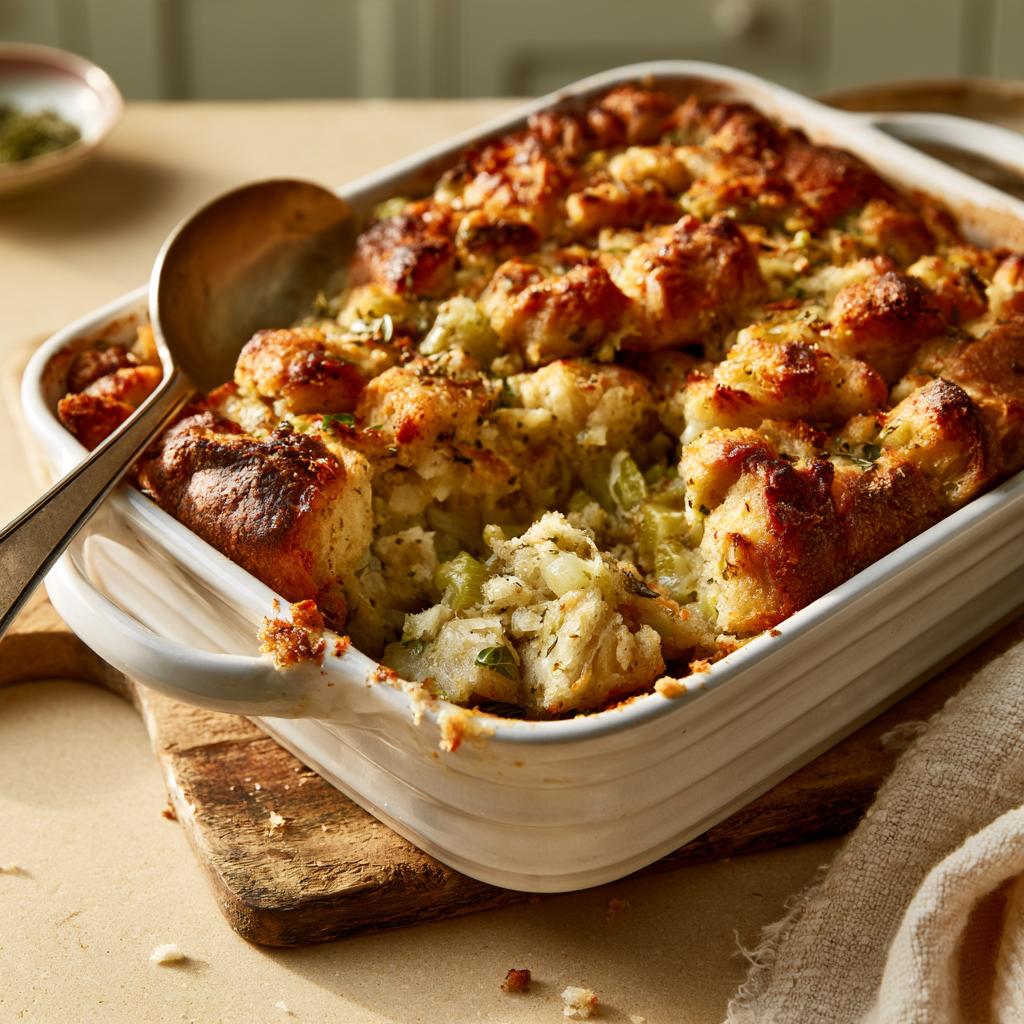
- Step 8: Transfer the Stuffing to the Baking Dish. Lightly grease a 9 × 13-inch (23 × 33 cm) baking dish with the optional tablespoon of unsalted butter, then spoon the prepared stuffing mixture into the dish. Spread it into a reasonably even layer with a spatula, distributing the onions, celery, and herbs throughout the casserole. Avoid packing the stuffing down tightly; keeping the bread relatively loose allows it to maintain some individual texture and gives the exposed cubes an opportunity to become lightly crisp during baking. If a few bread pieces on the surface appear completely dry, moisten them lightly with a spoonful of the remaining broth rather than saturating the entire casserole. Cover the dish securely with aluminum foil and prepare to bake it immediately after assembly.
- Step 9: Bake the Stuffing Covered Until Heated Through. Place the covered baking dish on the center rack of the preheated 350°F (175°C) oven and bake for approximately 30 minutes. The covered baking period helps limit surface drying while the broth heats and the bread becomes tender. After approximately 30 minutes, carefully lift one edge of the foil away from your face to release steam and check the center with an instant-read food thermometer. The stuffing may not yet have reached its final temperature, which is normal. Keep in mind that the exact cooking time depends on casserole depth, the initial temperature of the ingredients, and oven performance. The dish must continue baking until its center reaches a safe internal temperature of 165°F (74°C).
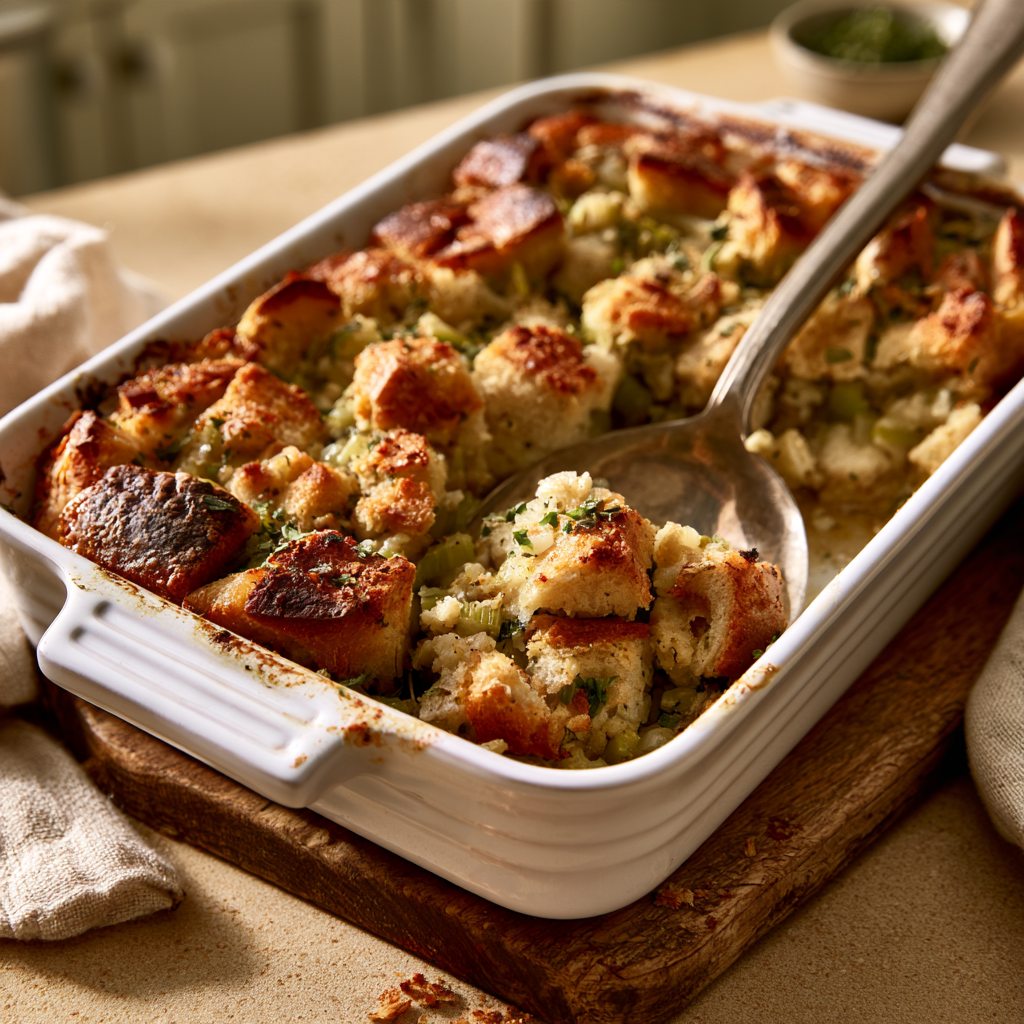
- Step 10: Uncover and Bake Until Beautifully Golden. Remove the aluminum foil and continue baking for approximately 15–20 additional minutes, or until the top develops an appetizing golden color with lightly crisp bread edges and the interior remains moist. Check the stuffing’s internal temperature by inserting an instant-read thermometer into the center of the casserole, away from the baking dish. The center must reach at least 165°F (74°C) before the stuffing is considered safely cooked. If the top browns too quickly while the center remains below this temperature, loosely replace the foil and continue baking until the required temperature is reached. If the surface looks dry before the center is cooked, add a small drizzle of warm broth to the driest areas, taking care not to flood the dish.
- Step 11: Rest, Garnish, and Serve Warm. Once the center of the Turkey Stuffing Recipe has reached 165°F (74°C) and the top is lightly golden, carefully remove the casserole from the oven and place it on a heat-resistant surface. Let the stuffing rest for approximately 5–10 minutes so the moisture settles and the bread structure becomes easier to serve. Sprinkle the reserved fresh parsley over the surface for a little color and freshness, then spoon the warm stuffing onto individual plates. Serve alongside roasted turkey, homemade gravy, mashed potatoes, cranberry sauce, green beans, or roasted vegetables. The finished stuffing should have a soft, savory center with distinct bread pieces and a lightly crisp, buttery top.
- Step 12: Store Leftover Turkey Stuffing Safely. After serving, transfer leftover cooked stuffing to shallow, clean, airtight containers and refrigerate within two hours of cooking, or within one hour if the surrounding temperature is above 90°F (32°C). Store at or below 40°F (4°C) and use refrigerated leftovers within 3–4 days. To reheat, place the stuffing in an oven-safe dish with a small splash of broth if needed, cover loosely to preserve moisture, and heat until the center reaches 165°F (74°C). For longer storage, freeze promptly cooled stuffing in freezer-safe containers for approximately 2–3 months for best quality. Thaw in the refrigerator or reheat safely from frozen, and avoid leaving cooked stuffing at room temperature for extended periods.
Notes
- The Origins of Turkey Stuffing Recipe: From Ancient Cooking Traditions to the American Thanksgiving Table
- 1. Ancient Origins: The Tradition of Stuffing Poultry
- 2. How Stuffing Became Part of European Cooking
- 3. Did the Pilgrims Eat Turkey Stuffing at the First Thanksgiving?
- 4. The Development of American Turkey Stuffing
- 5. How Thanksgiving Made Turkey Stuffing an American Holiday Classic
- 6. Why Sage, Onion, and Celery Became Traditional Ingredients
- 7. Stuffing vs. Dressing: Where Did the Different Names Come From?
- 8. Regional Turkey Stuffing Traditions Across America
- 9. How Modern Baking Changed the Traditional Turkey Stuffing Recipe
- 10. The Evolution From Traditional Bread Stuffing to Modern Homemade Variations
- 11. Why Turkey Stuffing Became a Symbol of Family and Thanksgiving
- 12. Why Traditional Turkey Stuffing Remains Popular Today
- Final Thoughts: The Timeless History of Turkey Stuffing Recipe
- Health Benefits of Turkey Stuffing Recipe: Nutrition, Wholesome Ingredients, and Healthier Holiday Cooking
- Nutritional Benefits of Turkey Stuffing Recipe Ingredients
- 1. Turkey Stuffing Provides Carbohydrates for Energy
- 2. Whole-Grain Turkey Stuffing Can Provide More Dietary Fiber
- 3. Onions Add Flavor and Small Amounts of Beneficial Nutrients
- 4. Celery Contributes Freshness, Texture, and Small Amounts of Micronutrients
- 5. Sage and Thyme Add Delicious Flavor Without Much Sodium
- 6. Homemade Turkey Stuffing Lets You Control Sodium
- 7. Turkey Stuffing Can Be Made With Less Saturated Fat
- 8. Adding Vegetables Can Improve Nutritional Variety
- 9. A Homemade Turkey Stuffing Recipe Can Be Part of a Balanced Holiday Meal
- 10. Baking Stuffing Separately Can Improve Food Safety
- Turkey Stuffing Recipe Nutrition: What Does One Serving Contain?
- 8 Practical Ways to Make Turkey Stuffing Healthier Without Losing Flavor
- What Is the Healthiest Way to Cook Turkey Stuffing?
- Final Thoughts: Is Homemade Turkey Stuffing Healthy?
- Nutritional Benefits of Turkey Stuffing Recipe Ingredients
- Why You Should Try This Turkey Stuffing Recipe: 12 Delicious Reasons to Make It for Thanksgiving and Beyond
- 1. It Delivers the Classic Flavors of Thanksgiving in Every Bite
- 2. The Perfect Combination of Crispy Edges and a Moist, Tender Center
- 3. It's Made With Simple, Affordable Ingredients
- 4. Homemade Stuffing Tastes Fresher and Lets You Control the Seasoning
- 5. It's Beginner-Friendly and Doesn't Require Complicated Cooking Techniques
- 6. You Can Prepare Several Components Ahead of Time
- 7. It Pairs Beautifully With Roasted Turkey and Classic Holiday Side Dishes
- 8. You Can Customize It With Your Favorite Ingredients
- 9. Baking Stuffing Separately Makes Serving Easier
- 10. It's a Wonderful Way to Use Day-Old Bread
- 11. It's Perfect for Thanksgiving, Christmas, and Cozy Family Dinners
- 12. Leftover Turkey Stuffing Can Be Turned Into Delicious New Meals
- What Makes This OoohDelish Turkey Stuffing Recipe Special?
- Expert Tips for Making the Best Turkey Stuffing Recipe
- Final Thoughts: Why This Turkey Stuffing Recipe Is Worth Making
The Origins of Turkey Stuffing Recipe: From Ancient Cooking Traditions to the American Thanksgiving Table
The fascinating history of the Turkey Stuffing Recipe goes back much further than the Thanksgiving celebrations we know today. Long before American families gathered around golden roasted turkeys, cooks in ancient civilizations were already filling poultry and other meats with aromatic ingredients to create flavorful, satisfying meals. Over centuries, this practical cooking technique evolved into one of the most beloved holiday side dishes in the United States: homemade turkey stuffing.
Today, a traditional Turkey Stuffing Recipe brings together simple ingredients such as dried bread cubes, melted butter, sautéed onions, tender celery, fragrant sage, thyme, parsley, and savory broth. Baked until the top is beautifully golden and the inside remains moist and tender, this comforting dish has become almost inseparable from Thanksgiving dinner.
But the journey from ancient stuffed birds to modern American bread stuffing is a story shaped by culinary traditions, immigration, regional ingredients, and generations of home cooking. Understanding the origins of turkey stuffing reveals why this humble combination of bread, vegetables, and herbs remains such an important part of holiday celebrations.
1. Ancient Origins: The Tradition of Stuffing Poultry
The idea of stuffing birds and other meats is thousands of years old. Ancient Mediterranean and Middle Eastern cuisines included preparations in which meats were filled with mixtures of grains, herbs, nuts, or other flavorful ingredients.
One important historical example comes from ancient Rome, where culinary texts describe elaborate dishes involving stuffed poultry and other meats.
The Roman cookbook commonly known as Apicius, compiled from recipes associated with late antiquity, includes preparations that demonstrate how sophisticated stuffing techniques had become.
These early fillings were quite different from the buttery bread stuffing served at modern American Thanksgiving dinners. Depending on the recipe, they could contain ingredients such as herbs, pepper, nuts, or other seasonings.
Nevertheless, the underlying cooking principle was familiar: adding a flavorful mixture to a bird or another food before cooking.
Stuffing therefore wasn’t invented specifically for turkey or Thanksgiving. It developed as part of a much older and broader culinary tradition.
2. How Stuffing Became Part of European Cooking
As cooking traditions developed across Europe, filling poultry with seasoned mixtures became a familiar way to prepare special meals.
Different regions developed their own approaches according to local ingredients, preferred seasonings, and available breads or grains.
Bread became an especially useful ingredient because it could absorb flavorful cooking liquids while adding texture and substance.
Rather than wasting bread that had started to dry out, cooks could incorporate it into dishes that benefited from its ability to soak up broth and other juices.
Herbs such as sage, thyme, parsley, and savory also became important in European poultry preparations.
These ingredients helped establish the flavor profile still associated with traditional turkey stuffing.
By the time European settlers established communities in North America, various bread-based and herb-seasoned stuffing traditions were already well established.
The American version would eventually develop its own identity by incorporating ingredients and customs from different cultures and regions.
3. Did the Pilgrims Eat Turkey Stuffing at the First Thanksgiving?
One of the most interesting questions surrounding the origins of the Turkey Stuffing Recipe is whether it appeared at the famous 1621 harvest gathering in Plymouth, Massachusetts.
The event, often described as the first Thanksgiving, brought together English colonists and members of the Wampanoag people. However, the surviving historical records provide only limited information about the foods served.
Historians know that venison and wildfowl were part of the celebration, but there is no reliable contemporary evidence confirming that the participants prepared a modern-style bread stuffing.
Turkey may have been among the birds available in the region, yet historians cannot establish that roasted turkey stuffed with bread, celery, onions, and sage was served at the gathering.
The Smithsonian’s National Museum of American History emphasizes that many dishes associated with modern Thanksgiving developed long after 1621.
The familiar Thanksgiving menu including turkey, mashed potatoes, bread stuffing, cranberry sauce, and pumpkin pie represents centuries of changing American food traditions rather than a documented recreation of that early harvest feast.
This distinction makes the history of turkey stuffing especially fascinating: its roots are old, but its identity as a Thanksgiving essential developed gradually.
4. The Development of American Turkey Stuffing
During the colonial period and the centuries that followed, European cooking traditions blended with ingredients available in North America.
Roasted poultry remained popular for family meals and special occasions, while bread-based fillings offered a satisfying accompaniment.
Over time, recipes became more recognizable to modern home cooks.
Bread cubes or crumbs provided the foundation, onions contributed savory sweetness, and herbs created the fragrant flavor associated with roasted poultry.
Butter and broth helped moisten the mixture, while other ingredients varied by household and region.
By the nineteenth century, as Thanksgiving developed into a more widely recognized American holiday, roasted turkey and familiar accompaniments became increasingly connected with the celebration.
Cookbooks, household publications, and family traditions helped spread different methods for preparing stuffing.
Some recipes were designed to cook inside the turkey, absorbing poultry juices. Others were prepared separately, allowing the surface to become more browned and crisp.
These variations eventually formed the foundation of the homemade Turkey Stuffing Recipe enjoyed across the United States today.
5. How Thanksgiving Made Turkey Stuffing an American Holiday Classic
The nineteenth century played an important role in shaping the Thanksgiving meal into a national tradition.
Thanksgiving celebrations already existed in parts of the United States, particularly in New England, but the holiday gained wider national recognition during the Civil War era.
In 1863, President Abraham Lincoln issued a proclamation calling for a national Thanksgiving observance in November.
As the holiday became more widely celebrated, families developed recognizable Thanksgiving menus featuring roast turkey and a variety of side dishes.
Bread stuffing became a natural companion to the turkey because its savory herbs, buttery richness, and soft interior complemented roasted poultry.
The dish was also practical for feeding larger gatherings. Bread could be prepared ahead of time, combined with affordable vegetables, and seasoned according to family preferences.
The familiar aroma of onions and celery cooking in butter, followed by the addition of sage and thyme, became associated with holiday meal preparation.
For many families, the Turkey Stuffing Recipe eventually became as essential to Thanksgiving as the turkey itself.
6. Why Sage, Onion, and Celery Became Traditional Ingredients
The familiar flavor of classic turkey stuffing comes from a small group of ingredients that work especially well together.
Sage brings an earthy, slightly peppery flavor closely associated with poultry dishes.
Onions add savory sweetness when slowly cooked in butter.
Celery contributes a mild vegetal flavor and gentle texture, preventing the bread mixture from tasting overly rich.
Thyme introduces delicate herbal notes that complement both sage and poultry broth.
Parsley provides freshness and a subtle contrast to the deeper flavors of the other ingredients.
Together, these seasonings create the recognizable aroma of traditional Thanksgiving stuffing.
The combination is particularly effective because bread has a relatively neutral flavor and readily absorbs broth, melted butter, and aromatic seasonings.
When baked, the bread develops a contrast between its moist interior and lightly crisp surface.
That combination of texture and fragrance helps explain why classic herb stuffing has remained popular even as more elaborate variations have emerged.
7. Stuffing vs. Dressing: Where Did the Different Names Come From?
One of the most interesting details in the history of turkey stuffing is the longstanding debate over whether the dish should be called stuffing or dressing.
Traditionally, the term stuffing describes a seasoned mixture placed inside the cavity of poultry or another food before cooking.
Dressing commonly refers to a similar mixture baked separately in a casserole dish.
However, the distinction isn’t universal. Many families use the words interchangeably, regardless of how the dish is prepared.
Regional preferences also influence the terminology. In parts of the American South, dressing is particularly common, while stuffing is widely used in other regions.
The differences are more cultural than culinary, since both versions often contain similar ingredients.
| Turkey stuffing | Turkey dressing |
|---|---|
| Traditionally cooked inside poultry | Traditionally baked in a separate dish |
| Can absorb turkey cooking juices | Moisture comes primarily from broth and other added ingredients |
| Usually has a softer texture | Can develop a crisp, golden surface |
| Requires careful internal temperature monitoring | Easier to cook and check separately |
| Common name in many U.S. regions | Especially familiar in Southern cooking |
The terminology reflects different family traditions rather than two entirely separate dishes.
8. Regional Turkey Stuffing Traditions Across America
Southern Cornbread Dressing: In many Southern households, cornbread replaces some or all of the white bread. The mixture often includes onions, celery, broth, and sage, creating a flavorful dish with a distinct cornmeal texture.
New England Bread Stuffing: White or country bread, butter, onions, celery, and poultry herbs form a familiar traditional combination. Some historical and regional versions also incorporate oysters or chestnuts.
Apple and Nut Stuffing: Chopped apples introduce gentle sweetness and moisture, while walnuts, pecans, or chestnuts contribute texture. These variations demonstrate how households adapt the classic bread stuffing to available ingredients.
Sourdough Herb Stuffing: Using sourdough introduces a subtle tangy flavor and chewy texture. Rosemary, thyme, and sage help complement its more pronounced bread flavor.
These regional variations highlight an important aspect of the Turkey Stuffing Recipe: there has never been one universal formula.
Instead, different communities and families have adapted the dish using their preferred breads, seasonings, and locally available ingredients.
9. How Modern Baking Changed the Traditional Turkey Stuffing Recipe
Historically, stuffing was frequently prepared inside roasted poultry.
As home cooks became more familiar with oven cooking and food safety recommendations, baking stuffing separately became an increasingly practical alternative.
Cooking the mixture in a casserole dish provides several advantages.
First, the stuffing can develop a beautifully golden top with crispy bread edges.
Second, it becomes easier to control moisture by adjusting the amount of broth.
Third, it can be prepared in a dedicated baking dish without affecting the roasting time of the turkey.
Separate baking also makes it easier to ensure the center reaches a safe temperature.
The USDA recommends cooking stuffing separately for more uniform doneness and safety. Whether cooked inside a turkey or in a casserole, the center should reach 165°F (74°C) as measured with a food thermometer.
This is why many modern homemade turkey stuffing recipes are baked independently and served alongside the roasted bird.
At OoohDelish, this casserole-style approach is especially appealing because it produces moist, savory bread underneath a lightly crisp, golden surface.
10. The Evolution From Traditional Bread Stuffing to Modern Homemade Variations
Over generations, American home cooks have continued experimenting with stuffing ingredients.
While classic recipes focus on bread, butter, onions, celery, and sage, modern versions may include mushrooms, roasted garlic, cranberries, apples, nuts, or different breads.
Some families prefer soft white bread because it absorbs broth easily and produces a tender texture.
Others enjoy sourdough, which provides a more pronounced flavor and slightly chewy structure.
Cornbread creates a distinctly Southern-style variation, while rustic country bread gives stuffing a heartier consistency.
One particularly delicious approach involves using homemade bread.
A sturdy loaf, such as the kind used in a same-day sourdough bread recipe, can provide flavorful bread cubes when properly dried before mixing with the broth and seasonings.
The drying stage is important because fresh, soft bread can absorb liquid unevenly and become pasty, while dried bread cubes are better suited to retaining individual pieces within the finished stuffing.
Despite countless variations, the essential goal remains the same: create a savory, herb-filled dish with enough moisture to taste tender and enough structure to avoid becoming soggy.
11. Why Turkey Stuffing Became a Symbol of Family and Thanksgiving
Beyond its ingredients and preparation techniques, turkey stuffing holds a special place in American holiday culture because of its connection to family traditions.
For many households, stuffing recipes are passed down through generations.
One family may insist on generous amounts of sage, another may prefer cornbread, while another adds apples or carefully browned onions.
These preferences often become part of a family’s holiday identity.
The preparation process itself also carries meaning.
Cutting bread into cubes, chopping celery and onions, melting butter, and mixing fragrant herbs into the stuffing are familiar activities that bring people together in the kitchen.
As the dish bakes, its savory aroma fills the home and signals that a special meal is approaching.
The result is more than a simple side dish. It becomes part of the holiday experience, associated with shared meals, familiar flavors, and traditions that return year after year.
This emotional connection helps explain why even families that experiment with new Thanksgiving recipes often keep a favorite stuffing recipe on their menu.
12. Why Traditional Turkey Stuffing Remains Popular Today
The enduring popularity of the Turkey Stuffing Recipe comes from its delicious combination of simplicity, flavor, and versatility.
Few side dishes transform such basic ingredients into something so satisfying.
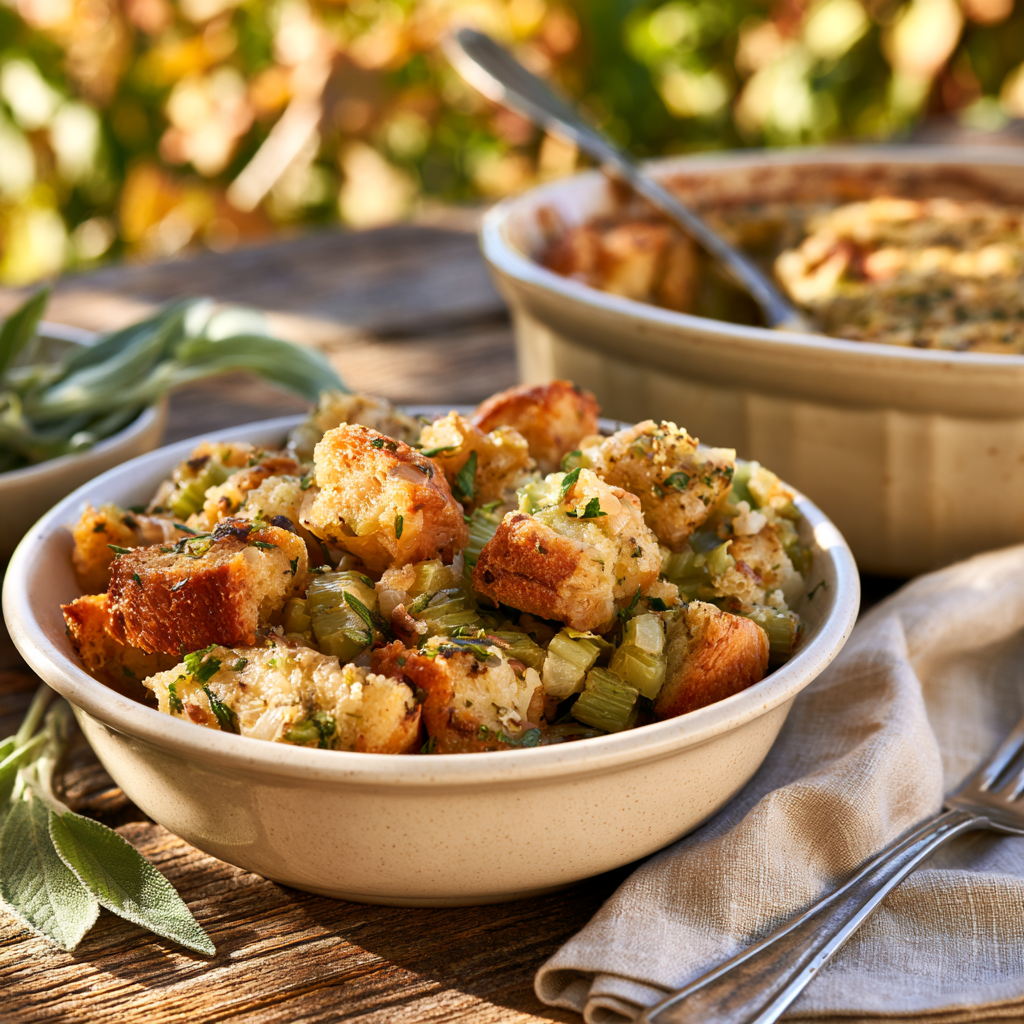
Dried bread cubes absorb rich broth and melted butter, onions and celery contribute savory flavor, and herbs introduce the unmistakable fragrance of a traditional Thanksgiving meal.
When baked properly, the mixture develops the ideal contrast between a moist, tender center and crisp, golden edges.
Turkey stuffing also complements many different dishes, including roasted turkey, mashed potatoes, gravy, roasted vegetables, and cranberry sauce.
Although it is strongly associated with Thanksgiving and Christmas, homemade stuffing can also be enjoyed as a comforting side dish throughout the colder months.
Modern variations make it easy to adapt the recipe to personal preferences while preserving its traditional character.
For home cooks who appreciate classic American comfort food, the combination of familiar ingredients and satisfying texture makes turkey stuffing a recipe worth returning to every year.
Final Thoughts: The Timeless History of Turkey Stuffing Recipe
The story of the Turkey Stuffing Recipe reflects centuries of culinary evolution, beginning with ancient traditions of filling poultry and developing into the herb-seasoned bread dish loved throughout America today.
European cooking practices provided an important foundation, while American home cooks gradually introduced regional ingredients, family preferences, and new preparation methods.
As Thanksgiving became a national tradition, turkey stuffing earned a permanent place beside roasted turkey and other familiar holiday dishes.
Today, whether you call it stuffing or dressing, prepare it with white bread or cornbread, or prefer it soft or crispy, the dish continues to represent the comforting flavors of homemade holiday cooking.
What makes this tradition especially meaningful is that every family can make it their own.
The same basic ingredients—bread, butter, onions, celery, herbs, and broth—can become something uniquely personal depending on the seasonings and techniques you choose.
OoohDelish Cooking Secret: For a classic Turkey Stuffing Recipe with beautifully golden edges and a moist interior, begin with properly dried bread cubes, gently sauté the onions and celery in butter, and add warm broth gradually until the bread is evenly moistened without becoming soggy. Bake in a casserole dish, checking that the center reaches 165°F (74°C), and uncover toward the end of baking to develop an irresistible golden crust.
Health Benefits of Turkey Stuffing Recipe: Nutrition, Wholesome Ingredients, and Healthier Holiday Cooking
A warm, homemade Turkey Stuffing Recipe is one of the most comforting dishes you can serve during Thanksgiving, Christmas, or a special family dinner. With golden bread cubes, fragrant sage, tender celery, sweet sautéed onions, and rich poultry broth, traditional turkey stuffing brings together familiar ingredients in a flavorful, satisfying side dish. But beyond its irresistible aroma and classic holiday appeal, you may be wondering whether turkey stuffing offers any nutritional benefits.
The answer depends on how the stuffing is prepared, which ingredients are included, and how much you serve. A traditional homemade Turkey Stuffing Recipe provides carbohydrates for energy, some B vitamins from bread, and smaller amounts of vitamins, minerals, and fiber from vegetables and herbs. Using whole-grain bread can increase its fiber content, while adding mushrooms, carrots, or other vegetables introduces additional nutrients and flavor.
One of the biggest advantages of making homemade turkey stuffing from scratch is the ability to control the amount of butter, salt, and broth. Unlike relying exclusively on a prepared stuffing mix, a homemade version allows you to select your preferred bread, use reduced-sodium broth, increase the vegetables, and adjust the seasonings according to your family’s needs.
However, traditional stuffing is primarily a bread-based side dish. It can be relatively high in refined carbohydrates, sodium, and saturated fat, particularly when prepared with generous amounts of butter and salty broth. It should not be considered a complete meal or a significant source of protein simply because it is called turkey stuffing.
When prepared thoughtfully and served alongside roasted turkey, vegetables, and other nutrient-rich foods, this beloved holiday dish can be part of a varied, satisfying meal.
Let’s explore the genuine nutritional benefits of turkey stuffing, the role of its ingredients, and practical ways to create a lighter, flavorful version without sacrificing the comforting taste everyone loves.
Nutritional Benefits of Turkey Stuffing Recipe Ingredients
The nutritional value of homemade turkey stuffing comes from the combination of bread, vegetables, herbs, cooking fat, and broth.
| Ingredient | Key nutrients or characteristics | Potential benefits and considerations |
|---|---|---|
| Bread cubes | Carbohydrates, some protein and B vitamins | Provide energy and structure; nutritional content depends on the bread. |
| Whole-grain bread | Dietary fiber, B vitamins, magnesium | Can improve fiber and whole-grain content compared with refined white bread. |
| Onions | Small amounts of fiber, potassium, and vitamin C | Add flavor and help reduce reliance on excessive salt. |
| Celery | Water, fiber, vitamin K, potassium | Adds texture and small amounts of micronutrients. |
| Unsalted butter | Fat, vitamin A | Adds flavor and richness but contributes saturated fat. |
| Chicken or turkey broth | Water, sodium, and varying amounts of minerals | Moistens the stuffing; reduced-sodium varieties allow better salt control. |
| Sage | Aromatic plant compounds | Provides distinctive poultry seasoning flavor in small quantities. |
| Thyme | Aromatic compounds and trace micronutrients | Adds herbal depth with minimal calories. |
| Parsley | Vitamin K and other micronutrients | Adds freshness; small garnish amounts contribute modest nutrition. |
| Mushrooms (optional) | B vitamins, potassium, some fiber | Add savory flavor and vegetable variety. |
| Walnuts or pecans (optional) | Unsaturated fats, fiber, minerals | Add texture and nutrient variety, but also calories and allergens. |
| Apples (optional) | Carbohydrates and fiber | Introduce natural sweetness and additional plant ingredients. |
1. Turkey Stuffing Provides Carbohydrates for Energy
One of the main nutritional contributions of a traditional Turkey Stuffing Recipe comes from its bread.
Bread contains carbohydrates, which the body breaks down into glucose to provide energy for normal bodily functions and physical activity.
Carbohydrates are particularly important for the brain and muscles, although the body can also use other energy sources.
Because stuffing is largely made from bread cubes, carbohydrates typically represent a substantial portion of its nutritional profile.
The type of bread you choose affects how much fiber and other nutrients the finished dish provides.
Traditional white bread creates a familiar, soft texture and absorbs broth beautifully. Whole-grain bread generally provides more fiber and may contribute additional magnesium and other nutrients.
A combination of white bread and whole-grain bread can offer a practical compromise between classic holiday flavor and additional fiber.
For the best texture, dry the bread cubes before assembling your stuffing. Properly dried bread absorbs broth more evenly and helps prevent the finished casserole from becoming excessively mushy.
Nutrition takeaway: Turkey stuffing contributes dietary energy, but its carbohydrate content means portion size may be relevant for people managing their overall intake.
2. Whole-Grain Turkey Stuffing Can Provide More Dietary Fiber
Fiber is one of the most valuable nutritional improvements you can make to a homemade stuffing recipe.
Traditional stuffing prepared entirely with refined white bread may contain relatively little dietary fiber.
Replacing some of that bread with whole-grain bread can increase the fiber content of the finished dish.
Dietary fiber contributes to normal digestive function, supports regular bowel movements, and can help increase the feeling of fullness after a meal.
Different types of fiber also play different roles in the digestive system. Some help add bulk to stools, while others can influence cholesterol levels or serve as substrates for intestinal microorganisms.
Whole-grain foods provide fiber along with additional nutrients, making them useful components of a varied diet.
For homemade turkey stuffing, try replacing approximately one-third to one-half of the white bread with a hearty whole-grain loaf.
This approach preserves much of the traditional taste while introducing additional texture and nutritional variety.
The amount of broth may need adjustment because different breads absorb moisture differently.
Nutrition takeaway: Choosing some whole-grain bread is one of the easiest ways to improve the fiber content of a Turkey Stuffing Recipe.
3. Onions Add Flavor and Small Amounts of Beneficial Nutrients
Onions are essential to the familiar flavor of classic turkey stuffing.
When slowly sautéed in butter or olive oil, onions become tender and develop a mellow sweetness that balances the savory herbs and broth.
Nutritionally, onions provide small amounts of dietary fiber, potassium, vitamin C, and naturally occurring plant compounds.
Among these compounds are flavonoids, including quercetin, which researchers have studied for various biological effects.
However, the quantities of onions typically found in one serving of stuffing are relatively small. Eating onion-containing stuffing should not be presented as a proven way to prevent inflammation, cardiovascular disease, or other medical conditions.
The more practical advantage of onions is their ability to contribute rich flavor without requiring large amounts of additional salt.
For the best result, cook chopped onions over medium heat until softened and translucent rather than deeply browned or burned.
This creates a balanced flavor that complements celery, sage, and thyme.
Nutrition takeaway: Onions add vegetable variety and help build savory flavor naturally.
4. Celery Contributes Freshness, Texture, and Small Amounts of Micronutrients
Celery is another classic ingredient in homemade turkey stuffing.
Its mild flavor and gently crisp texture complement the softness of bread cubes and the richness of butter.
Celery contains water, small amounts of fiber, potassium, and vitamin K.
Vitamin K plays an important role in normal blood clotting and bone metabolism, while potassium contributes to normal muscle and nerve function.
However, the nutritional contribution of celery in a typical serving of stuffing is modest because the recipe generally contains only a few stalks divided among several portions.
Its main culinary benefit is providing freshness and texture.
For a classic stuffing, dice the celery into reasonably even pieces so it softens uniformly during sautéing.
Cooking celery with onions allows the vegetables to develop a balanced aromatic base before the bread and broth are added.
Nutrition takeaway: Celery adds small quantities of nutrients while helping prevent stuffing from tasting overly heavy or one-dimensional.
5. Sage and Thyme Add Delicious Flavor Without Much Sodium
Herbs play a central role in the flavor of traditional turkey stuffing.
Sage gives the dish its distinctive earthy aroma, while thyme contributes subtle savory notes.
Parsley adds a fresh finish, and rosemary can provide a stronger herbal character when used sparingly.
These herbs contain various naturally occurring aromatic and plant compounds, but the small amounts normally used in stuffing are not enough to justify strong medicinal claims.
Their most meaningful benefit is culinary.
Using well-balanced herbs makes food taste flavorful and satisfying without needing to rely entirely on salt.
For example, a stuffing made with fragrant sage, thyme, black pepper, gently sautéed onions, and good-quality broth can be delicious even when the sodium level is moderated.
Fresh herbs and dried herbs can both work well, although dried herbs tend to have a more concentrated flavor.
If substituting dried herbs for fresh, begin with a smaller quantity and adjust according to the recipe.
Nutrition takeaway: Herbs are an excellent way to develop classic Thanksgiving flavor while keeping added salt under control.
6. Homemade Turkey Stuffing Lets You Control Sodium
One of the biggest nutritional advantages of making a Turkey Stuffing Recipe from scratch is the ability to control sodium.
Commercial stuffing mixes, regular poultry broth, salted butter, and packaged seasoning blends can all contribute sodium.
Using several salty ingredients together may result in a finished dish with more sodium than expected.
A homemade recipe allows you to choose reduced-sodium broth, unsalted butter, and individual herbs rather than relying on a pre-seasoned mix.
This gives you better control over the final flavor.
Sodium is an essential nutrient, but excessive sodium intake is associated with increased blood pressure in many people.
The American Heart Association recommends no more than 2,300 mg of sodium per day for most adults, with an ideal goal of 1,500 mg for many adults, particularly those with high blood pressure. Individual needs can vary.
To reduce sodium without making the stuffing bland, focus on building flavor through vegetables, herbs, and carefully selected broth.
Taste the broth and vegetable mixture before adding extra salt, remembering that the bread may also contain sodium.
Nutrition takeaway: Homemade preparation makes it easier to moderate sodium without giving up traditional holiday flavor.
7. Turkey Stuffing Can Be Made With Less Saturated Fat
Traditional turkey stuffing often contains a generous amount of butter.
Butter contributes flavor, richness, and a pleasant texture, helping the bread develop golden edges during baking.
However, butter is also a significant source of saturated fat.
High dietary saturated fat intake can raise LDL cholesterol in many people, particularly when it replaces unsaturated fats in the diet.
If you’re looking for a lighter version, you can reduce the amount of butter or replace a portion with olive oil.
Olive oil contains predominantly unsaturated fats and offers a pleasant savory flavor.
You don’t necessarily need to eliminate butter entirely.
Using a modest amount of butter for its distinctive taste and combining it with a little olive oil can provide a satisfying compromise.
Another practical technique is to sauté the vegetables in a measured quantity of fat, then add broth gradually to moisten the bread rather than relying on large amounts of melted butter.
Be careful not to remove too much fat or liquid without adjusting the recipe, since stuffing may become dry and crumbly.
Nutrition takeaway: Reducing butter modestly or replacing part of it with olive oil can lower saturated fat while preserving good flavor.
8. Adding Vegetables Can Improve Nutritional Variety
A traditional Turkey Stuffing Recipe already contains onions and celery, but additional vegetables can make it more colorful and nutritionally varied.
Mushrooms are particularly suitable because they contribute savory umami flavor and blend naturally with bread, poultry broth, and herbs.
Carrots introduce subtle sweetness and color, while chopped spinach or kale can add leafy vegetables.
Leeks provide a milder onion-like flavor, and roasted butternut squash brings a gently sweet seasonal character.
The key is choosing ingredients that complement the classic stuffing rather than overpowering it.
Most vegetables should be cooked or partially cooked before mixing them into the bread, especially if they release a substantial amount of moisture.
Mushrooms, for example, benefit from being sautéed until much of their liquid has evaporated.
Otherwise, excess moisture may make the stuffing soggy.
You can also add diced apples or dried cranberries for sweetness, although dried fruit may increase the overall sugar content.
Nutrition takeaway: Adding vegetables is a useful way to increase plant-food variety, color, and flavor in your Thanksgiving stuffing.
9. A Homemade Turkey Stuffing Recipe Can Be Part of a Balanced Holiday Meal
Thanksgiving meals often include several rich dishes served together, so considering how each food contributes to the overall meal is helpful.
Turkey stuffing provides primarily carbohydrates and fat, depending on its preparation. Roasted turkey contributes substantial protein, while vegetables such as green beans, carrots, and Brussels sprouts add fiber and micronutrients.
Combining these foods can create a more nutritionally varied plate than eating stuffing alone.
A practical approach is to serve a moderate portion of stuffing alongside roasted turkey and a generous helping of vegetables.
This allows you to enjoy traditional holiday flavors while including several food groups.
For example, a holiday plate might contain sliced roasted turkey, a ½-cup serving of homemade stuffing, roasted vegetables, and a spoonful of cranberry sauce.
This isn’t a mandatory serving plan, and individual energy needs differ. It’s simply an example of how a favorite comfort food can fit alongside other foods.
For another comforting homemade bread option to serve at family meals, our 3 Ingredient Biscuit Recipe uses just a few familiar ingredients to create fluffy, golden biscuits.
10. Baking Stuffing Separately Can Improve Food Safety
Food safety is especially important when preparing turkey stuffing because the mixture can contain moisture, broth, eggs, and ingredients that require proper cooking and storage.
Although the name suggests placing the mixture inside the turkey, baking stuffing separately in a casserole dish is generally the safer and more convenient approach.
When stuffing is cooked inside poultry, the turkey and the stuffing may reach safe temperatures at different times.
Even if the turkey meat is fully cooked, the center of the stuffing may remain undercooked.
The USDA recommends cooking stuffing separately for more uniform doneness and food safety. Whether it’s prepared in a casserole dish or inside poultry, the center of the stuffing must reach 165°F (74°C).
Baking stuffing separately also makes it easier to achieve the desirable contrast between a moist interior and a golden, lightly crisp top.
Use a food thermometer to check the center rather than relying only on the appearance of the crust.
For leftovers, refrigerate stuffing in shallow containers within two hours of cooking, consume refrigerated leftovers within three to four days, and reheat to 165°F (74°C).
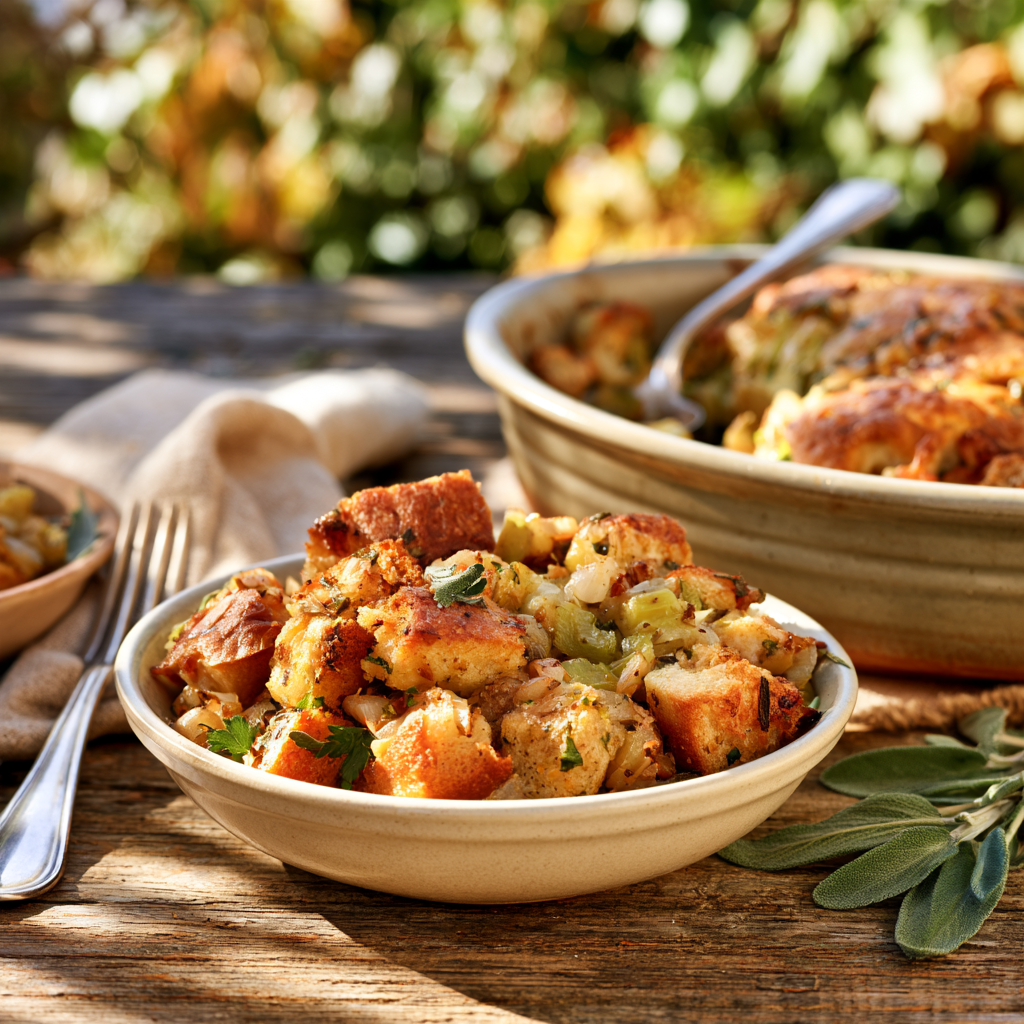
Turkey Stuffing Recipe Nutrition: What Does One Serving Contain?
The exact nutritional content of turkey stuffing depends on the type and quantity of bread, the amount of butter, the sodium content of the broth, and the serving size.
The following table gives an illustrative range for a ½-cup serving of homemade bread stuffing prepared with traditional ingredients.
| Nutrient | Approximate amount per ½ cup |
|---|---|
| Calories | 150–220 kcal |
| Carbohydrates | 18–27 g |
| Protein | 3–5 g |
| Total Fat | 6–12 g |
| Saturated Fat | 2–6 g |
| Dietary Fiber | 1–3 g |
| Sodium | 250–550 mg |
| Total Sugars | 2–5 g |
These ranges are general estimates, not nutrition calculations for the final OoohDelish recipe. A full recipe calculation should use the exact ingredient weights, brands, and finished yield.
The table demonstrates why preparation methods matter. A bread-heavy stuffing with substantial butter may be more calorie-dense than one using additional vegetables and a moderate amount of olive oil.
Similarly, the sodium content can vary dramatically depending on the broth, bread, and added seasonings.
8 Practical Ways to Make Turkey Stuffing Healthier Without Losing Flavor
You don’t need to completely reinvent a traditional Turkey Stuffing Recipe to make thoughtful nutritional improvements.
Small changes to the bread, vegetables, seasonings, and cooking fats can make a meaningful difference while preserving the buttery, savory flavor that makes stuffing so popular.
| Healthy cooking adjustment | Potential benefit | How to maintain great flavor |
|---|---|---|
| Replace some white bread with whole-grain bread | Increases fiber and whole-grain content | Start with a 50/50 combination |
| Use reduced-sodium turkey or chicken broth | Helps control sodium | Add sage, thyme, and black pepper |
| Replace part of the butter with olive oil | Reduces saturated fat | Keep a little butter for classic flavor |
| Add extra celery and onions | Increases vegetable content | Sauté until tender before combining |
| Include mushrooms | Adds savory flavor and nutrient variety | Brown them to remove excess moisture |
| Add chopped apples | Contributes fiber and natural sweetness | Choose firm apples that hold their shape |
| Use fresh or dried herbs generously | Creates flavor with little additional sodium | Balance sage with thyme and parsley |
| Serve moderate portions | Helps manage overall meal intake | Pair with turkey and roasted vegetables |
Can You Make Turkey Stuffing Without Butter?
Yes. You can prepare turkey stuffing using olive oil in place of some or all of the butter.
Olive oil helps soften onions and celery while contributing a pleasant savory flavor.
It also contains a higher proportion of unsaturated fat than butter.
For a classic holiday flavor, some home cooks prefer using a combination of olive oil and a smaller amount of butter.
Keep in mind that olive oil and butter are both calorie-dense. Replacing butter with oil changes the fatty acid composition but does not automatically make the recipe low-calorie.
If reducing calories is your goal, focus on the total amount of cooking fat as well as the type.
Is Whole-Wheat Bread Better for Turkey Stuffing?
Whole-wheat bread can be a nutritious option because it generally contains more dietary fiber than refined white bread.
However, the texture of the finished stuffing will depend on the particular loaf.
Some whole-wheat breads produce a pleasantly hearty stuffing, while very dense varieties may absorb broth differently.
For beginners, combining whole-wheat bread with traditional white or country bread is a practical way to preserve the familiar texture.
Dry the bread cubes thoroughly before assembling the stuffing, and add the broth gradually so the mixture becomes evenly moistened without turning soggy.
Can Turkey Stuffing Be Part of a Weight-Management Diet?
Turkey stuffing can fit into an eating pattern designed for weight management, but it isn’t inherently a weight-loss food.
Its calorie content depends largely on the bread, butter, cooking oil, broth, and serving size.
If you’re monitoring energy intake, choosing a moderate portion and pairing it with lean protein and vegetables may be a practical approach.
Increasing the vegetable content and choosing some whole-grain bread can also improve the variety and fiber content of the meal.
However, no individual stuffing ingredient guarantees weight loss.
Long-term weight management depends on overall dietary patterns, activity, and individual circumstances.
What Is the Healthiest Way to Cook Turkey Stuffing?
For a more nutrient-conscious homemade version, consider the following preparation approach:
- Choose a mixture of whole-grain and traditional bread cubes for balanced texture and additional fiber.
- Sauté onions, celery, and mushrooms using a measured amount of olive oil or a combination of olive oil and unsalted butter.
- Season with sage, thyme, parsley, and black pepper to develop savory flavor.
- Add reduced-sodium turkey or chicken broth gradually until the bread is pleasantly moist.
- Bake in a separate casserole dish until the stuffing is fully cooked and reaches an internal temperature of 165°F (74°C).
This method retains the comforting character of traditional Thanksgiving stuffing while offering more control over the ingredients.
Final Thoughts: Is Homemade Turkey Stuffing Healthy?
A traditional Turkey Stuffing Recipe can be an enjoyable part of a balanced Thanksgiving or Christmas meal, particularly when prepared with thoughtfully selected ingredients.
Bread supplies carbohydrates for energy, onions and celery contribute small amounts of micronutrients, and herbs provide distinctive flavor without requiring excessive salt.
Using whole-grain bread can increase dietary fiber, while choosing reduced-sodium broth and moderate amounts of butter helps control sodium and saturated fat.
Adding mushrooms, carrots, or other vegetables also introduces more plant-food variety and creates additional flavor.
The most important advantage of homemade stuffing is the flexibility it offers. You can maintain the traditional taste of sage, butter, bread, and broth while adjusting the recipe to suit your family’s preferences.
Remember that stuffing is primarily a starchy side dish rather than a complete meal. Enjoying it alongside roasted turkey and vegetables allows you to appreciate its comforting flavor as part of a more varied holiday dinner.
OoohDelish Healthy Cooking Tip: For a delicious, more balanced Turkey Stuffing Recipe, combine traditional bread with whole-grain bread, sauté extra onions and celery, use reduced-sodium poultry broth, and replace a portion of the butter with olive oil. Bake the stuffing separately until the center reaches 165°F (74°C), then serve warm with roasted turkey and your favorite vegetables.
OoohDelish Nutrition Disclaimer: This section provides general nutritional information for educational purposes. Actual nutrient values depend on ingredient brands, quantities, preparation methods, and serving sizes. Turkey stuffing is not a treatment or preventive measure for any medical condition.
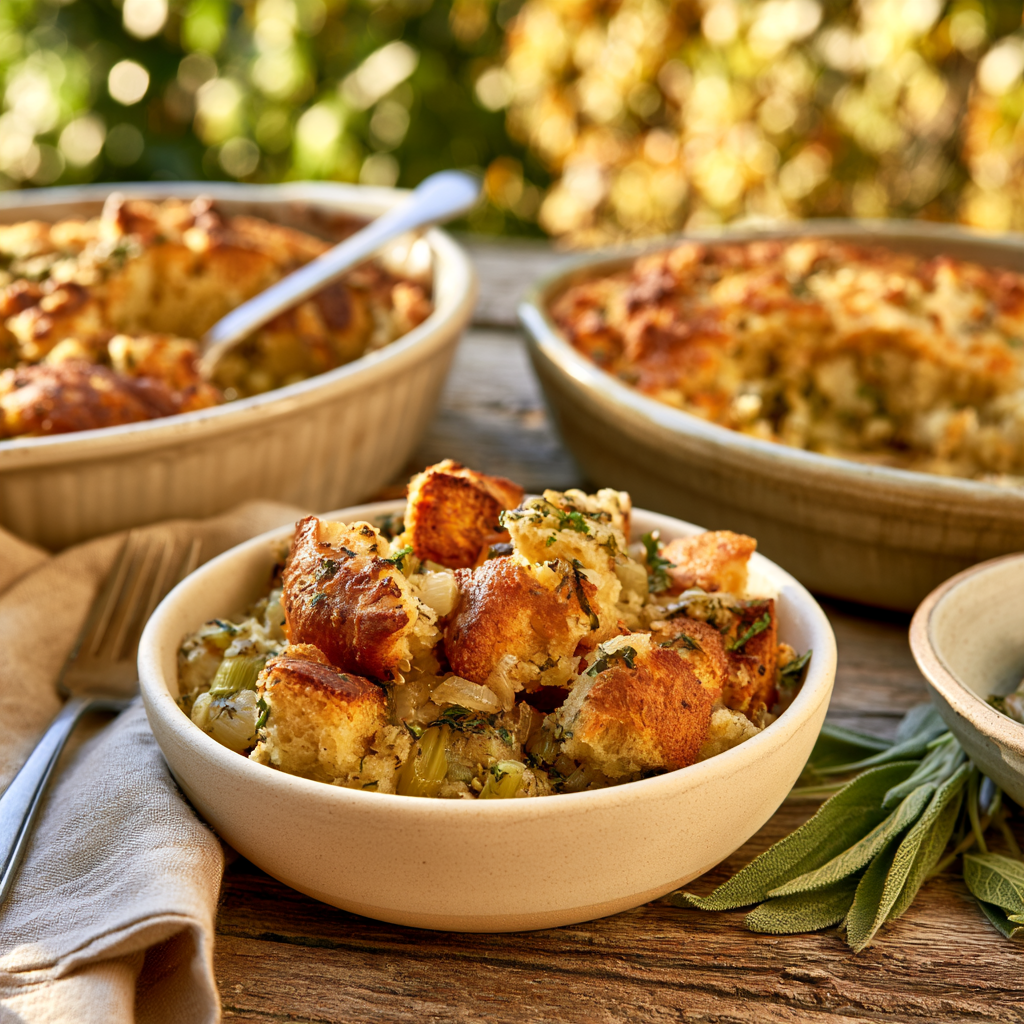
Why You Should Try This Turkey Stuffing Recipe: 12 Delicious Reasons to Make It for Thanksgiving and Beyond
There’s something truly special about a homemade Turkey Stuffing Recipe coming out of the oven, with its beautifully golden crust, buttery bread cubes, tender vegetables, and irresistible aroma of fresh herbs. The combination of savory turkey or chicken broth, gently sautéed onions, crisp celery, fragrant sage, and thyme creates one of the most comforting side dishes you can serve during Thanksgiving, Christmas, or a cozy family dinner.
While roasted turkey may be the centerpiece of a holiday meal, a delicious homemade stuffing often becomes the side dish everyone remembers. The secret lies in the perfect balance of textures: a soft, moist interior that absorbs all those wonderful buttery, herb-infused flavors, paired with lightly crispy edges that develop during baking. Every spoonful offers the familiar warmth of traditional American comfort food.
What makes this homemade Turkey Stuffing Recipe especially appealing is how easily you can customize it. You can prepare it with classic white bread, hearty sourdough, or a combination of different breads. You can adjust the herbs, add mushrooms or apples, prepare ingredients ahead of time, and bake it separately in a casserole dish for convenient serving.
Unlike packaged stuffing mixes, homemade turkey stuffing gives you control over the ingredients, texture, seasoning, and moisture. Whether you’re preparing your first Thanksgiving dinner or looking to improve a cherished family recipe, this dish offers an approachable way to create something delicious from everyday ingredients.
From its traditional flavor to its impressive versatility, here are 12 reasons why this easy Turkey Stuffing Recipe deserves a place on your holiday table.
1. It Delivers the Classic Flavors of Thanksgiving in Every Bite
One of the biggest reasons to try this Turkey Stuffing Recipe is its unmistakable holiday flavor.
Few combinations capture the essence of Thanksgiving quite like buttery bread, tender onions, celery, sage, thyme, and savory poultry broth.
Each ingredient plays a specific role in developing the finished dish.
Butter brings richness, onions contribute natural sweetness, and celery provides a gentle freshness that balances the heavier ingredients.
Sage introduces the familiar earthy aroma associated with traditional poultry dishes, while thyme adds subtle herbal notes.
The bread absorbs these flavors as the stuffing bakes, creating a wonderfully savory mixture that tastes comforting without requiring complicated seasoning blends.
What makes this combination particularly successful is its balance. No single ingredient needs to dominate. The bread, vegetables, herbs, and broth work together to produce a satisfying, well-rounded flavor.
For home cooks who enjoy traditional recipes, this is a wonderful way to bring familiar holiday aromas into the kitchen.
Why you’ll love it: Every serving captures the comforting taste of a traditional Thanksgiving meal, even when you’re preparing the stuffing for an ordinary Sunday dinner.
2. The Perfect Combination of Crispy Edges and a Moist, Tender Center
Texture is one of the most important reasons homemade turkey stuffing is so delicious.
A well-prepared stuffing should be moist enough to taste tender without becoming soggy or pasty.
The top should develop golden, lightly crisp bread edges, while the interior remains soft and full of savory flavor.
Achieving this balance begins with the bread.
Fresh bread contains considerable moisture and can become excessively soft when combined with broth. Dried bread cubes, on the other hand, absorb the added liquid more predictably and retain more of their structure.
The amount of broth also matters.
Too little broth can leave the stuffing unpleasantly dry, while too much may produce a dense, mushy texture.
The ideal mixture should feel evenly moistened, with no large pools of liquid collecting at the bottom of the bowl.
Baking in a casserole dish helps develop the contrast between a tender interior and crisp surface.
A covered baking period can help prevent excessive drying, while uncovering toward the end encourages the top to brown.
For a particularly beautiful finish, spread the stuffing in an even layer and avoid packing it down tightly.
Why you’ll love it: You get the best of both worlds—soft, flavorful stuffing underneath a beautifully browned top.
3. It’s Made With Simple, Affordable Ingredients
You don’t need expensive specialty ingredients to make a delicious Turkey Stuffing Recipe.
Most traditional versions rely on basic ingredients that are readily available in supermarkets or already stored in your kitchen.
| Ingredient | Why it’s important |
|---|---|
| Dried bread cubes | Form the foundation and absorb flavorful broth |
| Unsalted butter | Adds richness and helps soften the vegetables |
| Yellow onions | Provide sweetness and savory depth |
| Fresh celery | Adds aroma, texture, and balance |
| Turkey or chicken broth | Moistens the bread and enhances its flavor |
| Dried sage | Creates the signature traditional stuffing flavor |
| Thyme | Adds fragrant, earthy notes |
| Fresh parsley | Brings freshness and color |
| Salt and black pepper | Balance and enhance the seasonings |
| Eggs, if included | Help bind the stuffing and create a cohesive texture |
Another advantage is that stuffing can put bread that has become slightly stale to good use, provided it is still safe to eat and shows no signs of spoilage or mold.
Rather than purchasing expensive premade side dishes, you can prepare a generous casserole using familiar ingredients.
The exact cost depends on the bread, butter, herbs, and broth you select, but homemade stuffing offers flexibility for different budgets.
Why you’ll love it: A relatively short list of everyday ingredients produces a generous, comforting holiday side dish.
4. Homemade Stuffing Tastes Fresher and Lets You Control the Seasoning
Packaged stuffing mixes can be convenient, especially during busy holidays.
However, making turkey stuffing from scratch gives you more control over the final flavor.
Some packaged mixes contain substantial sodium or seasoning blends that may not match your personal preferences.
With homemade stuffing, you decide how much sage, thyme, parsley, salt, and black pepper to include.
You can also choose low-sodium poultry broth and unsalted butter to help control the amount of sodium in the recipe.
Freshly sautéed onions and celery add another layer of flavor that distinguishes homemade stuffing from a simple rehydrated bread mixture.
The difference becomes especially noticeable when the vegetables are cooked slowly enough to soften and develop their natural sweetness.
Homemade preparation also allows you to choose the size of the bread cubes, the amount of butter, and the texture of the finished casserole.
If you prefer a traditional stuffing with generous amounts of sage, you can adjust the seasoning accordingly.
If your family enjoys a milder version, you can use less sage and add more thyme or parsley.
Why you’ll love it: You can create a homemade flavor that matches your family’s preferences instead of relying on a fixed seasoning blend.
5. It’s Beginner-Friendly and Doesn’t Require Complicated Cooking Techniques
A traditional Turkey Stuffing Recipe may look impressive on a holiday table, but its preparation is surprisingly approachable.
You don’t need professional cooking equipment or advanced culinary experience.
The process mainly involves preparing the bread, chopping vegetables, sautéing aromatics, mixing the ingredients, and baking.
These are useful techniques that many home cooks already know.
The most important part is learning to recognize the correct moisture level before baking.
After adding the broth, the bread should feel damp and tender without disintegrating into a paste.
For beginners, adding the broth gradually is particularly helpful.
Start with part of the liquid, fold the mixture gently, and allow the bread a little time to absorb it before adding more.
You can always incorporate additional broth if the mixture is too dry, but removing excess liquid is much more difficult.
Another advantage is that the casserole can be assembled with a mixing bowl and spoon rather than a stand mixer or special appliance.
Why you’ll love it: Straightforward preparation makes this stuffing accessible even if you’re hosting Thanksgiving dinner for the first time.
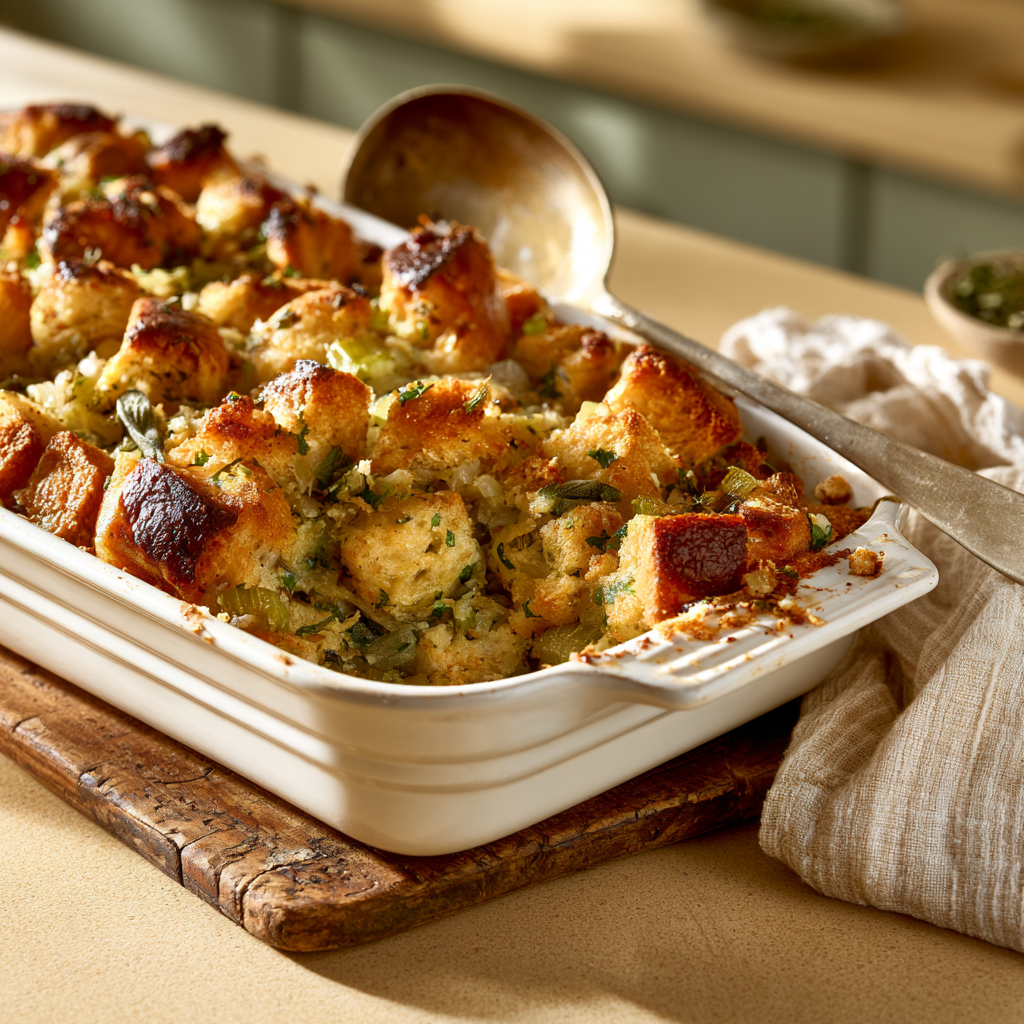
6. You Can Prepare Several Components Ahead of Time
Holiday cooking often involves preparing multiple dishes simultaneously.
A make-ahead-friendly Turkey Stuffing Recipe can help reduce some of that pressure.
Several components can be prepared in advance without compromising the final result.
For example, bread cubes can be dried ahead of time and stored in an airtight container once completely cooled.
Onions and celery can also be chopped in advance and refrigerated separately.
Fresh herbs can be washed, dried thoroughly, and prepared before cooking day.
You can even measure the dry seasonings ahead of time so everything is ready when you begin cooking.
Practical holiday preparation schedule
| 1–2 days ahead | Cube and dry bread; cool completely and store airtight. |
| The day before | Chop onions and celery; refrigerate. Measure herbs and seasonings. |
| Cooking day | Sauté vegetables, combine ingredients, add broth, and bake thoroughly. |
| Before serving | Check that the center reaches 165°F (74°C), then serve warm. |
For food safety, it’s best to keep the wet and dry stuffing components separate until you’re ready to cook. The USDA advises against refrigerating uncooked, fully mixed stuffing for later baking.
If you need to prepare the entire casserole in advance, bake it thoroughly first, refrigerate promptly, and reheat it to 165°F (74°C) before serving.
Why you’ll love it: Preparing the individual ingredients in advance makes the holiday cooking schedule much easier to manage.
7. It Pairs Beautifully With Roasted Turkey and Classic Holiday Side Dishes
One of the most convincing reasons to try homemade turkey stuffing is how beautifully it complements other savory dishes.
The bread absorbs rich flavors, while the herbs echo the seasonings often used on roasted poultry.
This makes stuffing a natural companion to roasted turkey.
A spoonful of warm gravy can also add extra richness and moisture, especially for people who prefer a softer texture.
But the pairing possibilities extend beyond turkey.
Turkey stuffing works wonderfully with mashed potatoes, roasted carrots, green beans, Brussels sprouts, and cranberry sauce.
The sweetness and acidity of cranberry sauce provide a particularly pleasant contrast to the savory stuffing.
For a generous holiday meal, you can also include homemade dinner rolls or biscuits.
Our 3 Ingredient Biscuit Recipe is an approachable option when you want fluffy, buttery bread alongside your favorite comfort-food dishes.
If you enjoy hearty, gravy-based meals beyond the holiday season, our Chicken Noodles Over Mashed Potatoes is another comforting dinner idea with savory flavors that suit colder evenings.
Why you’ll love it: Turkey stuffing works with an entire holiday menu rather than competing with the other dishes on the table.
8. You Can Customize It With Your Favorite Ingredients
Southern Cornbread Dressing: Replace some or all of the regular bread with dried cornbread. This creates a distinct cornmeal texture and a slightly sweeter, more rustic flavor.
Apple and Walnut Stuffing: Add diced firm apples and chopped toasted walnuts for a combination of savory herbs, gentle sweetness, and crunchy texture.
Mushroom and Herb Stuffing: Sauté mushrooms until their excess moisture evaporates, then combine them with sage, thyme, and the bread mixture for deeper savory flavor.
Cranberry and Herb Stuffing: Add a modest amount of dried cranberries to create little bursts of sweet-tart flavor that contrast with the buttery bread and poultry seasonings.
One of the greatest advantages of homemade turkey stuffing is that you can start with a classic recipe and adapt it to suit different occasions.
Other excellent additions include roasted garlic, sautéed leeks, chopped pecans, or finely diced carrots.
You can even experiment with different bread varieties.
Sourdough gives stuffing a slightly tangy character, while rustic country bread provides a hearty texture. White sandwich bread creates a softer, more traditional result.
When adding new ingredients, consider their moisture content.
Mushrooms should be sautéed before mixing, while fresh fruit may require slightly less broth.
Why you’ll love it: The traditional recipe is delicious on its own, but it also provides a flexible foundation for countless variations.
9. Baking Stuffing Separately Makes Serving Easier
Although traditional stuffing can be cooked inside poultry, baking it separately offers several practical advantages.
First, it allows you to control the cooking time without depending on the size or doneness of the turkey.
Second, a casserole dish provides more exposed surface area, which encourages the top to develop attractive golden edges.
Third, guests can easily serve themselves without waiting for stuffing to be removed from the turkey.
Most importantly, separate baking makes it easier to monitor the internal temperature of the stuffing.
The center should reach 165°F (74°C), whether the stuffing is cooked inside poultry or separately.
Baking independently also allows you to prepare a larger quantity for gatherings.
You can use a rectangular casserole dish for a generous batch or divide the stuffing between two smaller dishes if you need flexibility.
For people who love the crispy edges, shallower baking dishes can produce more browned surface area.
For those who prefer a softer, moister stuffing, a deeper dish and an appropriate covered baking period may be preferable.
Why you’ll love it: Separate baking simplifies serving, creates delicious crispy edges, and makes it easier to cook stuffing safely.
10. It’s a Wonderful Way to Use Day-Old Bread
Turkey stuffing is an excellent example of how simple ingredients can be transformed into a satisfying dish.
Bread that is slightly stale or has been intentionally dried works particularly well because it can absorb seasoned broth without immediately collapsing.
This makes stuffing a useful recipe when you have extra bread that is still safe to eat.
Different types of bread can be combined to create an interesting texture.
For example, leftover country bread and plain sandwich bread can work together, provided both are dried appropriately.
However, avoid using moldy or spoiled bread. Drying or baking does not make mold-contaminated bread safe.
The size of the bread cubes also influences texture.
Small cubes absorb moisture quickly and produce a more cohesive stuffing.
Larger cubes create a rustic dish with more distinct pieces of bread and potentially crispier edges.
For a traditional holiday casserole, cubes approximately ¾ to 1 inch across are a practical starting point.
Spread the pieces on a baking sheet and dry them gently in the oven, stirring occasionally, until they feel dry rather than toasted dark brown.
Why you’ll love it: Turkey stuffing turns ordinary bread into a flavorful, satisfying dish while helping you make good use of safe, leftover ingredients.
11. It’s Perfect for Thanksgiving, Christmas, and Cozy Family Dinners
Turkey stuffing is strongly associated with Thanksgiving, but there’s no reason to enjoy it only once a year.
Its savory, herb-filled flavor makes it an excellent side dish for Christmas meals, winter gatherings, and comforting weekend dinners.
You can serve it alongside roasted chicken, baked turkey breast, or other savory main dishes.
It also works well with vegetarian meals when prepared using vegetable broth and other suitable ingredients.
For smaller households, the recipe can be scaled down to fit a smaller baking dish.
For large family gatherings, you can prepare multiple casseroles to provide enough servings.
The combination of simple ingredients and familiar flavors makes stuffing particularly suitable for shared meals.
It also creates an inviting atmosphere while baking.
As the onions, celery, sage, and thyme warm in the oven, their aroma spreads throughout the kitchen.
That familiar smell is one reason stuffing feels so closely connected to family celebrations.
Why you’ll love it: A traditional Turkey Stuffing Recipe brings the comforting atmosphere of a holiday meal to almost any family gathering.
12. Leftover Turkey Stuffing Can Be Turned Into Delicious New Meals
Another practical reason to make turkey stuffing is its versatility after the main meal.
Properly stored leftovers can be used in several creative ways rather than serving exactly the same plate again.
For example, you can reheat stuffing in a baking dish with a small splash of broth to restore moisture.
You can also shape chilled stuffing into patties and heat them until thoroughly hot for a crisp exterior.
Leftover stuffing can become part of a turkey-and-vegetable casserole, provided all the ingredients have been stored safely.
For breakfast or brunch, thoroughly reheated stuffing can be served alongside cooked eggs.
If you have leftover roasted turkey, small portions can be combined with stuffing and vegetables for a quick comfort-food meal.
Whatever method you choose, refrigerate cooked stuffing within two hours and use refrigerated leftovers within three to four days.
Reheat leftovers to an internal temperature of 165°F (74°C).
For longer storage, freeze cooked stuffing in suitable airtight containers, then thaw safely before reheating.
Why you’ll love it: A generous batch of homemade stuffing can provide inspiration for several delicious meals after the holiday celebration.
What Makes This OoohDelish Turkey Stuffing Recipe Special?
| Feature | Why you’ll love it |
|---|---|
| Classic Thanksgiving flavor | Buttery bread, onions, celery, sage, and thyme |
| Moist, tender interior | Dried bread absorbs savory broth without becoming overly soft |
| Golden, crispy edges | Separate baking creates a beautifully browned surface |
| Simple ingredients | Uses everyday bread, vegetables, broth, and herbs |
| Beginner-friendly preparation | Requires straightforward chopping, sautéing, mixing, and baking |
| Customizable texture | Adjust bread type, broth, and casserole depth |
| Flexible seasoning | Control the amount of sage, thyme, parsley, and salt |
| Make-ahead convenience | Prepare bread, vegetables, and seasonings in advance |
| Excellent for gatherings | Easy to prepare in generous batches |
| No pork ingredients needed | Delicious savory flavor from herbs, butter, and poultry broth |
| Versatile serving options | Pairs with turkey, chicken, vegetables, and gravy |
| Useful leftovers | Reheat or incorporate safely stored stuffing into other dishes |
Expert Tips for Making the Best Turkey Stuffing Recipe
Even though homemade turkey stuffing is straightforward, understanding a few important techniques can make a remarkable difference in the finished result.
Choose Bread That Holds Its Shape
The best stuffing bread should absorb liquid without immediately turning into a paste.
White country bread, sourdough, and sturdy sandwich bread are all useful options.
Avoid very soft, fresh bread unless you dry it thoroughly first.
Dry the Bread Before Mixing
Spread bread cubes in a single layer on a baking sheet and dry them in a low oven, turning occasionally.
The goal is to remove excess moisture rather than toast the bread until dark.
Properly dried cubes absorb broth more evenly and help create a tender but structured stuffing.
Sauté the Vegetables Until Tender
Don’t add large quantities of raw onion and celery directly to the bread.
Cooking them gently in butter or olive oil softens their texture and develops their flavor.
The onions should become translucent and lightly sweet, while the celery should lose most of its raw crunch.
Add the Broth Gradually
One of the most common mistakes in turkey stuffing is adding too much broth at once.
Begin with part of the recommended amount, fold gently, and allow the bread to absorb the liquid.
Continue adding broth until the mixture is evenly moist without collecting liquid at the bottom.
Balance Sage With Other Herbs
Sage gives traditional turkey stuffing its distinctive flavor, but too much can become overpowering.
Pair it with thyme, parsley, and black pepper to create a more balanced seasoning profile.
Taste the sautéed vegetables and broth before combining them with the bread, adjusting the seasoning where necessary.
Avoid Packing the Mixture Too Tightly
Transfer the stuffing into a lightly greased casserole dish and spread it evenly.
Avoid pressing the mixture down firmly, as this can produce a dense texture.
A loosely arranged mixture provides more opportunities for the exposed edges to become lightly crisp during baking.
Cover, Then Uncover for Golden Edges
For recipes that benefit from covered baking, use foil during the initial stage to limit moisture loss.
Remove the foil toward the end so the top can turn golden and develop slightly crunchy edges.
The exact baking time depends on the dish’s depth, ingredients, and oven temperature.
Always check doneness using a food thermometer.
Let the Stuffing Rest Before Serving
Once the stuffing reaches 165°F (74°C), remove it from the oven and allow it to rest briefly.
A short rest helps the moisture settle throughout the casserole and makes serving easier.
The dish should remain warm and fragrant, with a lightly crisp top and a moist, tender interior.
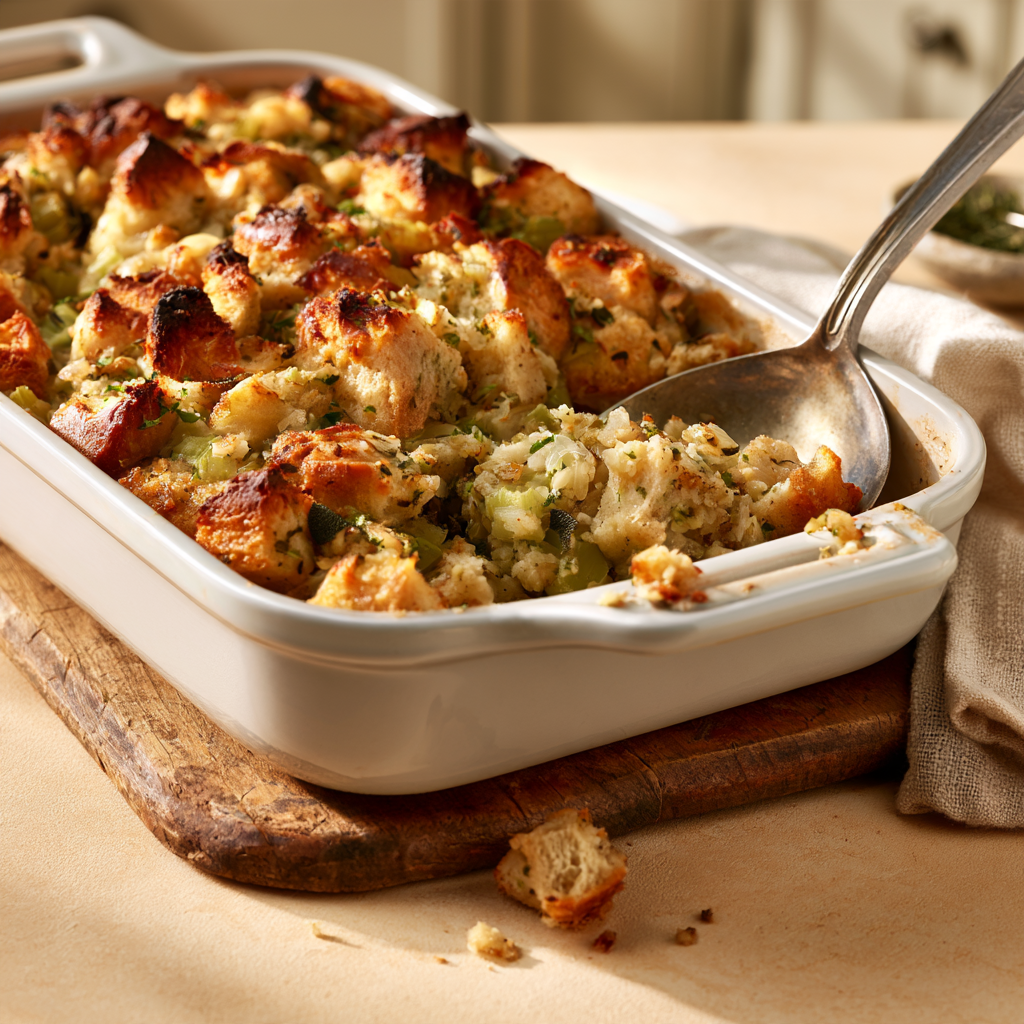
Final Thoughts: Why This Turkey Stuffing Recipe Is Worth Making
If you’re looking for a traditional holiday side dish that combines comforting flavors, simple ingredients, and an irresistible homemade aroma, this Turkey Stuffing Recipe is absolutely worth trying.
The combination of buttery bread cubes, tender onions, celery, savory broth, sage, and thyme creates a delicious classic that complements roasted turkey and countless other dishes.
What makes it especially appealing is its versatility. You can keep the recipe traditional, experiment with different breads, add vegetables, or customize the seasonings to create your own family favorite.
Preparing stuffing in a separate casserole dish also offers practical advantages, including easier serving, control over moisture, and beautifully golden edges.
Whether you’re hosting Thanksgiving, preparing Christmas dinner, or making a cozy weekend meal, this recipe brings familiar American comfort-food flavors to the table without requiring complicated techniques.
OoohDelish Cooking Secret: For the best homemade Turkey Stuffing Recipe, start with thoroughly dried bread cubes, slowly sauté onions and celery until tender, and add warm turkey or chicken broth gradually. The mixture should be evenly moist but never swimming in liquid. Bake separately until the center reaches 165°F (74°C), uncover toward the end for golden edges, and allow the stuffing to rest briefly before serving.
The result is everything a great homemade turkey stuffing should be: buttery, aromatic, perfectly seasoned, moist in the center, and deliciously crisp around the edges.
Frequently Asked Questions About Turkey Stuffing Recipe
Preparing homemade turkey stuffing for Thanksgiving or Christmas dinner? Whether you’re wondering which bread to use, how much broth to add, or how to get a perfectly moist center and golden, crispy top, these answers will help you prepare flavorful homemade stuffing with confidence. You’ll also find important food-safety tips for cooking stuffing inside or outside the turkey.
1. What is traditional Turkey Stuffing?
Traditional Turkey Stuffing is a savory American holiday side dish typically made with dried bread cubes, butter, onions, celery, broth, and aromatic herbs such as sage, thyme, and parsley. The ingredients are combined to create a moist mixture that can be baked in a casserole dish or cooked inside a turkey. A well-prepared stuffing has a tender, flavorful center and, when baked uncovered, a lightly golden, crispy surface. It is especially popular for Thanksgiving and Christmas dinners.
2. What is the difference between stuffing and dressing?
Stuffing and dressing are closely related dishes made with bread, vegetables, seasonings, and broth. Traditionally, stuffing refers to a mixture cooked inside poultry, while dressing is prepared separately in a baking dish. However, the names are often used interchangeably, and regional preferences vary across the United States. Both methods can produce delicious results, although baking separately offers more control over texture and even cooking.
3. What is the best bread for homemade Turkey Stuffing?
The best bread is one that absorbs broth without immediately collapsing. Day-old French bread, sourdough, Italian bread, and sturdy white sandwich bread are all popular choices. French bread creates a traditional texture, sourdough adds gentle tanginess, and white bread produces a softer, more classic stuffing. Avoid extremely delicate breads that become mushy when moistened. For a slightly richer variation, you can experiment with brioche or challah, adjusting the broth as needed.
4. Should you use fresh, stale, or toasted bread for stuffing?
Dried or lightly toasted bread generally works best because it absorbs broth while maintaining some structure. Fresh bread can become overly soft and produce dense stuffing. To prepare the bread, cut it into even cubes and spread them on a baking sheet. Dry them in a low oven, turning occasionally, until the surfaces feel dry without becoming deeply browned. Let the cubes cool before mixing. Day-old bread can also work, provided it is dry enough and shows no signs of spoilage.
5. How do you keep Turkey Stuffing moist but not soggy?
The secret is adding broth gradually instead of pouring in too much at once. Begin with dried bread cubes, sautéed vegetables, melted butter, and seasonings. Add warm broth in small amounts while gently tossing the mixture. The bread should feel evenly moistened without sitting in a pool of liquid. Different breads absorb moisture differently, so the exact amount varies. For a soft interior and crisp top, bake in a casserole dish, covering initially and uncovering toward the end. Always cook the center to 165°F (74°C).
6. What herbs and seasonings are best for Turkey Stuffing?
Sage, thyme, parsley, and black pepper are among the most recognizable seasonings in traditional turkey stuffing. Sage provides the familiar Thanksgiving aroma, while thyme adds a slightly earthy, savory flavor. Rosemary can be used sparingly because its flavor is more intense. Onion and celery are also important for building a classic savory base. For the best results, sauté the vegetables in butter before combining them with the bread. Taste and adjust salt carefully, especially when using salted broth.
7. Is it better to cook stuffing inside the turkey or separately?
Cooking stuffing separately is generally the safer and more reliable method. It allows the stuffing to cook more evenly and makes it easier to achieve a golden surface without overcooking the turkey. Stuffing cooked inside poultry can absorb flavorful juices, but its center may heat more slowly than the meat. If you choose to stuff the turkey, fill the cavity loosely immediately before roasting, cook without delay, and verify that both the turkey and the center of the stuffing reach 165°F (74°C).
8. What temperature should Turkey Stuffing reach to be safe?
According to USDA food-safety guidance, the center of turkey stuffing must reach at least 165°F (74°C). This applies whether the stuffing is baked in a casserole dish or cooked inside a whole turkey. Always use a food thermometer inserted into the center rather than relying only on the surface color or estimated baking time. If stuffing is cooked inside a turkey, check the temperature of the turkey separately in its recommended locations as well.
9. How long should you bake Turkey Stuffing in the oven?
Baking time depends on the recipe, amount of stuffing, and depth of the casserole dish. Many classic bread stuffing recipes are baked at 350°F (175°C) for approximately 30–45 minutes, although a larger or deeper casserole may require longer. Covering the dish initially helps retain moisture, while uncovering it near the end encourages a golden, crisp top. Baking time is only a guide: use a food thermometer to confirm the center reaches 165°F (74°C).
10. Can you make Turkey Stuffing ahead of time?
Yes, but make-ahead preparation requires proper food handling. You can cube and dry the bread in advance, chop the vegetables, and prepare individual ingredients separately. If stuffing will be cooked inside a turkey, keep the wet and dry components separate until immediately before filling and roasting the bird. Do not refrigerate fully assembled, uncooked stuffing to cook later. A convenient alternative is to bake the stuffing completely ahead of time, refrigerate it promptly in shallow containers, and reheat thoroughly to 165°F (74°C) before serving.
11. Do you need eggs in Turkey Stuffing?
Eggs are optional in many homemade turkey stuffing recipes. Some cooks add beaten eggs to help bind the bread mixture and create a slightly firmer, more cohesive texture. Other recipes rely entirely on broth, butter, and the starch in the bread cubes. For a looser, rustic stuffing, eggs may not be necessary. For a sliceable casserole-style stuffing, an egg binder can be useful. Whichever approach you choose, cook the completed dish until its center reaches 165°F (74°C).
12. Can I add sausage, apples, or mushrooms to Turkey Stuffing?
Absolutely! Turkey stuffing is easy to customize with savory or slightly sweet additions. Cooked sausage, sautéed mushrooms, diced apples, and dried cranberries are popular variations. Sausage adds richness, mushrooms contribute savory depth, and apples provide a pleasant contrast to the herbs. Fully cook raw sausage or other raw meat before incorporating it. Mushrooms should be sautéed to remove excess moisture. Add new ingredients moderately so they don’t overwhelm the bread mixture or change its moisture balance.
13. Why is my homemade Turkey Stuffing mushy or gummy?
Mushy stuffing usually results from excessive broth, very soft bread, or overcrowding the baking dish. Fresh bread can collapse when it absorbs too much liquid, while vigorous stirring can break the cubes into a paste. To improve texture, begin with dried bread cubes, add broth gradually, and toss gently. Use a sufficiently large casserole dish so moisture can distribute evenly. For a crispier surface, uncover the dish near the end of baking once the stuffing is cooking through.
14. How do you fix stuffing that is too dry?
If the stuffing mixture looks dry before baking, drizzle a small amount of warm chicken or vegetable broth over the bread and gently toss until evenly moistened. If already baked, add a little warm broth, cover the casserole dish with foil, and reheat thoroughly until the center reaches 165°F (74°C). Avoid adding excessive liquid at once, as it can turn a dry stuffing into a soggy one. A small amount of melted butter may also enhance richness and flavor.
15. How long does leftover Turkey Stuffing last, and can you freeze it?
Cooked Turkey Stuffing should be refrigerated within two hours of cooking, or within one hour when temperatures are above 90°F (32°C). Store it in shallow, airtight containers at 40°F (4°C) or below and consume within 3–4 days. For longer storage, freeze cooked stuffing in suitable freezer-safe containers. It generally maintains good quality for approximately 2–3 months, although properly frozen stuffing may remain acceptable longer. Reheat leftovers until the center reaches 165°F (74°C). Add a little broth if the stuffing seems dry.
16. What should you serve with Turkey Stuffing for Thanksgiving?
Turkey Stuffing pairs beautifully with roast turkey, homemade gravy, mashed potatoes, cranberry sauce, and roasted vegetables. For a flavorful vegetable side, try our Parmesan Roasted Broccoli Recipe , made with garlic, olive oil, and Parmesan. If you enjoy cornbread-inspired sides or want ideas for a flavorful cornbread stuffing variation, explore our Jiffy Mexican Cornbread Recipe . For a festive dessert, our Pumpkin Bread with Brownie Chunks makes a delicious sweet finish to your holiday meal.