


There’s something incredibly satisfying about waking up to the smell of freshly toasted English muffins, especially when they’re homemade with the wonderful tang of sourdough! Imagine slicing into a warm, golden muffin, revealing a soft, airy center filled with those irresistible little nooks and crannies just waiting to catch melted butter, homemade jam, or a drizzle of honey. That’s exactly what makes this Sourdough English Muffins Recipe so special. With their lightly crisp, golden-brown exterior, tender and chewy interior, and delicate sourdough flavor, these homemade English muffins bring a comforting, bakery-style breakfast right into your kitchen. Whether you’re enjoying a quiet morning with a cup of coffee or preparing a delicious weekend brunch for the whole family, these muffins make even the simplest breakfast feel like something worth celebrating.
What makes this homemade Sourdough English Muffins Recipe different from ordinary store-bought muffins is the slow fermentation process that develops their distinctive flavor and texture. Instead of relying on commercial yeast alone, these muffins use an active sourdough starter to naturally ferment the dough, creating a pleasant tanginess and a beautifully tender crumb. The dough is prepared with simple pantry ingredients, given time to rise, then gently shaped into rounds and cooked on a skillet or griddle rather than baked in a traditional oven. As the muffins cook, their surfaces develop a lovely golden crust while the centers remain soft and fluffy. And the best part? When you split them open with a fork instead of slicing them with a knife, you reveal those signature uneven pockets that make English muffins perfect for holding all your favorite toppings. A quick toast turns them wonderfully crisp around the edges while keeping the middle soft and delicious.


Sourdough English Muffins Recipe
Equipment
- Large mixing bowl
- Digital kitchen scale
- Measuring cups and spoons
- Wooden spoon or dough whisk
- Stand mixer with dough hook (optional)
- Dough scraper
- Baking Tray
- Clean kitchen towel
- Cast-iron skillet or electric griddle
- Wide spatula
- Instant-read food thermometer (recommended)
- Wire cooling rack
- Fork for splitting
Ingredients
- FOR THE SOURDOUGH ENGLISH MUFFIN DOUGH
- 120 g about 1/2 cup active sourdough starter, preferably 100% hydration and at peak activity
- 375 g 3 cups all-purpose flour
- 180 ml 3/4 cup whole milk, lukewarm
- 15 g about 2 teaspoons honey, or 15 g granulated sugar
- 28 g 2 tablespoons unsalted butter, melted and cooled slightly
- 6 g about 1 teaspoon fine salt
- FOR SHAPING AND COOKING
- A little additional flour only if needed for shaping
Instructions
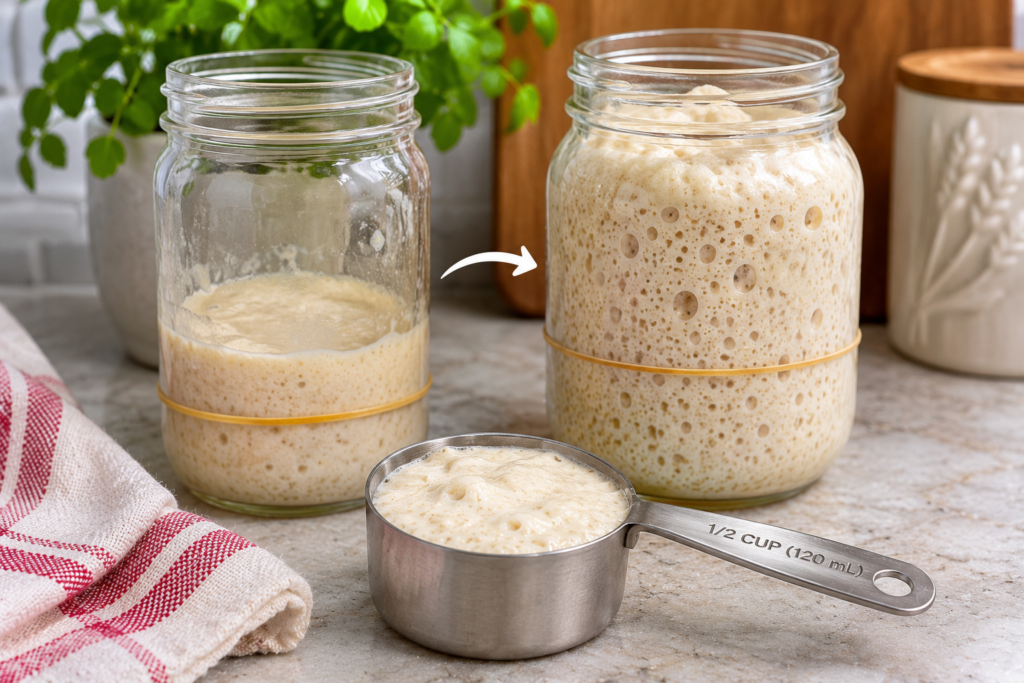
- Step 1: Activate Your Sourdough Starter – Feed your sourdough starter several hours before making the dough and allow it to become bubbly, visibly expanded, and near peak activity. Measure 120 g (about 1/2 cup) of active sourdough starter. A strong starter is essential because this recipe does not use commercial yeast.

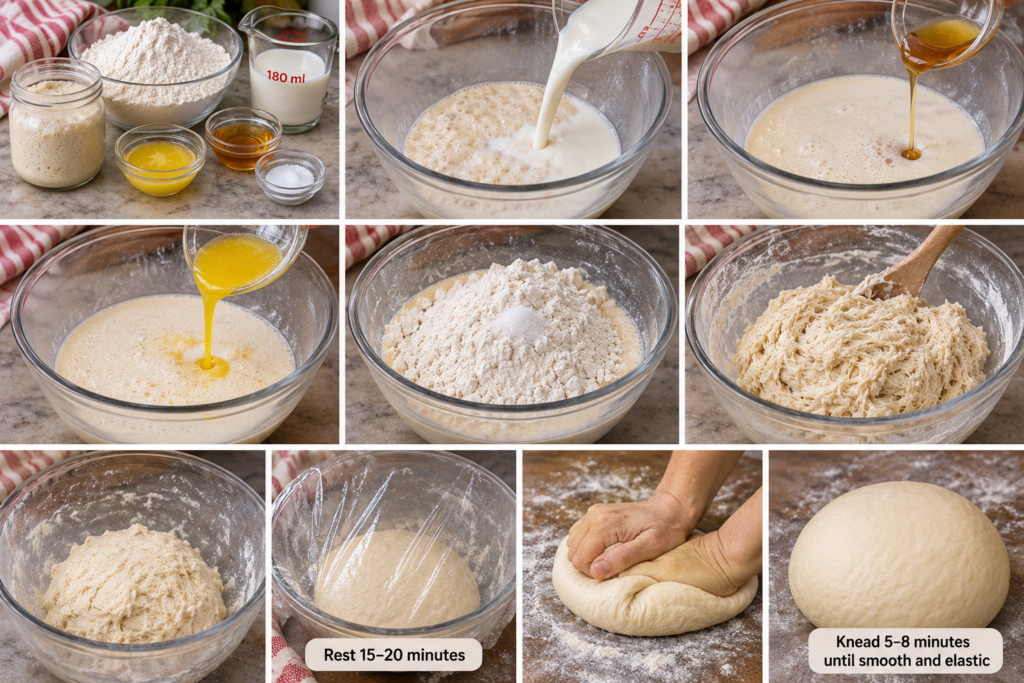
- Step 2: Mix the Sourdough English Muffin Dough – In a large bowl, combine 120 g active sourdough starter, 180 ml (3/4 cup) lukewarm whole milk, and 15 g honey or sugar. Stir in 28 g melted and slightly cooled unsalted butter, then add 375 g all-purpose flour and 6 g fine salt. Mix until a soft, slightly tacky dough forms. Rest for 15–20 minutes, then knead by hand for 5–8 minutes or with a stand mixer for 4–6 minutes until smooth and elastic.
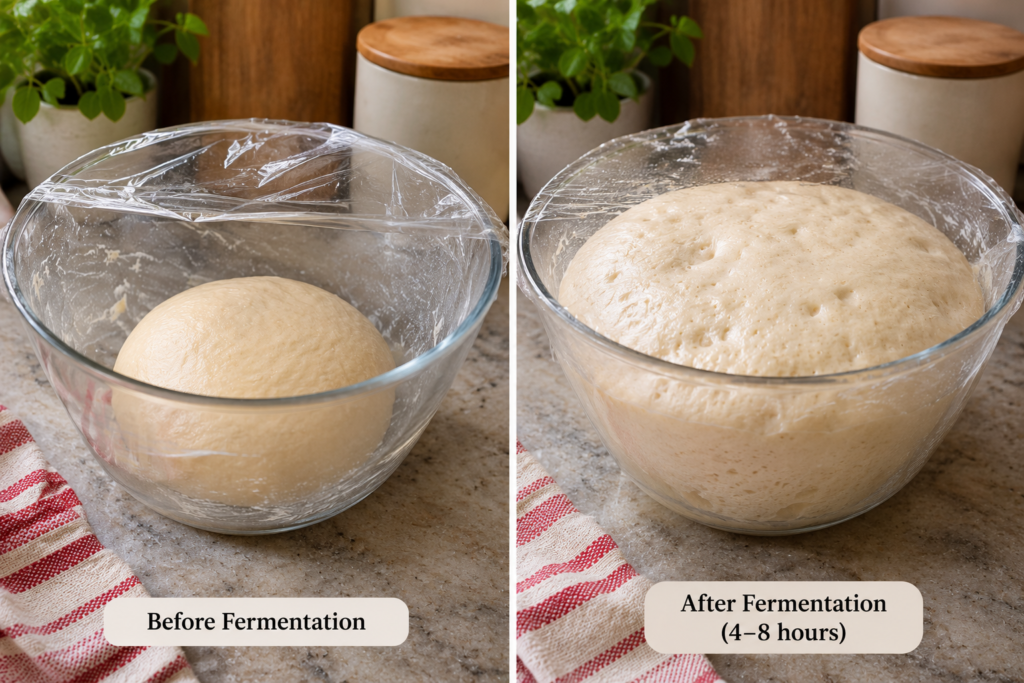
- Step 3: Allow the Dough to Ferment – Transfer the dough to a lightly greased bowl, cover, and leave at room temperature for approximately 4–8 hours until visibly puffy, airy, and noticeably expanded. Fermentation time varies depending on starter strength and room temperature. Avoid overfermenting until the dough collapses or becomes excessively sticky.
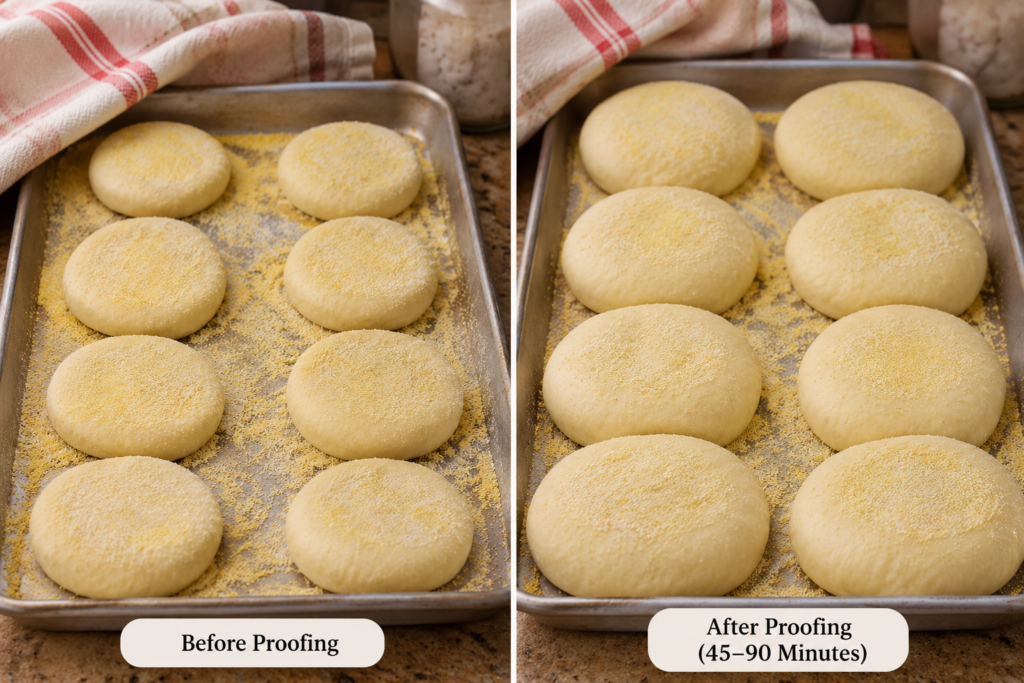
- Step 4: Shape the English Muffins – Transfer the fermented dough to a lightly floured surface and divide into 8 equal portions of approximately 90 g each. Shape each portion into a smooth ball and gently flatten into a disk about 3/4 inch (19 mm) thick. Arrange on a tray dusted with some of the 35–40 g cornmeal or fine semolina, leaving space between the muffins, and lightly dust their tops.
- Step 5: Proof the Shaped Muffins – Cover the shaped muffins loosely with a clean towel or lightly greased wrap and allow them to rise at room temperature for approximately 45–90 minutes until visibly puffy and slightly lighter. Handle gently to preserve the air bubbles and avoid overproofing, which may cause the muffins to flatten during cooking.
- Step 6: Cook the English Muffins on a Griddle – Preheat a cast-iron skillet or electric griddle to approximately 300–325°F (149–163°C), or use medium-low stovetop heat. Carefully place the muffins on the cooking surface and cook for approximately 6–10 minutes per side until golden brown and fully cooked. Work in batches if necessary. The centers should be cooked through, with an internal temperature around 190–200°F (88–93°C) as a useful doneness reference. Reduce the heat or finish briefly in a moderate oven if the outsides brown before the centers cook.
- Step 7: Cool and Split for Classic Nooks and Crannies – Transfer the cooked English muffins to a wire rack and cool for at least 15–20 minutes to allow the crumb to set. Insert the tines of a fork around the circumference of each muffin, then gently pull the halves apart to preserve the classic nooks and crannies. Avoid cutting completely through with a knife.
- Step 8: Toast, Serve, and Store – Toast the split English muffins until lightly golden and crisp, then serve with butter, honey, jam, cream cheese, avocado, eggs, or breakfast sandwich fillings. Store completely cooled muffins in an airtight container at room temperature for approximately 2–3 days, or freeze in freezer-safe packaging for 2–3 months for best quality. Toast directly from frozen or thaw before reheating.




Notes

- Origins of the Sourdough English Muffins
- Health Benefits of the Sourdough English Muffins
- Nutritional Benefits of Sourdough English Muffin Ingredients
- 1. Sourdough Fermentation May Improve Mineral Availability
- 2. May Support Easier Digestion for Some People
- 3. Provides Carbohydrates for Daily Energy
- 4. Whole-Grain Variations Can Increase Fiber Intake
- 5. Sourdough Fermentation May Affect Blood Sugar Response
- 6. Homemade Muffins Allow More Control Over Ingredients
- 7. Can Be Part of a Protein-Rich Breakfast
- Are Sourdough English Muffins Healthier Than Regular English Muffins?
- How to Make Sourdough English Muffins a Little Healthier
Origins of the Sourdough English Muffins
The history of the Sourdough English Muffins Recipe brings together two fascinating baking traditions: the centuries-old practice of sourdough fermentation and the development of English muffins as a beloved breakfast bread. Long before commercial yeast became widely available, bakers relied on naturally occurring wild yeasts and lactic acid bacteria to ferment their dough. Sourdough breadmaking dates back thousands of years, with early forms of fermented bread appearing in ancient civilizations, including Egypt. This traditional fermentation process gradually spread across different regions, shaping countless styles of bread. Meanwhile, Britain developed its own tradition of griddle-cooked breads, crumpets, and muffins, which were enjoyed as affordable, freshly prepared foods long before modern breakfast sandwiches became popular.
The modern English muffin has particularly strong connections to nineteenth-century Britain and the United States. English baker Samuel Bath Thomas, who emigrated to New York in the nineteenth century, is widely credited with popularizing a distinctive version of the English muffin in America during the 1880s. His griddle-cooked muffins became known for their lightly crisp exteriors and soft interiors, eventually gaining popularity as a convenient breakfast bread. Unlike sweet American-style muffins baked in paper liners, traditional English muffins are small, round yeast breads cooked on a hot griddle or skillet. Their signature texture, especially the irregular interior pockets commonly called nooks and crannies, makes them ideal for toasting and spreading with butter, jam, or other delicious toppings.
Health Benefits of the Sourdough English Muffins
here’s more to this Sourdough English Muffins Recipe than its golden, lightly crisp exterior and wonderfully soft, chewy center! Thanks to the natural fermentation process, homemade sourdough English muffins offer an interesting alternative to conventional breakfast breads. Made with a living sourdough starter, flour, and simple ingredients, these delicious muffins develop their distinctive flavor through the activity of wild yeasts and lactic acid bacteria. Beyond creating that signature tangy taste, fermentation can also influence how certain components of flour are broken down and how nutrients become available during digestion.
While sourdough English muffins aren’t automatically healthier than regular English muffins, their nutritional value can be improved through thoughtful ingredient choices, appropriate fermentation, and balanced toppings. Using whole-grain flour, controlling added sugar, and serving them with protein-rich foods can turn these homemade muffins into part of a satisfying breakfast.
Nutritional Benefits of Sourdough English Muffin Ingredients
| Ingredient or Component | Nutritional Benefits |
|---|---|
| Active Sourdough Starter | Contains wild yeasts and lactic acid bacteria that ferment the dough and produce organic acids. |
| Whole-Wheat Flour (Optional) | Provides dietary fiber, B vitamins, and minerals such as magnesium and phosphorus. |
| All-Purpose Flour | Supplies carbohydrates for energy and may provide iron and B vitamins when enriched. |
| Sourdough Fermentation | Can reduce some phytates in flour, potentially improving the availability of certain minerals. |
| Milk (If Used) | Contributes protein, calcium, and other nutrients depending on the type selected. |
| Olive Oil or Butter (If Used) | Adds fat and contributes to texture; olive oil provides more unsaturated fat than butter. |
| Natural Fermentation Acids | Help develop the characteristic sourdough flavor and may influence starch digestion. |
| Eggs and Other Protein-Rich Toppings | Add protein and nutrients that can help make breakfast more satisfying. |

1. Sourdough Fermentation May Improve Mineral Availability
One of the most interesting potential benefits of a Sourdough English Muffins Recipe comes from the fermentation process. Flour naturally contains phytic acid, also known as phytate, which can bind certain minerals, including iron, zinc, and calcium, and reduce their absorption.
During sourdough fermentation, acidic conditions and enzymatic activity can help break down some of these phytates. This may increase the availability of certain minerals, particularly in recipes that incorporate whole-grain flour.
However, the extent of phytate reduction depends on the flour, sourdough culture, fermentation temperature, and duration. Improved mineral availability in laboratory measurements does not necessarily mean every sourdough muffin provides a clinically meaningful nutritional advantage.
2. May Support Easier Digestion for Some People
The slow fermentation process used in homemade sourdough English muffins can change certain carbohydrates and proteins in the dough. Lactic acid bacteria and naturally occurring enzymes may break down some fermentable carbohydrates, depending on the specific sourdough process.
For some individuals, sufficiently fermented sourdough bread may be easier to tolerate than certain conventional breads. However, this effect isn’t guaranteed, and short fermentation times may not produce meaningful reductions in these compounds.
It’s especially important to understand that sourdough made from wheat flour still contains gluten. Traditional sourdough English muffins are not safe for people with celiac disease, unless specifically prepared using suitable gluten-free ingredients and procedures.
3. Provides Carbohydrates for Daily Energy
English muffins are a source of carbohydrates, which the body uses as an important energy source. Whether you’re heading to work, preparing for a busy day, or enjoying a leisurely weekend breakfast, a homemade sourdough English muffin can provide a convenient base for a balanced meal.
The amount of energy, fiber, and other nutrients depends on the flour and additional ingredients used. White-flour English muffins generally provide less fiber than versions containing substantial amounts of whole-grain flour.
For a more satisfying breakfast, serve a toasted muffin with scrambled eggs, cottage cheese, peanut butter, or another protein-rich topping rather than relying on the bread alone.
4. Whole-Grain Variations Can Increase Fiber Intake
Although classic sourdough English muffins are often made with white flour, you can experiment with replacing a portion of the flour with whole-wheat flour to increase the fiber content.
Dietary fiber supports normal bowel function and can contribute to feelings of fullness. Whole grains also provide nutrients such as magnesium, phosphorus, and certain B vitamins.
For a practical starting variation, try replacing approximately 25% of the white flour with whole-wheat flour. Keep in mind that whole-wheat flour absorbs more water and may produce a denser muffin, so the hydration and fermentation time may require adjustments.
This substitution is a suggested variation rather than a kitchen-tested modification to the current recipe.
5. Sourdough Fermentation May Affect Blood Sugar Response
Sourdough fermentation produces organic acids, including lactic and acetic acids, that can influence the characteristics of the finished bread. Some research suggests that certain sourdough breads may produce a different post-meal blood glucose response compared with conventional breads.
However, findings vary considerably between studies and bread formulations. Flour type, fiber content, portion size, fermentation conditions, and the foods eaten alongside the bread all influence blood sugar responses.
Therefore, it’s important not to assume that sourdough English muffins have a low glycemic index or are automatically suitable for blood sugar management. They still contain carbohydrates, and their effect on blood glucose depends on the complete meal and individual circumstances.

6. Homemade Muffins Allow More Control Over Ingredients
Preparing your own Sourdough English Muffins Recipe gives you the opportunity to choose what goes into each batch. You can select the flour, measure the salt, decide whether to add sugar, and choose the fat used in the dough.
For example, a recipe made with a modest amount of olive oil may provide a different fat profile from one made with butter. You can also prepare the muffins without unnecessary sweeteners if the dough formulation supports that change.
Homemade doesn’t automatically mean healthier, but it does provide flexibility to create a recipe that fits your taste and nutritional preferences.
7. Can Be Part of a Protein-Rich Breakfast
A plain sourdough English muffin contains some protein from flour, but it generally isn’t considered a high-protein food on its own. Its nutritional value as a breakfast can be improved by pairing it with foods that provide additional protein.
Try topping a toasted muffin with eggs, plain Greek yogurt-based spreads, cottage cheese, or nut butter. These additions contribute protein and other nutrients while complementing the muffin’s mildly tangy flavor.
For a savory option, combine a toasted sourdough English muffin with scrambled eggs, fresh spinach, and sliced tomatoes. This creates a more varied breakfast with carbohydrates, protein, and vegetables.
Are Sourdough English Muffins Healthier Than Regular English Muffins?
Sourdough English muffins can offer some nutritional advantages, but they aren’t necessarily healthier in every situation. Natural fermentation may reduce some phytates and alter certain fermentable carbohydrates, while whole-grain flour can increase dietary fiber and micronutrient content.
However, the final nutritional value depends on the exact recipe. A white-flour sourdough English muffin may contain similar calories, carbohydrates, and fiber to a conventional white-flour English muffin.
The most meaningful improvements often come from choosing whole-grain ingredients, managing portion sizes, limiting excessive added sugar, and combining the muffins with nutritious toppings.
How to Make Sourdough English Muffins a Little Healthier
If you’d like to make your homemade sourdough English muffins a more nutritious part of your breakfast routine, consider these practical adjustments:
- Incorporate Whole-Wheat Flour: Experiment with replacing approximately 25% of the all-purpose flour with whole-wheat flour to increase fiber content, adjusting hydration as needed.
- Use an Active Sourdough Starter: A healthy, active starter supports consistent fermentation and helps develop the muffins’ characteristic flavor and texture.
- Allow Adequate Fermentation: Follow the recipe’s recommended fermentation schedule rather than rushing the process. Fermentation time affects flavor, dough structure, and certain flour components.
- Limit Added Sugar: If your recipe includes sugar or honey, consider whether the full quantity is necessary. Adjustments may affect browning and fermentation.
- Choose Balanced Toppings: Pair toasted muffins with eggs, avocado, cottage cheese, nut butter, or fresh vegetables.
- Watch Portion Sizes: One English muffin, typically split into two halves, can form the base of a satisfying breakfast when combined with other nutritious foods.
- Use Moderate Amounts of Butter: Spread butter lightly, or experiment with mashed avocado or nut butter when you want a different nutritional profile.
- Avoid Overloading with Sweet Toppings: Jam, honey, and sweetened spreads can be delicious, but generous portions may significantly increase the meal’s added sugar content.
Oooh Delish! Kitchen Tip
The secret to enjoying these sourdough English muffins is appreciating what makes homemade sourdough special: simple ingredients, patient fermentation, and a wonderfully satisfying texture. For a balanced breakfast, toast your muffin until the edges become lightly crisp, then top it with something nutritious and delicious, such as scrambled eggs, fresh avocado, or a spoonful of nut butter.
Whether you prefer your English muffins savory or sweet, this Sourdough English Muffins Recipe offers a versatile homemade breakfast bread that can fit into a varied, balanced diet. Enjoy the comforting flavor of sourdough, experiment with whole-grain variations, and make every breakfast a little more delicious!

Frequently Asked Questions About Sourdough English Muffins Recipe
Want to make delicious homemade Sourdough English Muffins with golden, lightly crisp exteriors and soft interiors filled with those irresistible nooks and crannies? These naturally leavened breakfast breads develop their distinctive flavor through an active sourdough starter rather than commercial yeast. These practical answers explain how to prepare your starter, ferment the dough, shape uniform muffins, cook them evenly on a griddle, and avoid dense or doughy centers. Whether you’re preparing breakfast sandwiches, toasted muffins with butter and jam, or homemade bread for the week, this guide will help you achieve better results.
1. What are Sourdough English Muffins, and how are they different from regular English muffins?
Sourdough English Muffins are small, round breakfast breads naturally leavened with a sourdough starter. Unlike many traditional English muffin recipes that rely on commercial yeast, this OoohDelish version uses an active sourdough culture for fermentation. The result is a pleasantly tangy flavor, soft interior, and golden crust developed during griddle cooking. English muffins are usually split horizontally and toasted rather than eaten like sweet bakery muffins. For another naturally fermented bread, explore our Same Day Sourdough Bread Recipe , which uses a similar sourdough leavening principle in loaf form.
2. What ingredients do you need for this homemade Sourdough English Muffins Recipe?
The proposed OoohDelish recipe uses 120 g active sourdough starter, 375 g all-purpose flour, 180 ml whole milk, 15 g honey or sugar, 28 g unsalted butter, and 6 g fine salt. You will also need approximately 35–40 g cornmeal or semolina for dusting the dough and preventing sticking. These ingredients produce approximately eight English muffins. The starter provides natural leavening, flour creates structure, milk and butter contribute tenderness, and honey or sugar balances the sourdough’s tangy flavor. Accurate measurements help achieve a consistent dough texture.
3. Can you make Sourdough English Muffins with sourdough discard instead of active starter?
An active, bubbly sourdough starter is recommended for this recipe because it provides the leavening needed without commercial yeast. Sourdough discard may be less active, especially when it has been stored in the refrigerator for several days. Substituting inactive discard directly can produce dense muffins with little rise. Some discard-based recipes include commercial yeast or another leavening method, but that would be a different formulation. For this naturally leavened version, feed your starter and allow it to become active before mixing the English muffin dough.
4. How do you know when your sourdough starter is ready to make English muffins?
A ready sourdough starter should be visibly bubbly, expanded, and capable of reliably raising dough after feeding. Many healthy starters double in volume within several hours under suitable conditions, although the exact timing depends on room temperature and feeding ratios. Use the starter when it is near its peak activity, rather than after it has completely collapsed. A fresh, pleasantly tangy aroma is normal. An inactive starter may slow fermentation considerably and produce heavy English muffins. Consistent starter maintenance is one of the most important steps for reliable sourdough baking.
5. Do you need commercial yeast or baking soda to make Sourdough English Muffins?
No commercial yeast or baking soda is required in this OoohDelish Sourdough English Muffins Recipe. The proposed formulation relies on 120 g active sourdough starter to raise the dough naturally. Wild yeasts in the starter produce gas during fermentation, helping create the muffins’ airy interior. Commercial yeast can shorten fermentation in other recipes, while baking soda is sometimes added to different English muffin formulations. Neither ingredient is included here. For the most consistent first batch, use an active starter and follow the established ingredient measurements.
6. How long should Sourdough English Muffin dough ferment before shaping?
The proposed bulk fermentation time is approximately 4–8 hours at a comfortable room temperature. The dough should become noticeably puffy, lighter, and more elastic as fermentation progresses. Cooler kitchens may require additional time, while warmer conditions can accelerate the rise. Rather than relying entirely on the clock, observe the dough’s appearance and texture. Proper fermentation helps develop flavor and contributes to a lighter interior. Avoid allowing the dough to collapse from excessive fermentation, since overproofed dough may become sticky and difficult to shape successfully.
7. Can you prepare Sourdough English Muffin dough overnight in the refrigerator?
Yes, an overnight refrigerated rest can be used as a make-ahead variation. Chilling slows fermentation and allows you to organize the process around your breakfast schedule. However, cold dough may require additional time to become sufficiently puffy before cooking. Refrigeration also changes fermentation speed and sometimes the sour flavor, so the timing should be adjusted according to the dough’s condition. For another bread that benefits from natural fermentation, try our Sourdough Focaccia Recipe .
8. Why does this Sourdough English Muffins Recipe use milk, butter, and honey?
Milk, butter, and honey help create a softer, richer English muffin with balanced flavor. The recipe uses 180 ml whole milk, 28 g unsalted butter, and 15 g honey or sugar. Milk contributes moisture, butter provides tenderness, and the small amount of sweetener complements the starter’s natural acidity. Honey can be replaced with the specified sugar option. Dairy-free substitutions are possible in modified recipes, but different milks and fats may change the dough’s consistency and browning. Those variations should be tested before publishing specific cooking results.
9. How thick should you roll and shape Sourdough English Muffins?
Shape the dough into rounds approximately 3/4 inch (19 mm) thick. An even thickness helps the muffins cook uniformly and prevents excessively thin or oversized pieces. Divide the dough into eight similar portions, or gently roll it and cut rounds with a suitable cutter. Avoid pressing out all the fermentation bubbles while shaping. Transfer the rounds carefully onto a cornmeal-dusted tray. If you enjoy working with simple artisan doughs, our Stecca Bread Recipe offers another approach to homemade bread shaping.
10. Why do you use cornmeal or semolina when making English muffins?
Cornmeal or semolina helps prevent the shaped muffins from sticking and creates their familiar lightly textured exterior. This recipe allows approximately 35–40 g for dusting. Sprinkle a little over the shaping tray, then lightly coat the tops and bottoms of the dough rounds. Fine semolina produces a slightly different surface texture than coarse cornmeal, but both are practical. Use enough to prevent sticking without creating an excessively thick coating, which could burn on the hot griddle.
11. How long should Sourdough English Muffins rise after shaping?
The proposed final proof is approximately 45–90 minutes after the muffins are shaped. During this stage, the dough rounds should become noticeably puffy and slightly lighter. Cover them gently to prevent the surfaces from drying out. A cool kitchen or refrigerated dough may require a longer proofing period. Avoid cooking the muffins while the dough is still dense, but do not let the rounds overproof until they collapse. Handle the shaped pieces carefully when transferring them to the griddle.
12. What temperature should you use to cook Sourdough English Muffins on a griddle or skillet?
The proposed cooking range is approximately 300–325°F (149–163°C) on a preheated griddle. For a stovetop skillet without temperature control, use gentle medium-low heat and monitor the browning. English muffins need enough time for heat to reach the center without burning the exterior. A heavy-bottomed skillet, cast-iron pan, or electric griddle can work. If the bottoms become dark too quickly, reduce the heat. Cooking over excessively high heat may leave the centers underdone.
13. How long do Sourdough English Muffins take to cook, and how can you tell when they are done?
Cook the muffins for approximately 6–10 minutes per side as an initial guideline, adjusting for size and heat. Both sides should develop an even golden-brown color, while the interior should be fully cooked rather than wet or gummy. An instant-read thermometer can help; an internal temperature around 190–200°F (88–93°C) is a useful bread-baking doneness reference. If the outsides brown before the centers cook, finish the muffins in a moderate oven. Allow them to cool before splitting.
14. Why are my Sourdough English Muffins dense, gummy, flat, or burnt on the outside?
Dense or flat English muffins may result from an inactive starter, insufficient fermentation, or improper proofing. Gummy centers often indicate that the muffins need additional cooking time. Burnt exteriors combined with undercooked centers usually mean the griddle temperature is too high. Feed the starter until active, allow the dough to become visibly puffy, and cook over moderate heat. Avoid pressing heavily on the muffins during cooking, which can reduce their airy interior.
15. How do you get the classic nooks and crannies in homemade Sourdough English Muffins?
The characteristic nooks and crannies develop through fermentation, proper proofing, and gentle handling. A healthy sourdough starter produces gas bubbles that contribute to the irregular interior structure. Avoid excessively deflating the dough during shaping. After cooking, allow the English muffins to cool before opening them. Instead of cutting straight through with a sharp knife, insert a fork around the sides and gently pull the halves apart. This helps preserve the uneven interior that catches butter, jam, and other toppings.
16. How do you store, freeze, reheat, and serve Sourdough English Muffins?
Allow the muffins to cool completely, then store them in an airtight container at room temperature for approximately 2–3 days for best quality. For longer storage, split and freeze the muffins in freezer-safe packaging for approximately 2–3 months. Toast directly from frozen or thaw before warming. Serve with butter, jam, honey, eggs, or cheese, or use them for breakfast sandwiches. For another homemade bread option, explore our Easy and Quick Focaccia Recipe .