

If you love chocolate desserts but want something lighter, creamier, and surprisingly nutritious, this Cottage Cheese Chocolate Mousse Recipe is about to become your new favorite treat! Imagine a silky-smooth, rich chocolate mousse with a wonderfully creamy texture, deep cocoa flavor, and just the right amount of sweetness all made with a handful of simple ingredients. The best part? This delicious homemade dessert uses cottage cheese instead of heavy cream, making it a protein-rich alternative to traditional chocolate mousse.
What makes this easy Cottage Cheese Chocolate Mousse Recipe so special is how effortlessly it transforms everyday cottage cheese into a smooth, indulgent dessert. When blended with unsweetened cocoa powder, maple syrup or honey, and a touch of vanilla extract, the cottage cheese loses its familiar curd-like texture and becomes a velvety chocolate mixture that’s both satisfying and delicious.
Unlike classic French chocolate mousse, which often requires whipped cream, eggs, or melted chocolate, this healthy cottage cheese chocolate mousse requires no baking, no complicated techniques, and no raw eggs. Simply blend the ingredients until completely smooth, chill until slightly firmer, and enjoy.
It’s perfect for busy weeknights, meal-prep desserts, afternoon chocolate cravings, or a quick homemade treat after dinner. You can even customize it with dark chocolate shavings, fresh strawberries, raspberries, or a sprinkle of chopped nuts.
In this OoohDelish guide, you’ll discover how to make the best Cottage Cheese Chocolate Mousse Recipe, achieve a smooth texture without graininess, balance the chocolate flavor, and create an irresistibly creamy dessert that’s easy enough for anyone to prepare.
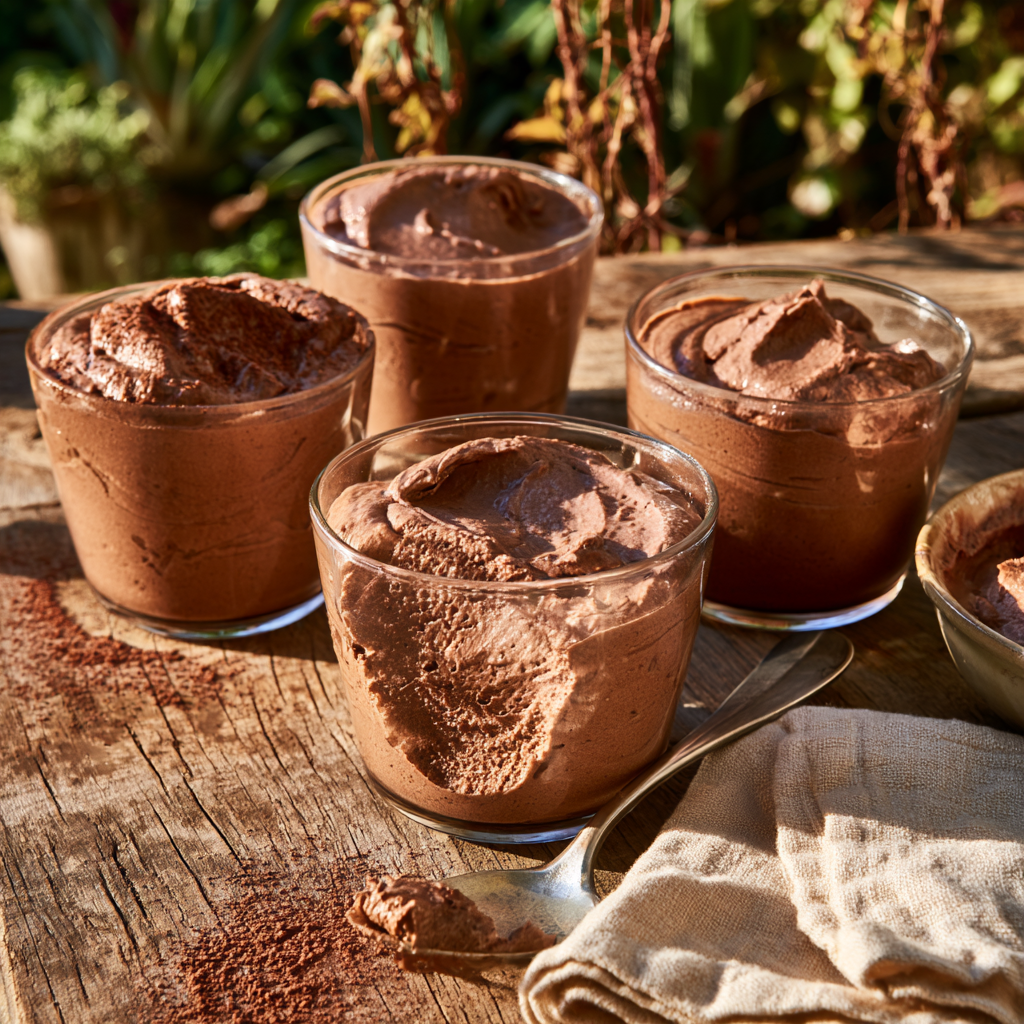
Cottage Cheese Chocolate Mousse Recipe
Equipment
- High-speed blender or food processor
- Digital kitchen scale
- Measuring cups and spoons
- Silicone Spatula
- 4 small dessert glasses, ramekins, or jars
- Small spoon for tasting
- Airtight lids or reusable food-safe covers
- Refrigerator
- Fine-mesh sieve (optional)
- Small piping bag (optional, for presentation)
Ingredients
- 450 g approximately 2 cups — plain cottage cheese, preferably 2% milk fat
- 20 g approximately ¼ cup — unsweetened cocoa powder, natural or Dutch-process
- 40 g approximately 2 tablespoons — pure maple syrup, or honey to taste
- 1 teaspoon 5 ml — nonalcoholic vanilla flavoring
- Optional: 1–2 teaspoons — milk only if absolutely needed to help blending
- Important: The recipe’s nutrition estimate uses the maple syrup option and excludes optional milk and toppings. Maple syrup and honey are alternative sweeteners not ingredients to add together.
- Optional Toppings
- Copy Toppings
- ¼ cup 30 g — fresh raspberries
- ¼ cup 38 g — fresh sliced strawberries
- 1 tablespoon 6 g — dark chocolate shavings
- 1 tablespoon 7 g — finely chopped almonds or walnuts
- 1 teaspoon — unsweetened cocoa powder for light dusting
- 1 tablespoon 16 g — smooth peanut butter, for a richer variation
- ¼ teaspoon — instant coffee powder for a mocha variation
- Ingredient Selection Guide
- Ingredient Best choice Why it matters
- Cottage cheese Mild creamy 2% cottage cheese Balances protein, fat, and smoothness
- Cocoa powder Unsweetened Dutch-process or natural cocoa Produces deep chocolate flavor without added sugar
- Sweetener Pure maple syrup Blends easily into the dairy base
- Vanilla Nonalcoholic vanilla flavoring Rounds out cocoa flavor
- Optional fruit Fresh raspberries or strawberries Adds freshness and a contrasting flavor
- Cottage cheese: Avoid adding separated whey unnecessarily. If the container contains a substantial pool of liquid stir first; if still excessively watery, drain a little liquid before weighing.
- Cocoa powder: Unsweetened cocoa is essential. Sweetened hot chocolate powder contains different proportions of cocoa and sugar and will not produce the same results.
- Sweetener: Honey may have a stronger floral flavor and slightly different sweetness than maple syrup. Start with the indicated weight taste, and adjust.
- Vanilla: Use nonalcoholic vanilla flavoring to keep the recipe free from alcohol-based ingredients.
Instructions
- Step 1: Choose the Best Cottage Cheese. Begin your Cottage Cheese Chocolate Mousse Recipe by selecting 450 g of mild, creamy cottage cheese, preferably a 2% milk-fat variety that offers a good balance of richness and protein. Check the package to ensure the cottage cheese is fresh, properly refrigerated, and within its labeled storage period. Both small-curd and large-curd cottage cheese can work, but a very dry variety may be more difficult to blend into a silky mousse, while a particularly watery variety may create a thinner dessert. If excess whey has visibly separated, stir the contents gently and drain a little free liquid if necessary before weighing the cottage cheese. Transfer the measured cheese to a clean blender or food processor and prepare your cocoa powder, maple syrup, and nonalcoholic vanilla flavoring. Starting with a good-quality cottage cheese is important because its flavor, moisture, and salt content directly influence the final dessert.
- Step 2: Blend the Cottage Cheese Until Completely Smooth. Place the 450 g of cottage cheese in a high-speed blender or food processor, secure the lid, and blend until the mixture begins to look smooth and creamy, generally for approximately 60–90 seconds depending on your appliance. Stop the machine as needed, scrape down the sides with a silicone spatula, and blend again so that any visible curds are fully incorporated. The mixture should gradually change from a lumpy white cheese into a uniform, thick dairy cream. Avoid adding milk or water at this stage unless your blender genuinely cannot process the mixture, since extra liquid can make the finished mousse too thin. If necessary, add only 1 teaspoon of milk at a time, keeping in mind that additional liquid changes the final consistency and nutrition. The smoother the cottage cheese becomes before adding the cocoa, the more velvety your chocolate mousse will feel when served.
- Step 3: Add the Unsweetened Cocoa Powder. Once the cottage cheese looks smooth, add 20 g (approximately ¼ cup) of unsweetened cocoa powder to the blender. Natural cocoa powder produces a slightly brighter, more acidic chocolate flavor, while Dutch-process cocoa tends to create a darker, smoother-tasting dessert. Both are suitable because this recipe does not require baking or chemical leavening. Distribute the cocoa over the cottage cheese rather than dumping it into one compact pile, which can make mixing more difficult. If your cocoa powder contains firm lumps, sift it into the blender first to prevent dry pockets. Secure the lid and pulse briefly until the cocoa begins to combine with the dairy base. The mixture will gradually change to a rich chocolate-brown color, although some dry powder may remain on the sides until the next blending stage.
- Step 4: Sweeten With Maple Syrup and Add Vanilla. Pour 40 g (approximately 2 tablespoons) of pure maple syrup into the blender, followed by 1 teaspoon of nonalcoholic vanilla flavoring. The maple syrup balances the natural bitterness of cocoa and the mild tanginess of cottage cheese, while vanilla rounds out the flavor and gives the mixture a more familiar chocolate-dessert aroma. If you prefer honey, substitute approximately the same weight and adjust according to taste, remembering that honey can have a more distinctive flavor. Avoid adding large amounts of extra sweetener before tasting, since the balance depends on the cocoa powder and cottage cheese used. Secure the blender lid and prepare to process the mixture until all the ingredients are fully incorporated. No melted chocolate, eggs, or heavy whipping cream are required for this easy no-bake dessert.
- Step 5: Blend Into a Silky Chocolate Mousse. Blend the cottage cheese, cocoa powder, maple syrup, and vanilla on medium to high speed for approximately 60–90 seconds, stopping once or twice to scrape down the sides and bottom of the container. Continue until the chocolate mixture is evenly colored, completely blended, and free from visible cottage cheese curds or dry cocoa pockets. The finished consistency should be thick, smooth, creamy, and spoonable, resembling a rich chocolate pudding or dense mousse rather than an aerated French mousse. If the mixture appears grainy, blend longer before trying to adjust its ingredients. If it is too thick for your blender to circulate, stop and scrape the sides, adding no more than a teaspoon of milk at a time only if absolutely necessary. Avoid excessive dilution because it can cause the mousse to become runny instead of rich and velvety.
- Step 6: Taste and Adjust the Chocolate Flavor. Using a clean tasting spoon, sample a small amount of the blended chocolate mousse and assess the balance between chocolate intensity, sweetness, and the mild dairy tang of the cottage cheese. If the cocoa flavor seems too bitter, add a small additional amount of maple syrup or honey, such as 1 teaspoon, and blend briefly until incorporated. If the mousse tastes too sweet or lacks chocolate depth, add approximately ½ teaspoon of unsweetened cocoa powder and blend again. Because cottage cheese often already contains salt, taste before adding any extra salt. For a subtle mocha variation, a very small pinch of instant coffee powder can be blended into the mixture, but it is not necessary for the classic recipe. Stop adjusting once the mousse tastes pleasantly chocolaty, with enough sweetness to balance the cocoa without masking its natural richness.
- Step 7: Check the Texture Before Portioning. Before transferring the mousse to serving containers, check its consistency by lifting a spoonful and allowing it to fall back into the blender. It should be thick enough to coat the spoon and form a soft mound before slowly settling, while remaining smooth rather than stiff or chalky. If visible curds remain, blend for another 20–30 seconds and scrape the container again. If the mixture is slightly softer than expected, remember that refrigeration may help it firm somewhat, although chilling cannot completely correct excessive liquid. If the mousse has become too thick after an unexpected amount of cocoa, you can blend in a very small quantity of cottage cheese to loosen the texture without diluting the chocolate flavor excessively. The goal is a creamy, spoonable dessert rather than a pourable chocolate sauce or a firmly set custard.
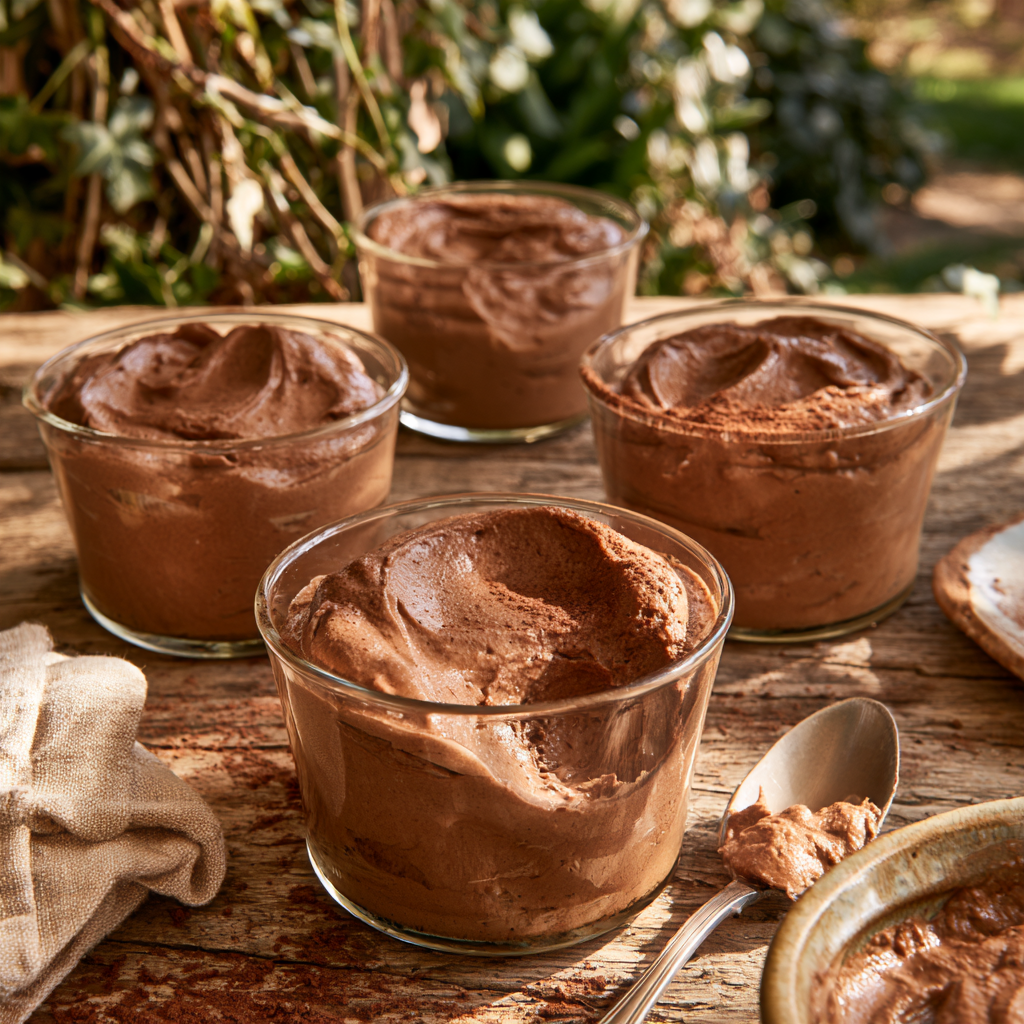
- Step 8: Divide the Mousse Into Individual Dessert Cups. Using a silicone spatula or spoon, transfer the finished chocolate mixture into four clean serving glasses, ramekins, or small dessert jars, dividing it as evenly as possible so each portion contains approximately one-quarter of the recipe. Scrape the blender carefully to avoid leaving a substantial quantity of mousse behind. Smooth the surface of each serving with the back of a spoon or create gentle swirls for a simple homemade presentation. If you want more decorative results, you may place the mixture into a piping bag and pipe it into the glasses, although this is entirely optional. Leave a little space at the top for raspberries, sliced strawberries, nuts, or chocolate shavings. Cover the servings with appropriate food-safe lids or reusable covers before refrigeration to protect the dessert from absorbing refrigerator odors.
- Step 9: Refrigerate Until Pleasantly Chilled. Place the covered dessert cups in the refrigerator at 40°F (4°C) or below for approximately 30–60 minutes before serving. This chilling period allows the mousse to become pleasantly cold and may help it develop a slightly firmer, more cohesive consistency. The exact texture depends on the moisture content and fat level of the cottage cheese as well as the amount of cocoa and sweetener used. Some batches will remain soft and pudding-like, while others become relatively thick and hold spoon marks easily. Do not expect the mixture to become as light and airy as traditional whipped French chocolate mousse, since this recipe relies on blending rather than folding aerated cream or egg whites. Keep the mousse covered while chilling and avoid leaving it at room temperature for extended periods because it contains fresh dairy.
- Step 10: Add Optional Toppings and Serve. When ready to serve, remove the chilled Cottage Cheese Chocolate Mousse Recipe from the refrigerator and uncover the individual dessert cups. Enjoy the mousse plain or finish each portion with a few fresh raspberries, thin strawberry slices, a light dusting of cocoa powder, or a small sprinkling of dark chocolate shavings. For a crunchy contrast, add a little finely chopped almond or walnut, ensuring that anyone with a nut allergy receives a suitable alternative. Keep garnishes modest so the creamy chocolate mousse remains the main attraction, and remember that added toppings change the calorie and nutrition values. Serve immediately using small dessert spoons so the mousse remains cold and smooth. This no-bake chocolate dessert works beautifully for family dinners, afternoon treats, meal preparation, and simple gatherings where you want an attractive presentation without complicated baking.
- Step 11: Store Leftover Chocolate Mousse Safely. If you are not serving every portion immediately, return the covered cottage cheese chocolate mousse to the refrigerator promptly and store it at 40°F (4°C) or below. For best quality, enjoy the mousse within approximately 3–4 days, provided the cottage cheese was fresh and correctly stored when the dessert was prepared. If the cottage cheese was already close to the end of its safe storage period, consume the dessert sooner rather than assuming preparation resets its shelf life. Avoid leaving the mousse at room temperature for more than 2 hours, or more than 1 hour when ambient temperatures exceed 90°F (32°C). Add berries, nuts, and other delicate toppings immediately before eating when possible, as fruit juices can collect on the surface and nuts may lose their crunch. Discard the mousse if it develops visible mold, unusual odors, or other signs of spoilage.
Notes
- The Origins of Cottage Cheese Chocolate Mousse Recipe: From French Chocolate Desserts to Modern High-Protein Treats
- 1. The French Origins of Chocolate Mousse
- 2. The Ancient Origins of Fresh Cheese
- 3. Why Is It Called Cottage Cheese?
- 4. How Cottage Cheese Became Popular in American Food Culture
- 5. The Evolution of Chocolate Mousse Into Lighter Desserts
- 6. The Rise of High-Protein Desserts
- 7. How Blending Transformed Cottage Cheese Into a Creamy Dessert Ingredient
- 8. How Social Media Helped Popularize Cottage Cheese Chocolate Mousse
- 9. Traditional Chocolate Mousse vs. Cottage Cheese Chocolate Mousse
- 10. Why Cocoa Powder Became the Ideal Chocolate Ingredient
- 11. The Role of Honey, Maple Syrup, and Vanilla in Modern Versions
- 12. How Cottage Cheese Chocolate Mousse Became a Convenient No-Bake Dessert
- 13. Popular Variations of Cottage Cheese Chocolate Mousse
- 14. Why Cottage Cheese Chocolate Mousse Appeals to Modern Home Bakers
- A Brief Timeline of Chocolate Mousse and Cottage Cheese
- Final Thoughts: The Modern Origins of Cottage Cheese Chocolate Mousse Recipe
- Health Benefits of Cottage Cheese Chocolate Mousse Recipe: Protein, Nutrition, and a Healthier Way to Enjoy Chocolate
- Nutritional Benefits of Cottage Cheese Chocolate Mousse Ingredients
- 1. Cottage Cheese Chocolate Mousse Is Naturally Rich in Protein
- 2. Protein Can Help Make This Chocolate Dessert More Satisfying
- 3. Cottage Cheese Provides Calcium for Strong Bones and Teeth
- 4. Cocoa Powder Contains Naturally Occurring Antioxidant Compounds
- 5. Cottage Cheese Chocolate Mousse Can Be Lower in Saturated Fat Than Traditional Mousse
- 6. This Recipe Can Be Made With a Controlled Amount of Added Sugar
- 7. Cottage Cheese Contains Vitamin B12 for Normal Nerve and Blood Cell Function
- 8. Cottage Cheese Supplies Phosphorus for Bone and Cellular Functions
- 9. Chocolate Mousse Made With Cottage Cheese Is Convenient for Protein-Focused Meal Planning
- 10. Fresh Berries Can Add Fiber and Vitamin C
- 11. Nuts and Seeds Can Increase Nutritional Variety
- 12. The Recipe Can Be Adapted to Different Dietary Preferences
- Nutritional Benefits of Cottage Cheese Chocolate Mousse Ingredients
- Cottage Cheese Chocolate Mousse Recipe Nutrition Facts
- Cottage Cheese Chocolate Mousse vs. Traditional Chocolate Mousse
- Is Cottage Cheese Chocolate Mousse Good for Weight Management?
- Is Cottage Cheese Chocolate Mousse Good for Muscle Recovery?
- Does Cottage Cheese Chocolate Mousse Contain Probiotics?
- Can People With Diabetes Eat Cottage Cheese Chocolate Mousse?
- 8 Practical Ways to Make Cottage Cheese Chocolate Mousse More Nutritious
- Important Considerations Before Making This Dessert
- Final Thoughts: Is Cottage Cheese Chocolate Mousse Recipe Healthy?
- Why You Should Try This Cottage Cheese Chocolate Mousse Recipe: 12 Delicious Reasons You'll Love It
- 1. It's Surprisingly Rich, Creamy, and Chocolaty
- 2. It's Naturally High in Protein Compared With Many Traditional Mousses
- 3. You Only Need a Handful of Simple Ingredients
- 4. No Baking, No Raw Eggs, and No Complicated Techniques
- 5. It's Ready to Blend in Just Five Minutes
- 6. You Can Control the Sweetness and Chocolate Intensity
- 7. It's a Delicious Way to Enjoy Cottage Cheese Differently
- 8. It's Easy to Customize With Delicious Toppings
- 9. It's Perfect for Meal Prep and Individual Dessert Cups
- 10. It's a Beginner-Friendly Dessert That Looks Impressive
- 11. It's a Versatile Dessert for Different Occasions
- 12. It Satisfies Chocolate Cravings Without Requiring a Heavy Dessert
- What Makes This OoohDelish Cottage Cheese Chocolate Mousse Recipe Special?
- Expert Tips for Making the Best Cottage Cheese Chocolate Mousse Recipe
- Choose the Right Cottage Cheese
- Blend Until Absolutely Smooth
- Use High-Quality Unsweetened Cocoa Powder
- Adjust Sweetness Gradually
- Add a Little Vanilla for Better Flavor
- Chill Before Serving
- Avoid Adding Too Much Liquid
- Don't Overload the Mousse With Cocoa
- Add Toppings Immediately Before Serving
- Keep the Dessert Properly Refrigerated
- Cottage Cheese Chocolate Mousse vs. Traditional Chocolate Mousse: Which Should You Try?
- Common Mistakes to Avoid When Making Cottage Cheese Chocolate Mousse
- Is Cottage Cheese Chocolate Mousse Worth Making?
- Final Thoughts: Why You'll Love This Cottage Cheese Chocolate Mousse Recipe
The Origins of Cottage Cheese Chocolate Mousse Recipe: From French Chocolate Desserts to Modern High-Protein Treats
The fascinating history of the Cottage Cheese Chocolate Mousse Recipe brings together two very different culinary traditions: the elegance of classic French chocolate mousse and the simplicity of traditional fresh cottage cheese. Although this creamy, protein-rich dessert has recently attracted attention among home cooks, its ingredients have histories stretching back centuries.
Traditional chocolate mousse originated in French culinary culture, where chefs developed delicate desserts by incorporating air into chocolate mixtures to create a light, smooth texture. Cottage cheese, meanwhile, emerged from much older traditions of fresh cheesemaking, when households transformed milk into soft curds rather than allowing valuable dairy products to go to waste.
The modern Cottage Cheese Chocolate Mousse Recipe combines these ideas in a surprisingly simple way. Instead of using whipped egg whites or heavy cream to achieve a rich, spoonable texture, it relies on blended cottage cheese, unsweetened cocoa powder, a sweetener such as maple syrup or honey, and vanilla.
The result is a chocolate dessert inspired by classic mousse but with a different texture and nutritional profile. Cottage cheese contributes protein and creaminess, while cocoa provides the deep chocolate flavor that makes the dessert so appealing.
Unlike traditional French mousse, this contemporary version generally requires no cooking, no eggs, and no complicated whipping techniques. A high-speed blender or food processor transforms the ingredients into a smooth chocolate mixture that thickens slightly when chilled.
To understand how this recipe developed, it’s worth exploring the history of French chocolate mousse, the origins of cottage cheese, and the modern food trends that brought them together.
1. The French Origins of Chocolate Mousse
The word mousse comes from French and means foam, a reference to the light, airy texture created when air is incorporated into a mixture.
Traditional French chocolate mousse is typically associated with melted chocolate and whipped egg whites, sometimes enriched with egg yolks, butter, sugar, or whipped cream.
Chocolate mousse developed in France during the eighteenth and nineteenth centuries as European cooks refined their techniques for preparing chocolate desserts.
Historical accounts associate the term mousse au chocolat with eighteenth-century French culinary writing, although early references could describe a frothy chocolate preparation rather than the chilled dessert familiar today.
One important milestone appeared in 1820, when the French cookbook Le Cuisinier Royal, by André Viard, included a chocolate mousse preparation.
Food historians also recount stories connecting the dessert to royal kitchens and figures such as Charles Fazi. However, these stories do not establish one universally agreed-upon inventor of modern chocolate mousse.
Over time, chocolate mousse became associated with French patisserie and restaurant desserts.
Its appeal came from the combination of rich chocolate flavor and a delicate texture that felt lighter than a dense pudding or chocolate custard.
This contrast between indulgence and lightness became the defining characteristic of the dessert.
How Traditional Chocolate Mousse Was Prepared
The classic technique generally involved melting chocolate, preparing an aerated ingredient such as whipped egg whites or cream, and carefully combining the mixtures.
The delicate folding process helped preserve the air bubbles responsible for the mousse’s light consistency.
If stirred too aggressively, the mixture could lose volume and become dense.
The finished mousse was typically chilled before serving to allow its texture to stabilize.
This preparation required attention to temperature, ingredient proportions, and mixing techniques.
For generations, mastering chocolate mousse was considered a useful skill for pastry chefs and enthusiastic home cooks.
The modern cottage cheese version takes inspiration from this traditional dessert but simplifies the process considerably.
2. The Ancient Origins of Fresh Cheese
While chocolate mousse belongs to French dessert history, cottage cheese comes from a much older tradition of dairy preservation and fresh cheesemaking.
People have produced simple forms of fresh cheese for thousands of years.
Early cheesemaking techniques involved separating milk into curds and whey through natural souring or the use of coagulating substances.
The curds could then be drained and eaten fresh, providing a practical way to turn milk into another food.
Different cultures developed their own soft cheeses using locally available milk and traditional methods.
Some were pressed, some were salted, and others remained loose and moist.
These ancient fresh cheeses were not necessarily identical to modern packaged cottage cheese, but they shared the basic principle of separating milk solids from liquid whey.
Unlike aged cheeses that undergo extended ripening, fresh cheeses could be eaten relatively soon after preparation.
This made them useful in everyday household cooking.
Modern cottage cheese continues this tradition through a mild, fresh product consisting of soft curds, sometimes combined with cream.
3. Why Is It Called Cottage Cheese?
The name cottage cheese reflects the historical association between fresh cheese production and household kitchens.
In earlier centuries, families often made soft cheeses at home using milk available from their own animals or local dairy production.
These simple cheeses could be produced without the elaborate aging facilities required for hard cheeses.
The expression cottage cheese became established in North American English during the nineteenth century.
According to The Oxford Companion to Food, historical fresh cheeses were associated with homemade preparations sometimes known as cottagers’ cheeses. The reference work identifies the term cottage cheese as a name that developed in North America during the nineteenth century, with a documented dictionary reference from 1848.
The name therefore connects the product with modest household food preparation rather than an individual inventor.
What Made Cottage Cheese Different From Other Cheeses?
Cottage cheese is a fresh, unripened cheese known for its small, soft curds and mild, slightly tangy flavor.
Unlike cheddar, Parmesan, or other aged cheeses, cottage cheese does not develop its characteristics through months of ripening.
Its texture comes from the curds formed during milk coagulation.
Depending on processing and the addition of cream, cottage cheese may be relatively lean or pleasantly rich.
This mild flavor and soft consistency make it adaptable to both savory and sweet recipes.
For many years, it was commonly served with fruit, vegetables, toast, or salads.
However, modern blending techniques opened the door to a much wider range of applications.
4. How Cottage Cheese Became Popular in American Food Culture
Cottage cheese became an established ingredient in American kitchens during the nineteenth and twentieth centuries.
Its relatively simple production method and nutritional characteristics helped make it familiar to households across the country.
During the twentieth century, cottage cheese was frequently promoted as a protein-containing dairy food.
It appeared in salads, sandwiches, breakfast dishes, and meals designed around lighter ingredients.
By the 1970s, cottage cheese had become especially associated with American diet culture, often served with sliced peaches, pineapple, or fresh vegetables.
Its reputation was therefore quite different from that of chocolate mousse.
Chocolate mousse represented an indulgent dessert, while cottage cheese was commonly viewed as a practical, everyday food.
The modern Cottage Cheese Chocolate Mousse Recipe brings those contrasting identities together.
Instead of serving cottage cheese as visible curds beside fruit, the recipe transforms it into a smooth chocolate dessert.
That transformation is one of the most interesting aspects of the dish’s contemporary popularity.
5. The Evolution of Chocolate Mousse Into Lighter Desserts
Traditional French mousse inspired countless adaptations as cooks experimented with different ingredients.
Some recipes replaced whipped egg whites with whipped cream, while others incorporated yogurt, tofu, avocado, or other ingredients to achieve a spoonable texture.
These versions were often developed to simplify preparation, accommodate dietary preferences, or change the nutritional composition.
Not every variation creates the same texture as classic mousse.
Whipped egg whites produce an especially airy structure, while blended dairy products typically create a denser, creamier consistency.
Nevertheless, the name chocolate mousse became widely used for smooth chocolate desserts that felt lighter or softer than a traditional pudding.
Cottage cheese fits into this modern category because it can become exceptionally smooth when blended thoroughly.
It offers a mild dairy base that can carry chocolate flavor without requiring eggs or melted chocolate.
The result is best understood as a modern mousse-inspired chocolate dessert rather than an exact reproduction of traditional French mousse.

6. The Rise of High-Protein Desserts
Interest in protein-rich foods has influenced home cooking, packaged food development, and online recipe trends.
Protein is an essential nutrient involved in tissue maintenance, normal physiological functions, and the body’s production of enzymes and other important molecules.
Foods that naturally contain protein, including cottage cheese, became attractive ingredients for people seeking alternatives to some traditional desserts.
This encouraged experimentation with familiar recipes.
Instead of relying exclusively on cream, butter, or other rich ingredients, home cooks began incorporating dairy foods such as Greek yogurt and cottage cheese.
Cottage cheese was particularly appealing because of its relatively mild taste and smooth consistency after blending.
Its versatility allowed it to appear in recipes for pancakes, dips, sauces, cheesecakes, ice cream-style desserts, and chocolate mixtures.
However, calling a dessert high-protein does not automatically mean it is low in sugar, low in calories, or nutritionally superior in every respect.
The final nutritional profile depends on the quantity of cottage cheese, cocoa, sweetener, and additional toppings.
For the Cottage Cheese Chocolate Mousse Recipe, the main nutritional difference from many traditional mousse preparations is that cottage cheese can contribute a meaningful amount of protein per serving.
7. How Blending Transformed Cottage Cheese Into a Creamy Dessert Ingredient
One of the most important developments behind the modern Cottage Cheese Chocolate Mousse Recipe was the use of powerful household blenders and food processors.
Traditionally, cottage cheese was recognized by its soft, individual curds. Although it was nutritious and mild in flavor, its lumpy texture made it an unusual choice for smooth chocolate desserts.
Blending changes that experience completely.
When cottage cheese is processed thoroughly, its curds break down into a much smoother, creamier mixture. The result can resemble a thick dessert cream rather than conventional cottage cheese.
This transformation makes it possible to incorporate cocoa powder, honey, maple syrup, vanilla, and other flavorings into a uniform chocolate mixture.
The key difference is that blending creates smoothness but does not necessarily incorporate enough air to reproduce the light foam structure of traditional French mousse.
That’s why homemade cottage cheese chocolate mousse often has a texture somewhere between chocolate mousse, pudding, and a thick chocolate cream.
The finished consistency depends on the cottage cheese variety, its moisture content, the blender’s power, and the proportions of the other ingredients.
For the smoothest result, a high-speed blender is particularly helpful.
8. How Social Media Helped Popularize Cottage Cheese Chocolate Mousse
The modern popularity of cottage cheese chocolate mousse fits into a broader trend of transforming familiar ingredients into simplified, protein-rich desserts.
During the 2020s, recipe creators on TikTok, Instagram, Pinterest, and other platforms increasingly shared ways to blend cottage cheese into sweet dishes.
Recipes featuring cottage cheese ice cream, cheesecakes, creamy puddings, and chocolate desserts attracted attention because they challenged assumptions about how cottage cheese could be used.
A particularly appealing feature of chocolate mousse made with cottage cheese is the visual transformation.
At the beginning of the preparation, cottage cheese looks white and visibly curdled.
After blending with cocoa powder and sweetener, it becomes a smooth, dark chocolate mixture.
That dramatic change makes the recipe well suited to short cooking videos.
It also appeals to people who prefer desserts requiring minimal equipment and preparation time.
However, although cottage cheese desserts became especially visible through social media, there is no well-established evidence identifying one person as the inventor of cottage cheese chocolate mousse.
The recipe is better understood as a contemporary adaptation developed through wider experimentation with blended dairy desserts.
9. Traditional Chocolate Mousse vs. Cottage Cheese Chocolate Mousse
Although the two desserts share a rich chocolate flavor, they differ significantly in ingredients, preparation, and texture.
| Feature | Traditional French chocolate mousse | Cottage cheese chocolate mousse |
|---|---|---|
| Culinary origin | French dessert tradition | Modern adaptation inspired by mousse |
| Main ingredients | Chocolate, whipped eggs and/or cream | Cottage cheese, cocoa, sweetener, vanilla |
| Texture | Light, aerated, and delicate | Smooth, creamy, and often denser |
| Preparation | Melting, whipping, and careful folding | Blending until smooth |
| Cooking | Often no baking; may involve heating chocolate or egg components | Usually no cooking |
| Protein | Depends on eggs and dairy used | Can be higher because cottage cheese is protein-rich |
| Fat content | Often rich in cream or chocolate fat | Varies with cottage cheese and additions |
| Preparation difficulty | Moderate | Beginner-friendly |
| Equipment | Whisk or mixer, bowls, spatula | Blender or food processor |
| Serving style | Chilled dessert cups | Chilled dessert cups or bowls |
Both desserts can be delicious, but they offer different eating experiences.
Traditional chocolate mousse emphasizes lightness and delicate aeration, while the cottage cheese version prioritizes creamy texture and simple preparation.
Neither should be considered automatically healthier without comparing the actual ingredients and portions.
10. Why Cocoa Powder Became the Ideal Chocolate Ingredient
Unsweetened cocoa powder is particularly useful in cottage cheese chocolate mousse because it adds concentrated chocolate flavor without requiring melted chocolate.
Cocoa powder is produced from processed cocoa beans after much of the cocoa butter has been removed.
Its intense flavor allows a relatively small amount to transform a mild dairy base into a chocolate dessert.
In this recipe, cocoa powder also contributes to the finished texture.
Because it is a dry ingredient, it can slightly thicken the blended cottage cheese mixture.
However, excessive cocoa powder can create a bitter or chalky result, particularly when using very lean cottage cheese.
That’s why the balance between cocoa, sweetener, vanilla, and cottage cheese is important.
Natural cocoa powder often has a brighter, more acidic chocolate flavor.
Dutch-process cocoa powder has been alkalized, producing a darker appearance and typically a smoother, less acidic taste.
Either type can work in a no-bake mousse recipe, although the flavor and color will differ.
For a particularly rich chocolate result, start with a moderate amount of cocoa and adjust after blending.
This flexibility makes cocoa powder one of the key ingredients in modern cottage cheese desserts.
11. The Role of Honey, Maple Syrup, and Vanilla in Modern Versions
The mild tanginess of cottage cheese creates an interesting contrast with chocolate.
However, unsweetened cocoa powder can taste quite bitter on its own.
Modern cottage cheese chocolate mousse recipes therefore often include honey, maple syrup, or another sweetener.
Honey adds a distinctive floral sweetness, while maple syrup contributes subtle caramel-like notes.
Both blend easily into the cottage cheese mixture without creating a gritty texture.
Vanilla extract adds another layer of flavor, making the mousse taste more rounded and dessert-like.
A small pinch of salt can also enhance chocolate flavor.
These additions reflect the flexibility of modern homemade dessert preparation.
Rather than relying on a fixed traditional formula, home cooks can adjust sweetness and intensity according to personal preferences.
However, honey and maple syrup are still sources of added sugar, and their use does not automatically make the dessert low-sugar.
For the best balance, begin with a measured amount of sweetener and taste the mousse before adding more.
The goal is to create a rich chocolate flavor that complements the natural creaminess of the cottage cheese.
12. How Cottage Cheese Chocolate Mousse Became a Convenient No-Bake Dessert
Another reason for the recipe’s appeal is its straightforward preparation.
Traditional chocolate mousse can require several bowls, temperature control, and careful folding.
Cottage cheese chocolate mousse generally needs only a blender and a few ingredients.
The usual process involves combining cottage cheese with cocoa powder, sweetener, and vanilla, then blending until smooth.
After blending, the mixture is spooned into serving glasses or small bowls.
Chilling allows it to become colder and sometimes slightly firmer, depending on the ingredients.
This simplicity makes it attractive for home cooks who want a chocolate dessert without baking.
It also works well for portioned desserts.
Small glass cups can be prepared for dinner guests and topped with berries, chocolate shavings, or chopped nuts shortly before serving.
Because the mousse contains fresh dairy, it must be refrigerated promptly and should not be left at room temperature for extended periods.
Its convenience, versatility, and creamy chocolate flavor help explain why the recipe has become a familiar part of modern no-bake dessert cooking.
13. Popular Variations of Cottage Cheese Chocolate Mousse
Classic Dark Chocolate Mousse: Made with cottage cheese, unsweetened cocoa powder, honey or maple syrup, and vanilla. A simple version with a rich chocolate flavor and creamy texture.
Chocolate Peanut Butter Mousse: A small amount of smooth peanut butter adds nutty richness and creates a more substantial, creamy dessert. Adjust the sweetener and thickness as needed.
Chocolate Berry Mousse: Finished with fresh strawberries or raspberries for a contrast between rich chocolate and naturally tart fruit.
Mocha Cottage Cheese Mousse: A small amount of cooled espresso or instant coffee powder enhances the chocolate flavor and introduces a café-inspired twist.
These variations demonstrate how a simple blended dairy dessert can be adapted to different preferences.
They also reflect the modern emphasis on customizable recipes that can be prepared with familiar ingredients.
14. Why Cottage Cheese Chocolate Mousse Appeals to Modern Home Bakers
The Cottage Cheese Chocolate Mousse Recipe offers several qualities that make it especially attractive to today’s home cooks.
It requires minimal preparation, uses widely available ingredients, and generally needs no oven.
It’s also easy to portion into individual servings, making it convenient for small households or entertaining guests.
Perhaps its most distinctive quality is the unexpected transformation of cottage cheese into a smooth chocolate dessert.
For people who dislike the usual curd texture of cottage cheese, blending it offers a completely different way to enjoy the ingredient.
Its protein content is another practical advantage, although the amount per serving depends on the formulation.
The recipe also invites experimentation with cocoa varieties, sweeteners, toppings, and flavor combinations.
For more chocolate dessert inspiration, our Chocolate Chip Cookie Dough offers another homemade treat that can be enjoyed without oven baking when prepared with the specified ready-to-eat ingredients.
Unlike edible cookie dough, however, this mousse relies on a blended dairy base rather than butter, sugar, and flour.
The two recipes offer different textures and flavors while sharing the convenience of no-bake preparation.
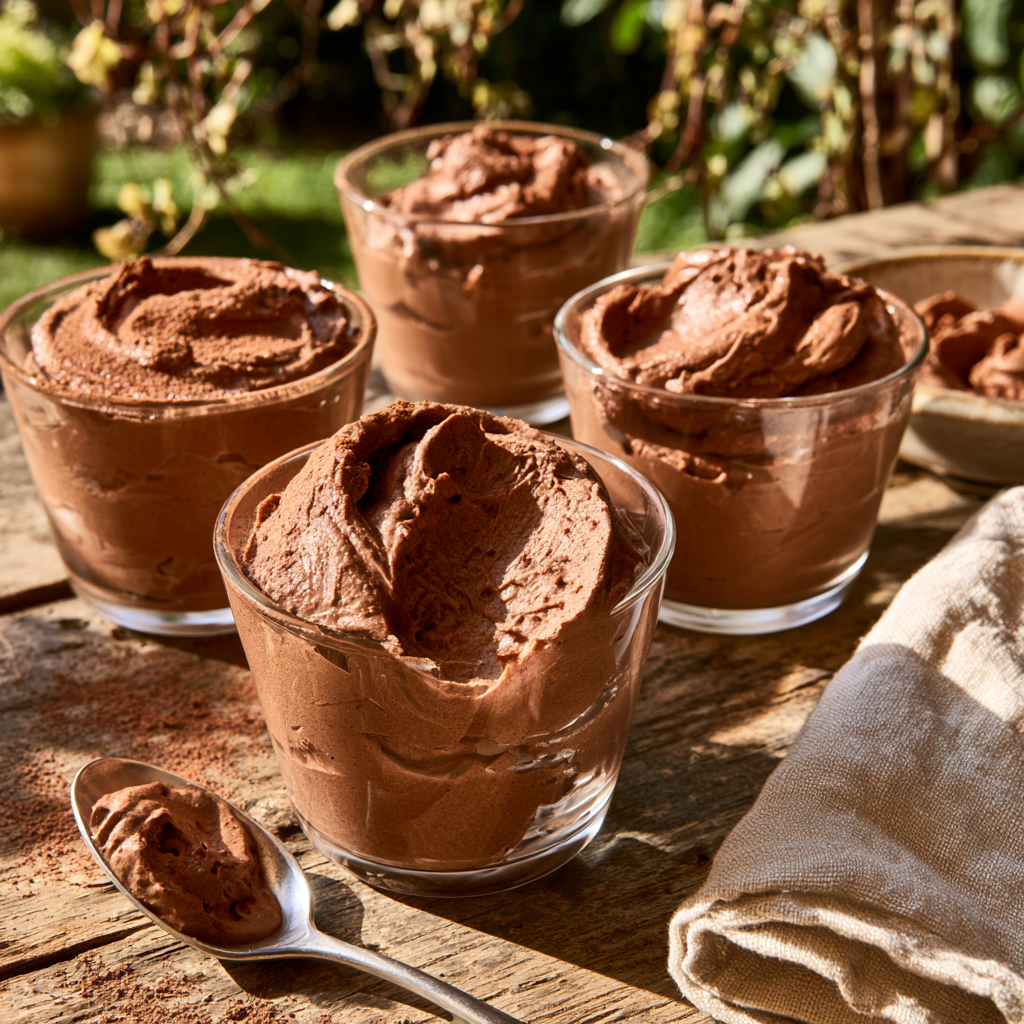
A Brief Timeline of Chocolate Mousse and Cottage Cheese
| Period | Culinary development |
|---|---|
| Ancient history | Different civilizations develop methods for producing fresh curd cheeses from milk. |
| Eighteenth century | French culinary writing includes early references to chocolate mousse and frothy chocolate preparations. |
| 1820 | André Viard publishes a chocolate mousse preparation in Le Cuisinier Royal. |
| Nineteenth century | The term cottage cheese becomes established in North American English. |
| Twentieth century | Cottage cheese becomes a familiar American dairy food, while chocolate mousse remains a classic dessert. |
| Late twentieth century | Home blenders and food processors make it increasingly convenient to create smooth mixtures from fresh dairy products. |
| 2010s–2020s | Interest grows in convenient no-bake desserts and protein-rich recipe adaptations. |
| 2020s | Blended cottage cheese desserts receive widespread attention through recipe websites and social media. |
| Today | Cottage cheese chocolate mousse is enjoyed as a simple, creamy, protein-containing alternative to traditional chocolate mousse. |
Final Thoughts: The Modern Origins of Cottage Cheese Chocolate Mousse Recipe
The story of the Cottage Cheese Chocolate Mousse Recipe is an example of how traditional ingredients can inspire entirely new dessert ideas.
Classic French chocolate mousse provided the inspiration for a smooth, rich chocolate dessert, while cottage cheese contributed a familiar dairy ingredient with a long history of household preparation.
Modern kitchen equipment made it possible to transform cottage cheese into a creamy base, opening the door to a variety of no-bake recipes.
As interest in convenient and protein-rich desserts grew, blended cottage cheese chocolate mousse became an appealing option for home cooks who wanted something delicious without complicated pastry techniques.
Although there is no single documented inventor of this modern recipe, its identity is clear: it combines the comforting taste of chocolate with the simplicity of blended cottage cheese.
Today, you can prepare it using just a few ingredients, customize the sweetness, and finish it with fresh berries, nuts, or chocolate shavings.
OoohDelish Chocolate Secret: For the smoothest Cottage Cheese Chocolate Mousse Recipe, choose a creamy cottage cheese, blend it thoroughly before adding too many extra ingredients, and use good-quality unsweetened cocoa powder. Sweeten gradually with maple syrup or honey, add a little vanilla for a rounded chocolate flavor, and chill the finished mousse before serving. A few dark chocolate shavings or fresh raspberries create a beautiful finish without complicating this easy homemade dessert.
Health Benefits of Cottage Cheese Chocolate Mousse Recipe: Protein, Nutrition, and a Healthier Way to Enjoy Chocolate
If you love rich, creamy chocolate desserts but want a more balanced alternative to traditional mousse, this Cottage Cheese Chocolate Mousse Recipe offers an irresistible combination of flavor and nutrition. Made with protein-rich cottage cheese, unsweetened cocoa powder, a touch of maple syrup or honey, and vanilla, this easy no-bake dessert transforms everyday ingredients into a velvety chocolate treat without requiring heavy cream, raw eggs, or complicated preparation.
One of the biggest advantages of this healthy Cottage Cheese Chocolate Mousse Recipe is its protein content. Cottage cheese naturally provides complete dairy protein, along with calcium, phosphorus, vitamin B12, and other essential nutrients. When blended until completely smooth, it creates a luxurious dessert base that can be satisfying without relying on large amounts of cream or butter.
Unsweetened cocoa powder adds deep chocolate flavor and supplies naturally occurring plant compounds called flavanols. These compounds have attracted scientific interest for their potential effects on cardiovascular function, although eating chocolate mousse should never be presented as a treatment or a way to prevent disease.
Another advantage of making homemade cottage cheese chocolate mousse is that you control the ingredients. You can adjust sweetness, choose the fat content of the cottage cheese, and add nutritious toppings such as raspberries, strawberries, or chopped nuts.
Let’s explore the real nutritional benefits of this dessert, what makes it different from traditional chocolate mousse, and how to prepare it in a way that supports a balanced diet.
Nutritional Benefits of Cottage Cheese Chocolate Mousse Ingredients
The nutritional value of this mousse comes primarily from cottage cheese and unsweetened cocoa powder, with smaller contributions from the sweetener and optional toppings.
| Ingredient | Key nutrients or characteristics | Nutritional contribution |
|---|---|---|
| Cottage cheese | Complete protein, calcium, phosphorus, vitamin B12 | Supports normal muscle maintenance, bone health, and cellular functions |
| Unsweetened cocoa powder | Fiber, minerals, cocoa polyphenols | Adds chocolate flavor and naturally occurring plant compounds |
| Maple syrup | Carbohydrates, small amounts of minerals | Sweetens the mousse; contributes added sugar |
| Honey | Carbohydrates, trace plant compounds | Provides sweetness; also contributes added sugar |
| Vanilla extract | Aromatic flavor compounds | Enhances perceived sweetness and chocolate flavor |
| Strawberries (optional) | Vitamin C, fiber, water | Adds natural sweetness and freshness |
| Raspberries (optional) | Fiber, vitamin C, plant pigments | Adds tartness and additional fiber |
| Walnuts (optional) | Unsaturated fats, plant protein, fiber | Adds texture and nutrient density |
| Dark chocolate shavings (optional) | Cocoa solids, fat, sugar | Adds chocolate richness; increases calories |
| Chia seeds (optional) | Fiber, plant-based omega-3 fats | Can thicken the mousse and add fiber |
1. Cottage Cheese Chocolate Mousse Is Naturally Rich in Protein
The most distinctive nutritional advantage of this Cottage Cheese Chocolate Mousse Recipe is its protein content.
Traditional chocolate mousse often relies on whipped cream, chocolate, and eggs for its rich texture. Although those ingredients also contain nutrients, cream-based mousse generally provides less protein relative to its calories than a carefully formulated cottage cheese version.
Cottage cheese contains two important types of milk protein: casein and whey.
Casein makes up most of the protein in cottage cheese, while whey proteins contribute a smaller amount.
Together, these dairy proteins supply all nine essential amino acids, making cottage cheese a source of complete protein.
Protein is essential for maintaining and repairing body tissues, producing enzymes and hormones, and supporting normal physiological functions.
A mousse prepared with approximately 450 g of low-fat cottage cheese and divided into four servings can provide roughly 13–14 g of protein per serving, depending on the brand and other ingredients.
That’s a meaningful amount of protein for a dessert.
However, protein content varies with cottage cheese type and recipe proportions, so the actual value should be calculated from the ingredients used.
Nutrition takeaway: This mousse can provide substantially more protein than many conventional chocolate puddings and cream-based desserts, making it a convenient option when you want both chocolate flavor and dietary protein.
2. Protein Can Help Make This Chocolate Dessert More Satisfying
Another reason to enjoy cottage cheese chocolate mousse is that protein contributes to feelings of fullness.
Protein-containing foods can influence appetite and satiety through several physiological processes.
Compared with a dessert composed mainly of sugar and fat, a protein-rich option may leave some people feeling more satisfied after a moderate portion.
This is particularly useful when you want a small dessert after dinner.
A serving of cottage cheese chocolate mousse combines creamy texture, chocolate flavor, and a relatively substantial amount of protein.
The result can feel more satisfying than a sweet snack that contains little protein.
However, appetite responses vary among individuals.
Eating a protein-rich dessert does not guarantee reduced hunger, lower calorie intake, or weight loss.
The dessert’s sweetness, portion size, and the rest of the meal also influence satisfaction.
For a more substantial dessert, serve the mousse with fresh raspberries or strawberries.
The fruit adds volume, fiber, and contrasting flavor without requiring another large serving of mousse.
Nutrition takeaway: The protein in cottage cheese can contribute to a satisfying dessert, especially when combined with sensible portions and fiber-containing toppings.
3. Cottage Cheese Provides Calcium for Strong Bones and Teeth
Calcium is one of the essential minerals found in cottage cheese.
The body needs calcium for several important functions, including maintaining bones and teeth, supporting normal muscle contraction, and enabling nerve signaling.
Bone tissue contains most of the calcium stored in the human body.
Consuming adequate calcium throughout life contributes to normal bone maintenance.
Cottage cheese can help contribute to daily calcium intake, although its calcium content varies considerably by brand and production method.
It is not always as calcium-rich per serving as milk or yogurt.
For that reason, it’s best to check the nutrition label of the cottage cheese used in the recipe rather than assuming every brand provides the same quantity.
A chocolate mousse made with cottage cheese can be one enjoyable way to include dairy nutrients in your diet.
Nevertheless, it should complement, rather than replace, other calcium sources.
Milk, yogurt, certain fortified plant-based beverages, and calcium-rich foods can all contribute to an adequate intake.
Nutrition takeaway: Cottage cheese contributes calcium, an essential mineral for normal bone, tooth, muscle, and nerve functions.
4. Cocoa Powder Contains Naturally Occurring Antioxidant Compounds
Unsweetened cocoa powder adds more than delicious chocolate flavor to this mousse.
Cocoa naturally contains a range of polyphenols, including compounds known as flavanols.
These substances have been studied for their antioxidant activity and potential effects on blood vessel function.
However, the amount of flavanols remaining in cocoa powder varies considerably.
Processing methods, including fermentation, roasting, and alkalization, can reduce flavanol levels.
This means that ordinary cocoa powder isn’t necessarily equivalent to specially formulated high-flavanol cocoa products used in clinical studies.
In 2023, the FDA concluded that the credible evidence supporting a reduced cardiovascular disease risk from high-flavanol cocoa powder was very limited, and the qualified claim does not apply to ordinary cocoa powder.
Therefore, it would be misleading to claim that cottage cheese chocolate mousse prevents heart disease or provides guaranteed antioxidant-related health improvements.
Its more defensible advantage is that unsweetened cocoa introduces chocolate flavor and naturally occurring plant compounds without requiring a large quantity of added sugar.
Nutrition takeaway: Cocoa powder contributes naturally occurring polyphenols, but their quantities and demonstrated health effects vary. Enjoy the mousse as food rather than a medicinal product.
5. Cottage Cheese Chocolate Mousse Can Be Lower in Saturated Fat Than Traditional Mousse
A classic chocolate mousse may contain heavy cream, butter, or substantial amounts of chocolate.
These ingredients can produce a delicious dessert but may also contribute significant saturated fat.
Using low-fat cottage cheese instead of heavy cream changes the fat composition of the recipe.
For example, cottage cheese containing 2% milk fat usually provides much less fat per 100 g than heavy whipping cream.
This allows you to create a creamy, spoonable chocolate dessert without relying on the same quantity of high-fat dairy.
The difference can be particularly noticeable when the recipe uses unsweetened cocoa powder instead of large amounts of melted chocolate.
However, the finished mousse is not automatically low-fat.
Full-fat cottage cheese, peanut butter, coconut cream, and generous chocolate toppings can increase its fat content.
A moderate amount of fat is not inherently problematic, but ingredient quantities matter when comparing recipes.
For a lighter version, choose a cottage cheese that blends well while offering a suitable fat content.
Nutrition takeaway: Replacing heavy cream with low-fat cottage cheese can substantially reduce saturated fat, depending on the complete recipe.
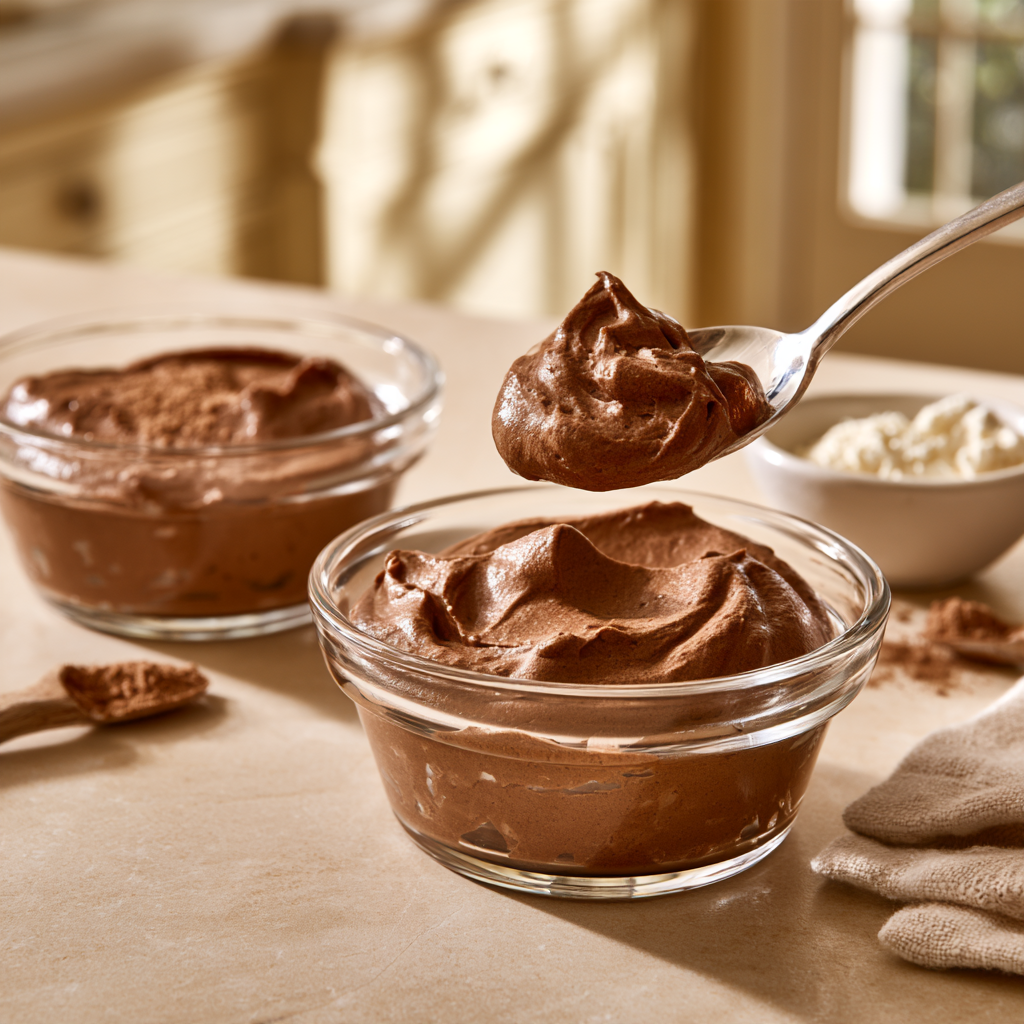
6. This Recipe Can Be Made With a Controlled Amount of Added Sugar
One of the practical benefits of preparing chocolate mousse at home is the ability to decide how sweet it should taste.
Commercial chocolate desserts and some traditional mousse recipes may contain substantial amounts of added sugar.
With this Cottage Cheese Chocolate Mousse Recipe, you can begin with a modest amount of maple syrup or honey and adjust gradually.
Unsweetened cocoa powder provides strong chocolate flavor without the sugar found in many sweetened chocolate products.
Vanilla can help round out the flavor and make the dessert taste more aromatic.
However, maple syrup and honey remain sources of added sugar, even though they are often described as natural sweeteners.
Their carbohydrate and calorie contributions should be counted just as they would be for other added sugars.
If you prefer a less sweet mousse, reduce the sweetener slowly rather than eliminating it immediately.
Cottage cheese has a mildly tangy flavor, and cocoa can taste bitter, so a small amount of sweetness may be useful for creating a balanced dessert.
Nutrition takeaway: Homemade mousse allows you to control the sweetener, but honey and maple syrup should not be mistaken for sugar-free ingredients.
7. Cottage Cheese Contains Vitamin B12 for Normal Nerve and Blood Cell Function
Vitamin B12 is an essential nutrient naturally found in many animal-derived foods.
It participates in normal red blood cell formation, neurological function, and DNA synthesis.
Dairy products, including cottage cheese, can contribute to vitamin B12 intake.
The exact amount varies among products.
A mousse prepared with cottage cheese provides a source of dairy nutrients that a dessert based exclusively on cocoa and sugar may lack.
However, a single serving may not supply a large proportion of daily vitamin B12 needs.
It is important to consider total dietary intake rather than relying on one dessert to meet nutritional requirements.
People who avoid animal products need appropriate alternative sources of B12, such as fortified foods or supplements when indicated.
Cottage cheese chocolate mousse is a dairy-based recipe and is therefore unsuitable for a vegan diet unless fundamentally reformulated.
Nutrition takeaway: Cottage cheese can contribute vitamin B12, supporting normal nerve function and red blood cell production.
8. Cottage Cheese Supplies Phosphorus for Bone and Cellular Functions
Phosphorus is another important mineral present in dairy products.
It is involved in bone mineral structure and forms part of compounds that the body uses for energy storage and transfer.
Phosphorus is also present in cell membranes and genetic material.
Because cottage cheese is a dairy food, it naturally contributes phosphorus along with protein and other nutrients.
For most healthy individuals eating a varied diet, phosphorus requirements can generally be met through ordinary foods.
However, people with certain kidney conditions may need to monitor phosphorus intake and should follow individualized medical guidance.
The phosphorus content of processed dairy products can also be influenced by ingredients used during manufacturing.
For general home cooking, the key point is that cottage cheese contributes more than protein alone.
Nutrition takeaway: Cottage cheese supplies phosphorus, a mineral involved in bone structure and normal cellular processes.
9. Chocolate Mousse Made With Cottage Cheese Is Convenient for Protein-Focused Meal Planning
Convenience is one of the biggest advantages of this recipe.
A cottage cheese chocolate mousse can usually be prepared in just a few minutes using a blender or food processor.
The ingredients are easy to measure, combine, and portion into individual serving cups.
Unlike traditional mousse, this version generally does not require whipping egg whites or carefully folding melted chocolate into an aerated mixture.
That makes it practical when you want a dessert without spending much time in the kitchen.
It can also fit into a protein-focused eating pattern.
For example, people who prefer to distribute protein across meals and snacks may appreciate a dessert that contributes a meaningful amount.
However, this mousse should not automatically be described as a replacement for a balanced meal.
It usually lacks the dietary fiber and variety of nutrients found in a complete meal containing vegetables, fruit, whole grains, and other foods.
Nutrition takeaway: A quick, portionable chocolate dessert with dairy protein can be convenient for meal planning without needing to replace regular meals.
10. Fresh Berries Can Add Fiber and Vitamin C
One of the easiest ways to improve the nutritional variety of cottage cheese chocolate mousse is to add fresh fruit.
Raspberries and strawberries are particularly good choices because their slightly tart flavor contrasts beautifully with rich cocoa.
Raspberries provide dietary fiber and naturally occurring plant compounds.
Strawberries contribute vitamin C, water, and fiber.
Both add freshness and visual appeal without requiring a complicated topping.
You can place a few berries on top of the mousse immediately before serving or layer them between spoonfuls of chocolate mixture.
For an attractive presentation, combine a few raspberries with thinly sliced strawberries.
Avoid adding large amounts of fruit puree during blending unless the recipe has been developed for it, because excess liquid can thin the mousse.
Nutrition takeaway: Adding berries introduces additional fiber and micronutrients while making the dessert colorful and satisfying.
11. Nuts and Seeds Can Increase Nutritional Variety
Chopped nuts and seeds offer another way to customize this recipe.
Walnuts contain unsaturated fats and small amounts of fiber and plant protein.
Almonds provide vitamin E, unsaturated fats, and a pleasant crunch.
Chia seeds contribute dietary fiber and plant-based omega-3 fats.
These toppings can make the dessert more interesting by adding texture to its smooth chocolate base.
However, nuts and seeds are energy-dense, so their quantities should be considered when calculating nutritional values.
A small sprinkle is usually enough to create contrast.
For example, add 1 teaspoon of finely chopped almonds or walnuts to an individual serving.
Avoid adding nuts when preparing the dessert for someone with a relevant allergy.
Nutrition takeaway: Small portions of nuts or seeds can introduce unsaturated fats, fiber, and texture, although they also increase calories.
12. The Recipe Can Be Adapted to Different Dietary Preferences
A homemade Cottage Cheese Chocolate Mousse Recipe is relatively flexible.
The basic version is generally vegetarian and gluten-free when all ingredients are appropriately selected.
It can also be prepared without eggs or heavy cream.
However, cottage cheese contains milk proteins and lactose.
Therefore, the standard recipe is not dairy-free and is unsuitable for individuals with a milk allergy.
People with lactose intolerance may tolerate different amounts of cottage cheese depending on the product and their individual sensitivity.
A lactose-free cottage cheese can be an option when available.
If gluten avoidance is medically necessary, check the labeling of cocoa powder, vanilla, sweeteners, and toppings for potential gluten-containing ingredients or cross-contact.
The recipe can also be adjusted to different sweetness preferences, although changes may affect the final flavor and texture.
Nutrition takeaway: This dessert offers useful flexibility, but dietary suitability depends on the actual ingredients and individual needs.
Cottage Cheese Chocolate Mousse Recipe Nutrition Facts
The following nutritional estimate uses a simple homemade mousse prepared with:
- 450 g (approximately 2 cups) 2% cottage cheese
- 20 g (approximately ¼ cup) unsweetened cocoa powder
- 40 g (approximately 2 tablespoons) pure maple syrup
- 1 teaspoon nonalcoholic vanilla flavoring, optional
- 4 servings
| Nutrient | Approximate amount per serving |
|---|---|
| Calories | 130 kcal |
| Protein | 13–14 g |
| Total Carbohydrates | 13–14 g |
| Total Fat | 3–4 g |
| Saturated Fat | 1–1.5 g |
| Dietary Fiber | 1–2 g |
| Total Sugars | 10–12 g |
| Calcium | Varies by cottage cheese brand |
| Phosphorus | Present in meaningful amounts |
| Vitamin B12 | Present in dairy |
| Sodium | Approximately 350–450 mg |
| Cholesterol | Depends on cottage cheese brand |
These figures are illustrative estimates rather than lab-tested values. Actual nutrition depends on the cottage cheese brand, curd moisture, sweetener amount, and toppings. In particular, cottage cheese can be relatively high in sodium, even when it is low in fat.
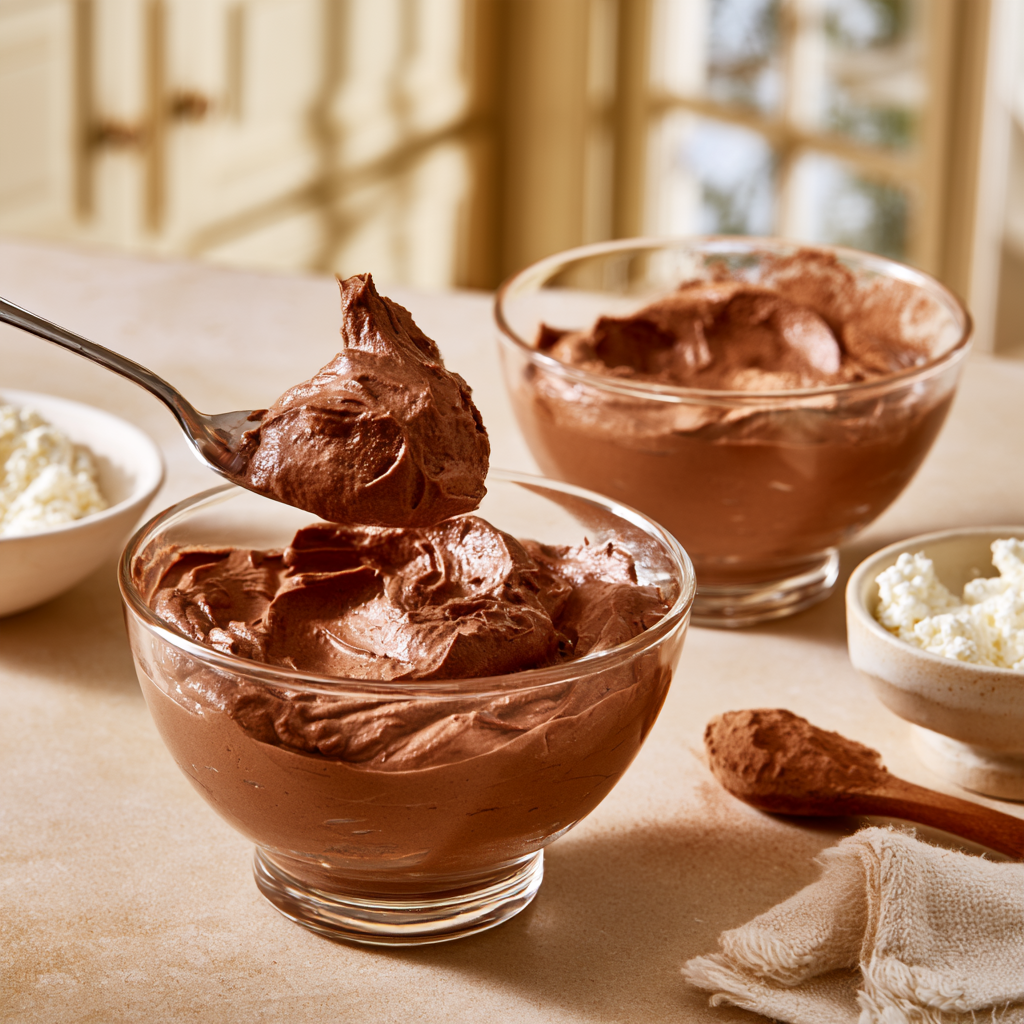
Cottage Cheese Chocolate Mousse vs. Traditional Chocolate Mousse
| Nutritional characteristic | Cottage cheese chocolate mousse | Traditional chocolate mousse |
|---|---|---|
| Main creamy ingredient | Blended cottage cheese | Often heavy cream and/or eggs |
| Protein | Often relatively high | Depends on eggs and cream |
| Saturated fat | Can be lower with low-fat cottage cheese | Often higher when rich in cream or butter |
| Added sugar | Adjustable | Depends on the recipe |
| Calcium | Contributed by dairy | Depends on ingredients |
| Texture | Smooth, creamy, sometimes pudding-like | Light, airy, and foam-like |
| Eggs | Usually not needed | Often included |
| Preparation | Blender or food processor | Whipping and folding may be required |
| Baking | Not required | Not usually required |
| Main advantage | Protein-rich simplicity | Delicate, traditional mousse texture |
Neither version is automatically superior for everyone.
Traditional mousse can be enjoyed as part of a balanced diet, while cottage cheese mousse provides an alternative when you want a simpler dessert with more protein and potentially less saturated fat.
Is Cottage Cheese Chocolate Mousse Good for Weight Management?
Cottage cheese chocolate mousse can fit into a weight-conscious eating pattern when portion sizes and ingredients are appropriate.
Its protein content may contribute to fullness, and using low-fat cottage cheese can reduce the amount of fat compared with some cream-heavy desserts.
However, the mousse does not directly burn fat or cause weight loss.
A dessert’s role in weight management depends on its energy content and how it fits into a person’s overall eating pattern.
Sweeteners, chocolate chips, nut butter, and generous toppings can significantly increase calories.
For a lighter version, use a moderate portion, measure sweetener carefully, and finish with berries instead of a large quantity of chocolate or nuts.
The goal is to create a dessert you genuinely enjoy while keeping portions consistent with your needs.
Is Cottage Cheese Chocolate Mousse Good for Muscle Recovery?
Cottage cheese provides complete protein containing essential amino acids.
Protein contributes to the maintenance and repair of body tissues, including skeletal muscle.
This makes a cottage cheese-based dessert a convenient way to add protein to an eating pattern that supports regular physical activity.
However, the amount of protein needed after exercise varies according to body size, activity, and overall daily intake.
A small serving of mousse may provide a useful contribution, but it is not necessarily sufficient as a complete post-workout meal.
It can be enjoyed alongside other appropriate foods or as a separate dessert.
Its main advantage is convenience rather than any unique muscle-building property.
Does Cottage Cheese Chocolate Mousse Contain Probiotics?
Not necessarily.
Although cottage cheese is a fermented dairy product in some manufacturing processes, commercially available cottage cheese does not always contain live probiotic cultures in meaningful quantities.
Some brands specifically include live and active cultures.
Others do not.
Even when live cultures are present, they should not automatically be described as proven probiotics unless the microorganisms and their demonstrated health effects meet the relevant criteria.
If probiotic content matters to you, check the product label for information about live cultures.
Do not assume that every cottage cheese chocolate mousse provides probiotic benefits.
Can People With Diabetes Eat Cottage Cheese Chocolate Mousse?
People managing diabetes may be able to include cottage cheese chocolate mousse in an individualized eating plan, but the recipe is not automatically suitable for everyone.
Cottage cheese contributes protein, while unsweetened cocoa powder adds relatively little sugar.
However, honey and maple syrup contribute carbohydrates that can affect blood glucose.
The total carbohydrate content depends on the quantities used.
For anyone monitoring carbohydrate intake, the most useful approach is to calculate the actual amount per portion using ingredient labels.
Some people may prefer less sweetener or a suitable alternative, but changes should be consistent with personal dietary needs.
A healthcare professional or registered dietitian can provide individualized guidance when necessary.
8 Practical Ways to Make Cottage Cheese Chocolate Mousse More Nutritious
| Adjustment | Practical benefit | Recommended approach |
|---|---|---|
| Choose protein-rich cottage cheese | Supports a higher-protein dessert | Check protein content per serving |
| Use unsweetened cocoa powder | Provides chocolate flavor without added sugar | Adjust cocoa gradually |
| Measure maple syrup or honey | Controls added sugar | Start with a modest amount |
| Add fresh raspberries | Introduces fiber and vitamin C | Use as a topping |
| Add strawberries | Adds freshness and natural sweetness | Slice just before serving |
| Sprinkle chopped almonds or walnuts | Adds unsaturated fats and crunch | Use a small portion |
| Choose lower-sodium cottage cheese if needed | Helps reduce sodium intake | Compare nutrition labels |
| Portion into small dessert cups | Makes serving sizes easier to manage | Refrigerate in covered containers |
Important Considerations Before Making This Dessert
Despite its nutritional advantages, cottage cheese chocolate mousse is not suitable for every dietary need.
Milk allergy: The recipe contains dairy proteins and should be avoided by people with a milk allergy.
Lactose intolerance: Cottage cheese contains lactose, although individual tolerance varies. Lactose-free cottage cheese may be appropriate where available.
Sodium: Some cottage cheese products contain considerable sodium. People monitoring sodium intake should compare product labels.
Added sugar: Honey and maple syrup count toward added sugar intake, even though they are natural ingredients.
Cocoa sensitivity: Cocoa contains small amounts of caffeine and theobromine, which may matter to sensitive individuals.
Food safety: Since the recipe uses fresh dairy, refrigerate the mousse at 40°F (4°C) or below. Prepare it using clean equipment, avoid leaving it at room temperature for more than two hours, and generally consume refrigerated portions within 3–4 days.
Final Thoughts: Is Cottage Cheese Chocolate Mousse Recipe Healthy?
The Cottage Cheese Chocolate Mousse Recipe can be a nutritious and satisfying alternative to some traditional chocolate desserts, particularly when prepared with protein-rich cottage cheese, unsweetened cocoa powder, and a controlled amount of sweetener.
Its main advantages are its meaningful protein content, contribution of dairy minerals and vitamins, and flexibility in ingredient selection.
Cocoa adds rich chocolate flavor and naturally occurring plant compounds, while optional berries and nuts introduce additional nutrients and textures.
The dessert also offers a practical benefit: it is simple to prepare, requires no baking, and can be divided into individual portions.
However, it is important to maintain realistic expectations.
Cottage cheese chocolate mousse is still a dessert. Its nutritional profile depends on the ingredients, serving size, and toppings. It should not be presented as a treatment for disease, a guaranteed weight-loss food, or a substitute for balanced meals.
When prepared thoughtfully, it offers a delicious combination of creamy chocolate flavor and useful nutritional value.
OoohDelish Healthy Chocolate Secret: For an exceptionally creamy and protein-rich Cottage Cheese Chocolate Mousse Recipe, choose a smooth, good-quality cottage cheese and blend it thoroughly until no visible curds remain. Add unsweetened cocoa powder gradually, sweeten with a measured amount of maple syrup or honey, and use nonalcoholic vanilla flavoring to round out the chocolate taste. Chill the mousse before serving and finish with a few fresh raspberries or finely chopped almonds. The result is a satisfying, silky chocolate dessert made from simple, everyday ingredients.
OoohDelish Nutrition Disclaimer: This article provides general nutrition information and does not replace individualized medical or dietary advice. Nutritional values are estimates. The recipe contains dairy, and its suitability depends on individual needs, product ingredients, and serving sizes.
Research note (not for the article body): The claims about cocoa flavanols were checked against the NIH and FDA, which emphasize that evidence for specific cardiovascular benefits is limited and that ordinary cocoa powder cannot be assumed to provide the effects seen in high-flavanol studies.
Why You Should Try This Cottage Cheese Chocolate Mousse Recipe: 12 Delicious Reasons You’ll Love It
If you’re a chocolate lover who wants a rich, creamy dessert without spending hours in the kitchen, this Cottage Cheese Chocolate Mousse Recipe deserves a place in your recipe collection. Imagine a spoonful of silky chocolate mousse with deep cocoa flavor, a smooth and velvety texture, and just the right amount of sweetness all made with simple ingredients you probably already have in your refrigerator and pantry.
What makes this easy Cottage Cheese Chocolate Mousse Recipe so appealing is its unexpected main ingredient: cottage cheese. Although cottage cheese is usually associated with savory meals, breakfast bowls, and protein-rich snacks, blending it with unsweetened cocoa powder, maple syrup or honey, and a little vanilla transforms it into a delicious chocolate dessert. The familiar curds disappear when blended thoroughly, leaving a thick, creamy mixture that resembles chocolate pudding or a dense, mousse-inspired dessert.
Unlike traditional French chocolate mousse, which often requires melted chocolate, whipped cream, and carefully beaten egg whites, this version is incredibly straightforward. You don’t need an oven, special pastry techniques, or raw eggs. Just blend, taste, chill, and enjoy.
Better still, cottage cheese naturally contributes protein, making this dessert a practical alternative to some cream-heavy chocolate recipes. You can customize the sweetness, choose your favorite cocoa powder, and add toppings such as fresh raspberries, strawberries, dark chocolate shavings, or chopped almonds.
Whether you’re searching for a high-protein chocolate dessert, an easy no-bake treat, or a simple way to satisfy chocolate cravings, here are 12 excellent reasons to try this homemade cottage cheese chocolate mousse.
1. It’s Surprisingly Rich, Creamy, and Chocolaty
The first reason to try this Cottage Cheese Chocolate Mousse Recipe is its wonderfully creamy texture.
Cottage cheese may not sound like an obvious ingredient for chocolate mousse. After all, its recognizable curds and slightly tangy flavor are quite different from the smooth, airy texture of a classic French dessert.
However, blending changes its consistency dramatically.
When cottage cheese is processed in a high-speed blender or food processor, the individual curds break down into a smooth dairy mixture. Adding cocoa powder creates a rich chocolate color and flavor, while a little maple syrup or honey balances the cocoa’s natural bitterness.
The result is a dessert that feels creamy and indulgent despite its simple ingredients.
The texture is generally thicker and denser than traditional whipped chocolate mousse, but that is part of its appeal. It can resemble a luxurious chocolate pudding with a mousse-like finish.
For the smoothest possible consistency, blend the cottage cheese thoroughly and scrape down the sides of the blender as necessary.
You can also chill the mixture before serving, allowing it to become colder and slightly firmer.
Why you’ll love it: Every spoonful delivers rich chocolate flavor and a velvety consistency without requiring heavy cream or complicated dessert techniques.
2. It’s Naturally High in Protein Compared With Many Traditional Mousses
One of the biggest advantages of this healthy Cottage Cheese Chocolate Mousse Recipe is its protein content.
Cottage cheese naturally contains dairy protein, including casein and whey proteins. These provide essential amino acids that support normal tissue maintenance and other physiological functions.
Many traditional chocolate mousse recipes rely primarily on heavy cream, chocolate, and sugar. While delicious, those ingredients may provide relatively little protein compared with the amount of energy in the finished dessert.
Using cottage cheese changes that balance.
For example, a recipe prepared with approximately 450 g of protein-rich cottage cheese and divided into four portions may provide around 12–15 g of protein per serving, depending on the brand and additional ingredients.
This makes the mousse a convenient choice for anyone interested in desserts that contribute more protein.
It can also be useful when you want a satisfying afternoon snack or a small chocolate dessert after dinner.
However, protein content depends on your cottage cheese, portion size, and recipe proportions. Check the product’s nutrition label to determine the actual amount.
Why you’ll love it: You can satisfy a chocolate craving while enjoying a meaningful contribution of protein from the cottage cheese.
3. You Only Need a Handful of Simple Ingredients
Another reason this easy Cottage Cheese Chocolate Mousse Recipe is worth making is its wonderfully short ingredient list.
You don’t need expensive chocolate, specialty baking ingredients, or complicated flavorings.
Most versions begin with four everyday ingredients.
| Ingredient | Why it works |
|---|---|
| Cottage cheese | Creates the creamy base and contributes dairy protein |
| Unsweetened cocoa powder | Gives the mousse its deep chocolate flavor and color |
| Maple syrup or honey | Balances the cocoa’s bitterness with sweetness |
| Vanilla flavoring | Adds warmth and rounds out the chocolate taste |
| Pinch of salt (optional) | Enhances the perception of chocolate flavor |
For a basic recipe, these ingredients are enough to make a delicious dessert.
There’s no need to melt chocolate over a double boiler, separate eggs, or carefully fold whipped cream into a delicate mixture.
You simply measure the ingredients, place them in a blender, and process until smooth.
Another benefit of using familiar ingredients is that substitutions are relatively easy.
You can choose low-fat or full-fat cottage cheese, adjust the sweetener, or use natural versus Dutch-process cocoa powder.
The final consistency and flavor may change slightly, but the basic method remains uncomplicated.
Why you’ll love it: Four main ingredients can create a rich homemade chocolate dessert without a lengthy shopping list.
4. No Baking, No Raw Eggs, and No Complicated Techniques
Traditional chocolate mousse can be a beautiful dessert, but preparing it often involves several steps.
Depending on the recipe, you may need to melt chocolate, whip egg whites, beat cream, control ingredient temperatures, and fold everything together carefully.
The goal is to incorporate air without deflating the mixture.
Those techniques can be rewarding, but they also require time and attention.
This homemade Cottage Cheese Chocolate Mousse Recipe takes a much simpler approach.
The blender performs nearly all the work.
Add cottage cheese, cocoa powder, sweetener, and vanilla, then blend until the mixture becomes completely smooth.
If the mousse looks grainy, blend for longer rather than immediately adding extra liquid.
Once smooth, transfer it into serving cups and refrigerate.
There is no baking involved, and the basic formulation doesn’t require raw eggs.
This makes the recipe approachable for beginners and convenient for busy households.
It’s also helpful during hot weather when you don’t want to heat your kitchen with an oven.
Why you’ll love it: You can prepare an impressive chocolate dessert without traditional mousse-making techniques or any baking.
5. It’s Ready to Blend in Just Five Minutes
Some homemade desserts require hours of preparation before they’re ready to chill.
This recipe is different.
Once your ingredients are measured, the active preparation can take approximately five minutes.
The general process is simple:
- Add the cottage cheese to a blender.
- Add unsweetened cocoa powder, sweetener, and vanilla.
- Blend until the mixture is smooth and creamy.
- Taste and adjust the chocolate flavor or sweetness.
- Spoon into dessert glasses and refrigerate until pleasantly chilled.
The mousse can be eaten immediately after blending, but chilling for approximately 30–60 minutes often improves the serving temperature and may help it firm slightly.
This makes it ideal for last-minute dessert preparation.
If unexpected guests arrive or you want a quick chocolate treat after dinner, you can prepare the mixture without planning hours ahead.
The short preparation time also makes it easy to prepare several individual portions at once.
Why you’ll love it: Just a few minutes of blending creates a homemade chocolate dessert with minimal effort and cleanup.

6. You Can Control the Sweetness and Chocolate Intensity
One of the most satisfying aspects of making your own cottage cheese chocolate mousse is being able to customize its flavor.
Some people prefer a deeply chocolaty dessert with only a little sweetness.
Others enjoy a sweeter, milk-chocolate-style flavor.
With this recipe, you can adjust both.
Unsweetened cocoa powder provides the chocolate base, while maple syrup or honey balances its bitterness.
Start with the amount recommended in your recipe, blend thoroughly, and taste.
If the flavor seems too bitter, add a little more sweetener.
If the cocoa flavor feels too mild, add a small amount of cocoa powder and blend again.
For an especially smooth chocolate profile, Dutch-process cocoa powder can be a good choice because it often has a mellower taste than natural cocoa powder.
However, both types work in a no-bake recipe.
You can also use a tiny pinch of salt to make the chocolate flavor more pronounced.
Remember that honey and maple syrup both contribute added sugars, even though they are often described as natural sweeteners.
Why you’ll love it: You’re in control of how dark, sweet, and intense your homemade chocolate mousse tastes.
7. It’s a Delicious Way to Enjoy Cottage Cheese Differently
Cottage cheese has a distinctive appearance and texture that not everyone enjoys.
Some people love its soft curds and slightly tangy flavor, while others find those qualities less appealing.
This Cottage Cheese Chocolate Mousse Recipe offers an entirely different way to experience the ingredient.
Instead of eating cottage cheese as visible curds, you blend it until smooth.
The familiar texture disappears, and the cocoa transforms its appearance into a rich chocolate cream.
The natural tanginess may still be noticeable depending on the brand and amount of sweetener, but it is usually much less prominent when balanced with cocoa and vanilla.
This transformation can be especially appealing for people who want to include cottage cheese in their diet but don’t enjoy eating it straight from the container.
It also demonstrates how versatile fresh dairy ingredients can be.
Cottage cheese isn’t limited to salads, toast, or savory dishes.
With the right preparation, it becomes a dessert base that works beautifully with chocolate, fruit, nuts, and other flavorings.
Why you’ll love it: You can enjoy the nutritional qualities of cottage cheese in a completely different form, with creamy chocolate flavor replacing its familiar curd-like texture.
8. It’s Easy to Customize With Delicious Toppings
A basic cottage cheese chocolate mousse is delicious on its own, but toppings make it even more enjoyable.
Because the mousse has a thick, creamy texture, it pairs especially well with ingredients that introduce freshness, crunch, or contrasting flavors.
Fresh Raspberry Chocolate Mousse: Add a handful of fresh raspberries for a tart contrast to the chocolate. Their bright color makes the dessert especially attractive.
Chocolate Strawberry Mousse: Top the mousse with sliced strawberries for natural sweetness and a refreshing finish. Add the fruit shortly before serving.
Chocolate Almond Crunch: Sprinkle finely chopped almonds over the mousse for a nutty flavor and crunchy texture that contrasts with the smooth chocolate base.
Double Chocolate Mousse: Finish with a few dark chocolate shavings or a light dusting of cocoa powder for a more intense chocolate presentation.
Other delicious possibilities include chopped walnuts, toasted coconut flakes, a spoonful of peanut butter, or a small pinch of cinnamon.
For a coffee-inspired variation, a little instant coffee powder can make the chocolate flavor taste deeper and more complex.
Keep toppings reasonably modest so they complement the mousse rather than overwhelm it.
Why you’ll love it: One basic recipe becomes a variety of exciting chocolate desserts with simple changes to the toppings.
9. It’s Perfect for Meal Prep and Individual Dessert Cups
If you enjoy preparing food in advance, cottage cheese chocolate mousse is an excellent dessert to portion ahead of time.
Because the preparation involves blending rather than baking, it’s easy to make several servings at once.
After blending the mixture, divide it evenly between small glass jars or dessert cups.
Cover each container and refrigerate promptly.
This makes serving convenient because you don’t need to scoop from a large bowl every time you want dessert.
Individual portions also help you keep serving sizes consistent.
For best quality, store the mousse at 40°F (4°C) or below and generally enjoy it within three to four days, provided the cottage cheese was fresh and within its safe storage period when used.
Keep toppings such as fresh berries, chopped nuts, and chocolate shavings separate until serving if you want to preserve their texture.
Because the mousse contains fresh dairy, it should not be left unrefrigerated for extended periods.
Freezing is possible, but the mixture may separate or become grainy after thawing.
Why you’ll love it: You can prepare several delicious chocolate desserts in advance and keep them ready in the refrigerator for convenient serving.
10. It’s a Beginner-Friendly Dessert That Looks Impressive
Some desserts look beautiful but require considerable preparation.
This Cottage Cheese Chocolate Mousse Recipe offers an easier approach.
Although it uses only a few basic ingredients, the finished mousse can look attractive when served in small glass cups or bowls.
The rich chocolate color creates a beautiful contrast with fresh red berries, white chocolate shavings, or chopped nuts.
A simple dessert glass can turn the mixture into something that looks appropriate for a dinner party or special occasion.
For an elegant presentation, spoon the mousse into small clear glasses and smooth the top with the back of a spoon.
If you want a slightly more polished finish, transfer the mixture into a piping bag and pipe it into the glasses.
However, piping is entirely optional.
The most important detail is achieving a smooth consistency before serving.
A grainy mousse won’t have the same appeal, so take the time to blend thoroughly.
After chilling, finish each portion with a simple garnish.
Why you’ll love it: You can make a beautiful homemade chocolate dessert that looks special without needing professional baking or pastry skills.
11. It’s a Versatile Dessert for Different Occasions
Another reason to love this easy Cottage Cheese Chocolate Mousse Recipe is its versatility.
It’s simple enough for an ordinary afternoon snack but attractive enough for entertaining guests.
For busy weekdays, serve it in a small bowl with a few sliced strawberries.
For a weekend family dinner, portion it into individual glasses and add dark chocolate shavings.
For Valentine’s Day, finish each serving with fresh raspberries or heart-shaped strawberry slices.
For a birthday dinner, garnish with a little grated chocolate and chopped nuts.
The basic recipe also works well when you need a no-bake dessert during warm weather.
You don’t have to use an oven, and the chilled texture feels refreshing after a meal.
If you’re planning a larger gathering, prepare the mousse in advance and add the toppings shortly before serving.
Its short ingredient list makes scaling the recipe straightforward.
Just ensure your blender is large enough to process the increased quantity smoothly.
Why you’ll love it: The same simple chocolate mousse can work for everyday treats, family dinners, holidays, and casual celebrations.
12. It Satisfies Chocolate Cravings Without Requiring a Heavy Dessert
Perhaps the best reason to try this Cottage Cheese Chocolate Mousse Recipe is that it delivers rich chocolate flavor in a relatively simple dessert.
Sometimes you want something chocolaty after dinner but don’t feel like preparing a cake, brownies, or a complicated pastry.
This mousse offers another option.
The cocoa powder gives the dessert its deep chocolate taste, while the blended cottage cheese creates a satisfying creamy base.
You can choose a smaller portion when you want just a few spoonfuls or serve it with fruit for a more substantial treat.
Unlike traditional mousse recipes made with generous amounts of heavy cream and butter, a version prepared with low-fat cottage cheese can contain less saturated fat.
However, the comparison depends on the exact recipes, and cottage cheese mousse isn’t automatically lower in calories or sugar.
The most useful advantage is the flexibility.
You can adjust sweetness, control serving size, and choose toppings that suit your preferences.
This allows you to enjoy chocolate flavor without needing an elaborate dessert every time.
Why you’ll love it: You get a rich and satisfying chocolate treat with simple preparation, flexible ingredients, and an easy-to-control portion size.
What Makes This OoohDelish Cottage Cheese Chocolate Mousse Recipe Special?
| Feature | Why you’ll love it |
|---|---|
| Rich chocolate flavor | Unsweetened cocoa creates a deep chocolate taste |
| Smooth and creamy | Thoroughly blended cottage cheese creates a velvety base |
| Protein-rich | Cottage cheese contributes complete dairy protein |
| No baking required | No oven or baking equipment needed |
| Quick preparation | Approximately 5 minutes of active work |
| Only a few ingredients | Cottage cheese, cocoa, sweetener, and vanilla |
| No raw eggs | The basic recipe doesn’t need eggs |
| Adjustable sweetness | Sweeten gradually according to preference |
| Easy variations | Add berries, nuts, chocolate shavings, or coffee |
| Great for meal prep | Portion into individual covered dessert cups |
| Beginner-friendly | Blend, taste, chill, and serve |
| Suitable for entertaining | Beautiful presentation with minimal effort |
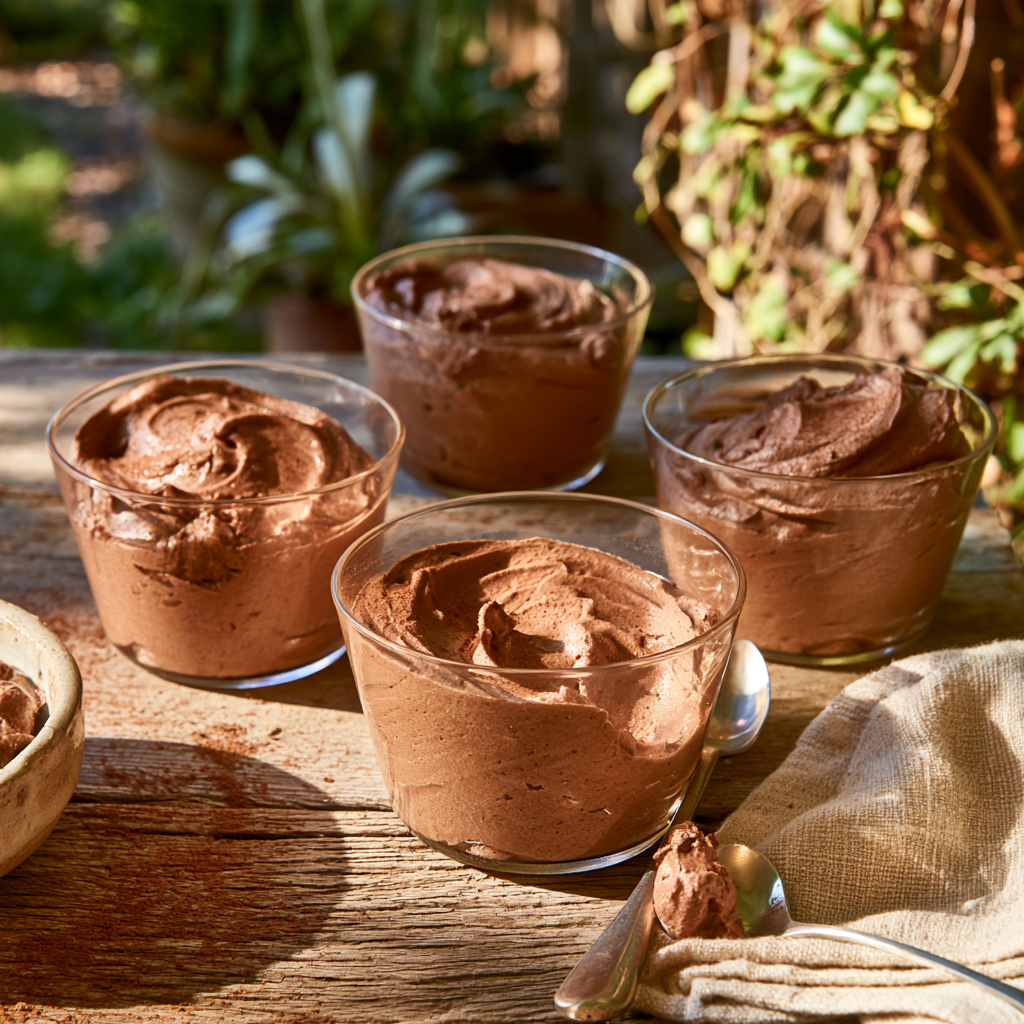
Expert Tips for Making the Best Cottage Cheese Chocolate Mousse Recipe
Even though this dessert is remarkably simple, several small details can make the difference between a grainy chocolate mixture and a smooth, creamy mousse.
Choose the Right Cottage Cheese
The cottage cheese you select has a significant effect on the finished texture.
Small-curd cottage cheese can be convenient, but either small- or large-curd varieties can work if your blender is powerful enough.
A creamy cottage cheese often produces a richer mouthfeel than a very dry, low-fat variety.
If you prefer a lighter dessert, choose low-fat cottage cheese, but remember that extremely lean varieties can sometimes need more blending to become smooth.
Check the ingredient label and select a product with a flavor you enjoy.
Because cottage cheese is the main ingredient, its tanginess and saltiness will influence the final dessert.
Blend Until Absolutely Smooth
The most important technique for this recipe is thorough blending.
Cottage cheese contains visible curds, which need to break down completely to create a smooth consistency.
Place the cottage cheese in a high-speed blender or food processor and blend until the mixture begins to look creamy.
Add the cocoa powder, sweetener, and vanilla, then continue blending.
Stop occasionally to scrape down the sides of the container.
If you still see tiny white flecks or feel a grainy texture, continue processing.
Avoid adding excessive water or milk to speed up blending because this can make the finished mousse too thin.
Use High-Quality Unsweetened Cocoa Powder
Cocoa powder provides most of the chocolate flavor, so its quality matters.
Choose unsweetened cocoa powder rather than a sweetened hot chocolate mix.
Natural cocoa powder generally has a more pronounced, slightly acidic flavor.
Dutch-process cocoa powder often tastes smoother and produces a darker color.
Either option works for this no-bake dessert because there is no chemical leavening reaction to consider.
Start with the quantity specified in your recipe and taste before adding more.
Too much cocoa can create excessive bitterness or a dry, chalky finish.
Adjust Sweetness Gradually
Rather than adding a large amount of sweetener immediately, begin with a modest quantity.
Blend the mixture, taste it, and add a little more sweetener only if needed.
The ideal sweetness depends on your cocoa powder, cottage cheese, and personal preferences.
A mousse made with natural cocoa may require a different sweetener balance than one made with Dutch-process cocoa.
Remember that honey and maple syrup are both sources of added sugar.
Add a Little Vanilla for Better Flavor
Vanilla complements chocolate particularly well because it adds warmth and rounds out the cocoa’s bitterness.
A small amount is usually sufficient.
For a recipe made with approximately 2 cups of cottage cheese, a little vanilla flavoring can make the dessert taste more balanced.
Use a nonalcoholic vanilla flavoring if avoiding alcohol-based ingredients.
You can also add a very small pinch of salt, although cottage cheese may already contain substantial sodium.
Taste before adding extra salt.
Chill Before Serving
Although cottage cheese chocolate mousse can be eaten immediately after blending, chilling often improves the experience.
Transfer the smooth mixture into dessert glasses, cover, and refrigerate for approximately 30–60 minutes.
This allows the dessert to become pleasantly cold and may help it firm slightly.
The final texture depends on the ingredients.
Some mixtures remain soft and pudding-like, while others become thicker.
Do not expect every cottage cheese mousse to develop the same airy structure as traditional whipped mousse.
Avoid Adding Too Much Liquid
One common mistake is adding large amounts of milk or water when the cottage cheese is difficult to blend.
While a small splash may help certain blenders, excessive liquid can turn the mixture into a chocolate sauce.
Try stopping the blender and scraping down the sides before adding anything.
A compact food processor or blender cup can sometimes process smaller portions more effectively than a large blender pitcher.
If your mixture becomes too thin, additional chilling may help slightly, but it will not always restore a thick consistency.
Don’t Overload the Mousse With Cocoa
A deep chocolate flavor is desirable, but too much cocoa powder can overwhelm the mild dairy base.
Excess cocoa may create bitterness and a slightly chalky mouthfeel.
Start with a moderate quantity and increase gradually.
If you want a richer chocolate flavor, you can experiment with a little melted and cooled dark chocolate, but this will alter the recipe’s fat content, calories, and thickness.
For the simplest version, unsweetened cocoa powder is sufficient.
Add Toppings Immediately Before Serving
Fresh berries, chopped nuts, and chocolate shavings taste wonderful with this mousse.
However, some toppings release moisture or lose their texture during refrigeration.
Fresh strawberries can soften and release juice, while nuts may become less crisp after prolonged contact with the mousse.
For the best presentation, store the plain mousse in covered cups and add toppings just before serving.
Keep the Dessert Properly Refrigerated
Because cottage cheese chocolate mousse is made with fresh dairy, proper storage is important.
Use clean utensils and containers during preparation.
Refrigerate the mousse promptly and keep it at 40°F (4°C) or below.
For best quality, generally consume refrigerated portions within three to four days, provided all ingredients were fresh and safely stored.
Avoid leaving the mousse at room temperature for more than two hours, or more than one hour in very hot conditions.
If the mousse develops an unusual odor, visible mold, or other signs of spoilage, discard it.
Cottage Cheese Chocolate Mousse vs. Traditional Chocolate Mousse: Which Should You Try?
| Feature | Cottage Cheese Chocolate Mousse | Traditional Chocolate Mousse |
|---|---|---|
| Main creamy ingredient | Blended cottage cheese | Whipped cream and/or eggs |
| Chocolate ingredient | Usually cocoa powder | Often melted chocolate |
| Texture | Smooth, thick, and creamy | Light, airy, and delicate |
| Protein content | Often higher | Varies by recipe |
| Preparation | Blend ingredients together | May require whipping and folding |
| Raw eggs | Not needed | Used in some recipes |
| Oven | Not needed | Usually not needed |
| Hands-on preparation | Often around 5 minutes | Typically longer |
| Sweetness | Easily adjustable | Depends on chocolate and sugar |
| Main appeal | Simplicity and protein-rich creaminess | Classic French mousse texture |
Both desserts are worth enjoying for different reasons.
Traditional mousse is ideal when you want the delicate, aerated texture associated with French patisserie.
Cottage cheese mousse is a practical alternative when you want something quicker, thicker, and rich in dairy protein.
The choice depends on your preferred texture, nutritional priorities, and the ingredients you have available.
5 Delicious Ways to Serve Cottage Cheese Chocolate Mousse
1. Classic Chocolate Dessert Cup: Serve chilled in a small glass with a light dusting of cocoa powder for an easy, elegant finish.
2. Chocolate Strawberry Parfait: Layer the mousse with fresh strawberry slices just before serving for a colorful, refreshing dessert.
3. Chocolate Walnut Crunch: Sprinkle a few finely chopped walnuts over the mousse for a rich, nutty contrast.
4. Mocha Chocolate Mousse: Blend in a small amount of instant coffee powder for a deeper, café-inspired chocolate flavor.
5. Chocolate Peanut Butter Mousse: Add a little smooth peanut butter for a creamy, nutty variation with extra richness.
Common Mistakes to Avoid When Making Cottage Cheese Chocolate Mousse
| Common mistake | What happens | How to fix it |
|---|---|---|
| Not blending long enough | Grainy texture with visible curds | Blend longer, stopping to scrape the sides |
| Adding too much cocoa | Bitter or chalky mousse | Start with less and adjust gradually |
| Adding too much liquid | Thin, runny consistency | Avoid unnecessary milk or water |
| Choosing very salty cottage cheese | Noticeable savory aftertaste | Compare brands and taste before preparing |
| Adding too much sweetener | Overly sweet dessert | Sweeten gradually |
| Skipping chilling | Softer texture and less refreshing temperature | Refrigerate for 30–60 minutes |
| Adding wet fruit too early | Extra liquid collects in dessert cups | Add berries just before serving |
| Using a blender too large for the batch | Ingredients remain below the blades | Use a smaller blender jar or food processor |
| Expecting traditional airy mousse | Texture seems denser than anticipated | Understand that blended cottage cheese creates a creamy mousse-inspired dessert |
Is Cottage Cheese Chocolate Mousse Worth Making?
Absolutely, especially if you enjoy chocolate desserts and appreciate recipes that are easy to prepare with familiar ingredients.
The combination of blended cottage cheese, cocoa powder, sweetener, and vanilla produces a creamy treat without complicated pastry techniques.
Its protein content makes it distinctive, while its customizable flavor allows you to experiment with different cocoa varieties, berries, nuts, and other toppings.
The recipe is particularly appealing for people who want an easy no-bake dessert that can be prepared ahead of time and served in individual portions.
However, its greatest strength isn’t simply that it contains protein.
It’s that it transforms a familiar ingredient into a chocolate dessert that feels satisfying, tastes delicious, and requires very little effort.
Final Thoughts: Why You’ll Love This Cottage Cheese Chocolate Mousse Recipe
This Cottage Cheese Chocolate Mousse Recipe proves that a delicious chocolate dessert doesn’t need a complicated ingredient list or hours of preparation.
With only a handful of everyday ingredients, you can create a smooth, rich, and creamy mousse-inspired treat that combines deep cocoa flavor with the natural protein content of cottage cheese.
The recipe is easy to customize, requires no baking, and works beautifully for individual servings, family desserts, or simple meal preparation.
Whether you prefer your mousse topped with raspberries, dark chocolate shavings, chopped almonds, or nothing at all, the basic chocolate mixture provides a delicious starting point.
It’s also a creative way to enjoy cottage cheese beyond its usual savory applications.
OoohDelish Chocolate Secret: For the creamiest Cottage Cheese Chocolate Mousse Recipe, blend the cottage cheese by itself first until the curds disappear, then add unsweetened cocoa powder, maple syrup or honey, and nonalcoholic vanilla flavoring. Continue blending until the mixture looks silky and uniform, tasting before adding extra sweetener or cocoa. Refrigerate for at least 30 minutes, then finish with fresh raspberries or a few dark chocolate shavings. The secret is not adding more ingredients it’s achieving a beautifully smooth texture and the right balance between rich chocolate flavor and gentle sweetness.
Frequently Asked Questions About Cottage Cheese Chocolate Mousse Recipe
Wondering how to make cottage cheese chocolate mousse taste rich, silky, and delicious without a grainy texture? These practical answers cover choosing the best cottage cheese, getting a smooth chocolate finish, fixing watery mousse, adjusting sweetness, adding protein, chilling, and safe storage. Discover how to turn simple ingredients into a creamy homemade chocolate dessert.
1. What is cottage cheese chocolate mousse?
Cottage cheese chocolate mousse is a creamy, no-bake dessert made by blending cottage cheese with chocolate ingredients and a sweetener. Unlike traditional chocolate mousse, which often relies on whipped cream or whipped eggs, this modern version gets much of its creamy texture from blended cottage cheese. It has a rich chocolate flavor and can provide more protein than many conventional mousse recipes. The finished texture is usually dense, smooth, and pudding-like rather than highly airy.
2. What ingredients do you need for cottage cheese chocolate mousse?
Most versions use cottage cheese, unsweetened cocoa powder or melted chocolate, and a sweetener such as maple syrup or honey. Vanilla extract and a tiny pinch of salt are common optional additions that can enhance the chocolate flavor. Some recipes combine cocoa powder and melted chocolate for a more intense result. The exact ingredients depend on your preferred sweetness and texture, so follow the proportions in your chosen recipe rather than combining different formulas.
3. What kind of cottage cheese works best for chocolate mousse?
Full-fat cottage cheese, usually around 4% milkfat, is a good choice when you want a rich, creamy mousse. It blends into a smooth base and usually gives a fuller mouthfeel than fat-free varieties. However, 2% cottage cheese can also produce excellent results. Choose a fresh, mild-tasting product and check the container for excessive liquid. If a large amount of whey has separated, pour off the excess before blending. This can help prevent runny mousse.
4. How do you make cottage cheese mousse completely smooth?
The secret is blending the cottage cheese thoroughly before serving. Use a high-speed blender or food processor and process until the curds are no longer visible. Stop occasionally to scrape down the sides so everything blends evenly. Depending on the appliance, this may take approximately 1–2 minutes or longer. Add only the liquid your recipe requires, since too much can thin the mousse. A properly blended mixture should look glossy and creamy, without noticeable cottage cheese lumps.
5. Does cottage cheese chocolate mousse taste like cottage cheese?
When blended properly, cottage cheese usually contributes a mild dairy tang rather than a pronounced cheese flavor. Cocoa powder, chocolate, vanilla, and sweetener help create the familiar taste of chocolate dessert. Full-fat cottage cheese often tastes creamier, while some brands have a saltier or tangier flavor than others. If you’re sensitive to the taste, start with a mild cottage cheese and adjust the chocolate and sweetness according to your recipe. Chilling can also help the flavors become more balanced.
6. Is cocoa powder or melted chocolate better for this mousse?
Both ingredients work, but they create different results. Unsweetened cocoa powder adds strong chocolate flavor without much additional fat or sugar, while melted chocolate contributes cocoa butter, richness, and a firmer texture after chilling. Dark chocolate makes a more intense, less sweet dessert, while milk chocolate usually gives a sweeter flavor. If using melted chocolate, allow it to cool slightly before blending, but don’t let it harden. Use your recipe’s specified ingredient for consistent results.
7. Can I make cottage cheese chocolate mousse without a blender?
You can try using a food processor, which works well for creating a smooth mixture. However, stirring cottage cheese by hand usually won’t remove the curds completely. An immersion blender in a suitable narrow container can also work if it is powerful enough. For the smoothest dessert, blend the cottage cheese before adding other ingredients. If necessary, pass the blended mixture through a fine sieve to remove remaining small lumps.
8. Why is my cottage cheese chocolate mousse grainy or lumpy?
Graininess commonly occurs when the cottage cheese hasn’t been blended long enough or the appliance leaves small curds behind. Melted chocolate can also form small firm pieces if it cools too quickly when mixed with very cold ingredients. Blend the cottage cheese until completely smooth first, then incorporate chocolate according to the recipe. Scrape down the blender and check the texture before portioning. If the mousse is still lumpy, process it briefly again until evenly combined.
9. Why is my cottage cheese chocolate mousse too thin or runny?
A runny mousse usually contains too much liquid relative to its thickening ingredients. Some cottage cheese brands contain more loose whey than others, and adding extra milk, syrup, or other liquids can make the problem worse. Start with thick cottage cheese, drain obvious excess whey, and measure ingredients carefully. Refrigerating the mixture may help it firm up, particularly when it contains melted chocolate. Avoid adding more liquid simply to make the mixture easier to blend.
10. How can I thicken cottage cheese chocolate mousse without gelatin?
Chilling is the easiest first step, especially in recipes containing melted chocolate. Refrigerate the mousse in individual serving dishes until it develops a thicker consistency. If your formula uses only cocoa powder, the mousse may remain more pudding-like. A small amount of additional cocoa powder can sometimes help, but too much may produce bitterness or dryness. For a reliably firmer result, choose a recipe formulated with melted chocolate instead of adding random thickeners.
11. Can I make cottage cheese chocolate mousse without refined sugar?
Yes. Depending on the recipe, you can sweeten the mousse with maple syrup, honey, or another suitable sweetener. These ingredients provide different flavors, and their quantities may need adjustment. Maple syrup adds a gentle caramel note, while honey has its own distinctive taste. Remember that both still contribute added sugars, even though they aren’t refined white sugar. For a lower-sugar version, consider an appropriate alternative sweetener and unsweetened cocoa powder.
12. Is cottage cheese chocolate mousse healthy and high in protein?
Cottage cheese naturally provides protein, calcium, and several important nutrients, making it a useful ingredient in a protein-containing dessert. However, the actual protein content depends on the cottage cheese brand, recipe proportions, and serving size. Chocolate, sweeteners, and optional toppings can also contribute sugar, fat, and calories. This mousse can fit into a balanced eating pattern, but it shouldn’t automatically be considered low-calorie or low-sugar. Use the complete ingredient list to calculate accurate nutrition.
13. Is cottage cheese chocolate mousse gluten-free or keto-friendly?
Cottage cheese and unsweetened cocoa powder are naturally gluten-free, so many simple mousse recipes contain no gluten ingredients. However, check packaged chocolate, flavorings, and toppings for gluten-containing additives or cross-contact if serving someone with celiac disease. Keto suitability depends on total carbohydrates and serving size. Regular maple syrup, honey, and sweetened chocolate may make the mousse unsuitable for a strict ketogenic diet without significant recipe adjustments.
14. Can I make this chocolate mousse dairy-free or vegan?
Traditional cottage cheese contains dairy, so this mousse is not naturally dairy-free or vegan. You would need to replace the cottage cheese with a suitable plant-based ingredient and choose dairy-free chocolate and other compatible additions. However, substituting plant-based yogurt directly may produce a thinner texture and different protein content. For a dessert specifically designed without dairy, try our Vegan Chocolate Avocado Mousse Recipe , which uses avocado for creaminess.
15. How long should cottage cheese chocolate mousse chill, and how do you store it?
Cottage cheese chocolate mousse can often be enjoyed immediately after blending, but 30–60 minutes of refrigeration can improve its texture and allow the flavors to settle. Recipes using melted chocolate may become noticeably firmer as they cool. Store prepared mousse in covered containers at 40°F (4°C) or below and enjoy within approximately 3–4 days for best quality. Refrigerate promptly and never leave this perishable dairy dessert sitting out for extended periods.
16. Can you freeze cottage cheese chocolate mousse, and what toppings go best?
You can freeze this mousse in small, freezer-safe portions, but the texture may become grainy or watery after thawing because dairy can separate. For the smoothest consistency, refrigeration is usually preferable. If frozen, try enjoying it partially frozen as a chocolate dessert rather than expecting an identical freshly blended texture. Delicious toppings include raspberries, strawberries, shaved chocolate, toasted nuts, and a little whipped cream. For another cottage cheese treat, explore our Cottage Cheese Baked Oats Recipe .