

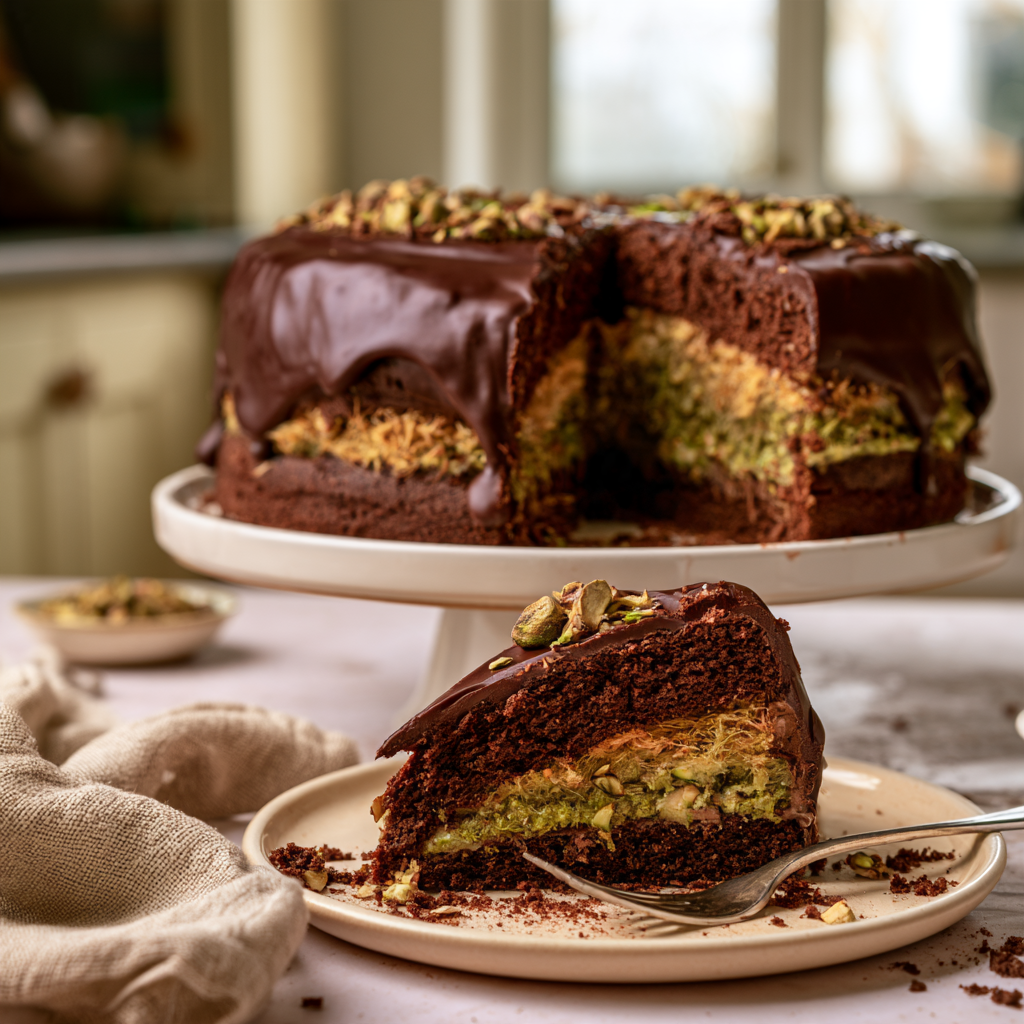
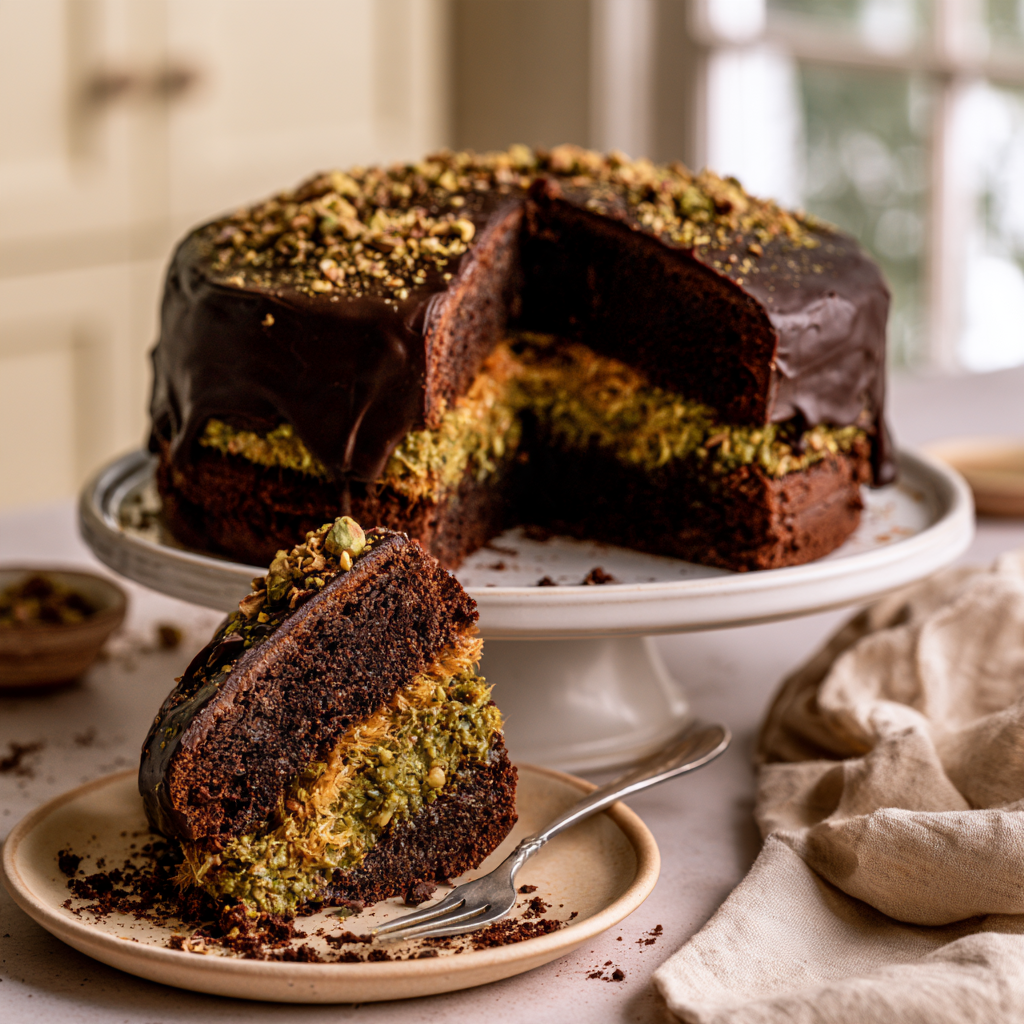
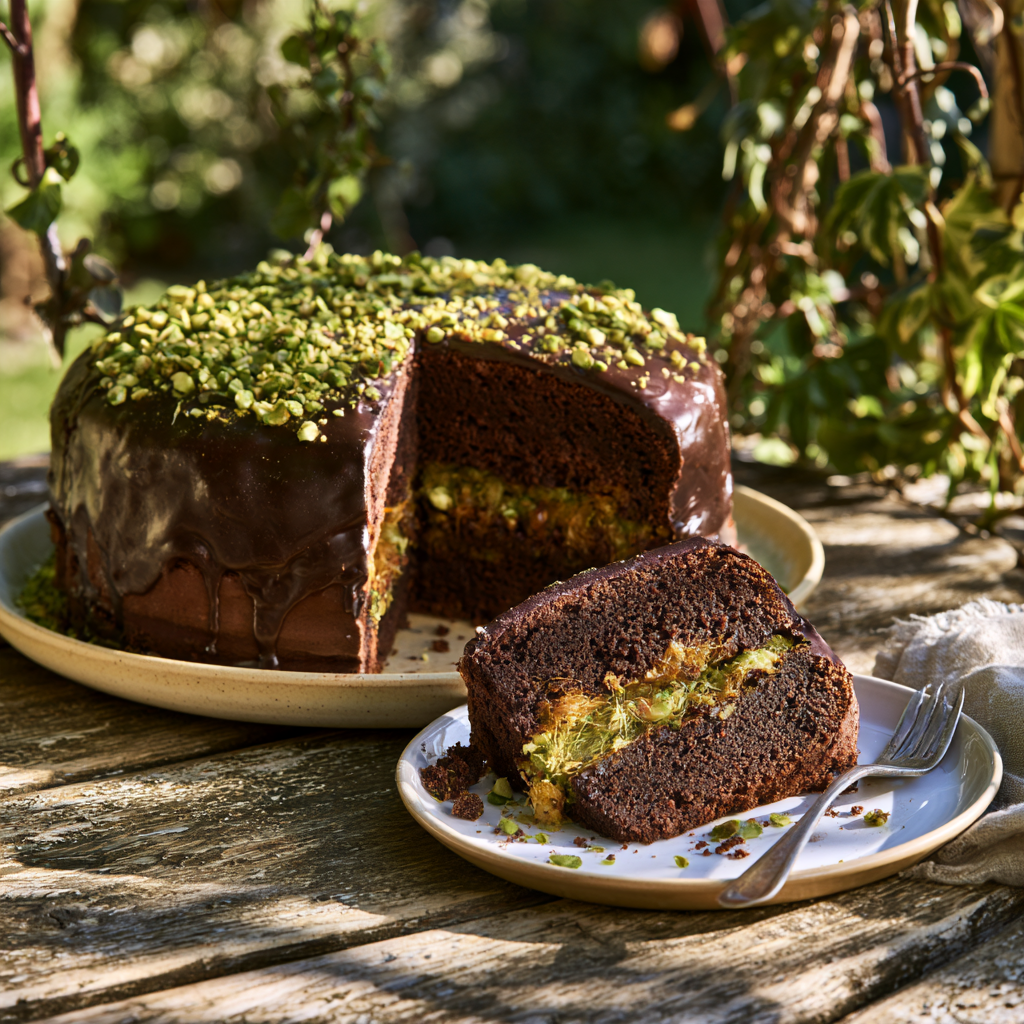
Imagine cutting into a beautifully moist chocolate cake and discovering a thick layer of silky pistachio cream filled with delicate, buttery, golden-crisp pastry. The rich chocolate melts gently on your tongue, the pistachio filling adds a wonderfully nutty sweetness, and the crunchy kataifi creates that satisfying contrast that makes you want another bite. That’s exactly what makes this Dubai Chocolate Cake Recipe so special! Inspired by the famous Dubai chocolate bar that captured the attention of dessert lovers around the world, this homemade cake combines soft chocolate sponge, creamy pistachio filling, crispy toasted kataifi, and a smooth chocolate ganache into one irresistible dessert. It looks impressive enough for a celebration, yet its individual components are surprisingly approachable when you prepare them step by step in your own kitchen.
If you’ve seen those viral chocolate bars filled with bright green pistachio cream and crunchy pastry, you’ve probably wondered what those delicious flavors would taste like in a cake. The answer is absolutely wonderful! This Dubai Chocolate Cake Recipe transforms the signature chocolate-and-pistachio combination into a rich, layered dessert that brings together three distinctly satisfying textures: fluffy, moist chocolate cake, smooth and creamy pistachio filling, and golden, crispy kataifi pastry. Rather than simply adding pistachio frosting to an ordinary chocolate cake, this recipe recreates the essential contrast that makes Dubai-inspired chocolate desserts so memorable. Every slice should reveal a generous pistachio layer nestled between chocolate cake layers, creating an inviting combination of deep cocoa flavor, sweet nuttiness, and delicate crunch.
Dubai Chocolate Cake Recipe
Equipment
- Two 8-inch (20 cm) round cake pans, preferably at least 2 inches deep
- Large mixing bowl
- Medium mixing bowl
- Whisk or electric hand mixer
- Digital kitchen scale
- Measuring cups and spoons
- Fine-mesh sieve
- Rubber spatula
- Wire cooling rack
- Wide nonstick skillet
- Wooden spoon or silicone spatula
- Small saucepan
- Heatproof bowl
- Offset spatula
- Piping bag with round tip or a sturdy food-safe bag
- Serrated knife or cake leveler
- Cake stand or serving plate
- Parchment paper
- Refrigerator
Ingredients
- 220 g 1 3/4 cups all-purpose flour
- 65 g approximately 3/4 cup natural unsweetened cocoa powder
- 275 g approximately 1 1/3 cups plus 1 tablespoon granulated sugar
- 1 1/2 teaspoons baking powder
- 1 teaspoon baking soda
- 1/2 teaspoon fine salt
- 2 large eggs room temperature
- 240 ml 1 cup buttermilk, room temperature
- 120 ml 1/2 cup neutral vegetable oil
- 2 teaspoons vanilla extract
- 180 ml 3/4 cup hot brewed coffee or hot water
Instructions
- Step 1: Prepare the Oven and Cake Pans. Preheat your oven to 350°F (175°C). Lightly grease two 8-inch (20 cm) round cake pans, preferably at least 2 inches deep, and line their bottoms with parchment paper. Lightly grease the parchment and dust the sides with a small amount of cocoa powder or flour, tapping out any excess. Proper pan preparation helps the delicate chocolate sponge release cleanly after baking. Arrange an oven rack near the center of the oven and allow the oven to preheat fully while preparing the batter. Gather all your ingredients and bring the eggs and buttermilk to room temperature for easier mixing. Using two equal-size pans will help create even chocolate cake layers that are easier to stack with the pistachio-kataifi filling.
- Step 2: Combine the Dry Chocolate Cake Ingredients. In a large mixing bowl, sift together 220 g all-purpose flour, 65 g natural unsweetened cocoa powder, 1 1/2 teaspoons baking powder, 1 teaspoon baking soda, and 1/2 teaspoon fine salt. Add 275 g granulated sugar and whisk everything thoroughly until the mixture looks uniform and no large cocoa lumps remain. Sifting the cocoa powder helps distribute it evenly throughout the batter, while whisking the dry ingredients ensures the leavening agents are properly dispersed. Use natural cocoa powder for this formulation because its acidity contributes to the reaction with baking soda. Avoid packing flour into measuring cups or adding extra flour, since too much can make the cake dense or dry.
- Step 3: Mix the Wet Ingredients. In a separate medium bowl, add 2 large eggs, 240 ml buttermilk, 120 ml neutral vegetable oil, and 2 teaspoons vanilla extract. Whisk until the eggs are fully incorporated and the mixture looks relatively smooth. The vegetable oil helps produce a soft, moist chocolate sponge, while the buttermilk contributes acidity and tenderness. If you do not have buttermilk, combine 225 ml milk with 15 ml lemon juice or white vinegar and let the mixture stand for approximately 10 minutes before using. This homemade substitute may behave slightly differently from cultured buttermilk but works as a practical alternative. Make sure the ingredients are properly combined before adding them to the dry mixture.
- Step 4: Prepare the Chocolate Cake Batter. Pour the wet ingredients into the bowl containing the flour, cocoa powder, sugar, and leavening ingredients. Mix gently with a whisk or electric mixer on low speed until the ingredients are just combined. Gradually add 180 ml hot brewed coffee or hot water while stirring carefully. The hot liquid helps the cocoa disperse and contributes to the batter’s deep chocolate flavor. Coffee can intensify the cocoa taste, but hot water is a suitable alternative if you prefer not to use coffee. The finished batter will be noticeably thinner than many traditional butter-based cake batters, which is normal for this recipe. Scrape the sides and bottom of the bowl to ensure everything is mixed evenly, but avoid prolonged mixing once the flour is fully incorporated.
- Step 5: Divide and Bake the Chocolate Cake Layers. Divide the prepared chocolate batter evenly between the two lined 8-inch cake pans. Gently tap each pan once or twice on the countertop to release unusually large trapped air bubbles without excessively disturbing the batter. Place the pans in the preheated oven and bake at 350°F (175°C) for approximately 28–35 minutes, or until a toothpick inserted near the center comes out with a few moist crumbs rather than wet batter. Baking time may vary according to your oven and the depth of the batter. Avoid repeatedly opening the oven door during the early baking stage because sudden temperature changes can affect the cake’s rise. Once baked, remove the pans from the oven and place them on a heat-resistant surface to begin cooling.
- Step 6: Cool the Chocolate Sponge Completely. Allow the baked cake layers to cool in their pans for approximately 15 minutes before carefully running a thin knife around the edges and turning them onto a wire cooling rack. Remove the parchment paper and leave the sponges to cool completely, typically another 60–75 minutes depending on room temperature. This cooling stage is extremely important because warm cake layers can soften the pistachio filling, melt the chocolate ganache, and cause the assembled cake to slide. Once the sponges have cooled, inspect their surfaces and use a serrated knife or cake leveler to trim any pronounced dome if necessary. Keep the layers intact and handle them gently so they remain moist and tender. Prepare the pistachio filling and chocolate ganache during this cooling period to make the recipe more efficient.
- Step 7: Prepare and Chop the Kataifi Pastry. Measure 150 g raw kataifi pastry and separate any tightly packed strands using clean hands. If the pastry was purchased frozen, thaw it according to the package instructions before preparation. Transfer the kataifi to a cutting board and chop it into shorter pieces, approximately 1–2 inches long, so the strands are easier to toast evenly and incorporate into the pistachio filling. Do not use ordinary uncooked dried pasta as a substitute because its texture and cooking properties are different. The purpose of the kataifi is to create the signature delicate, crispy texture associated with Dubai chocolate desserts. Keep the prepared pastry away from unnecessary moisture and have a wide skillet ready for the next step.
- Step 8: Toast the Kataifi Until Golden and Crispy. Place a wide nonstick skillet over medium-low to medium heat and melt 20 g unsalted butter. Add the chopped kataifi pastry and stir frequently with a wooden spoon or silicone spatula, gently separating any clumps as the strands begin to toast. Continue cooking for approximately 8–12 minutes, or until the pastry is evenly golden brown, dry, and crispy. Actual cooking time depends on your pan size, heat level, and the moisture content of the pastry. Avoid using excessively high heat because the delicate strands can burn before becoming uniformly crisp. Once the kataifi reaches a beautiful golden color, remove it from the heat and transfer it to a plate or shallow tray. Spread it out and allow it to cool completely before combining it with pistachio cream.
- Step 9: Prepare the Creamy Pistachio-Kataifi Filling. Place 320 g sweetened pistachio cream in a medium mixing bowl. Add 15 g tahini if desired, along with a small pinch of salt if the filling tastes overly sweet. Stir until the mixture is smooth and evenly combined. Add the completely cooled toasted kataifi and gently fold it into the pistachio cream using a spatula until the crisp pastry strands are evenly coated. The finished filling should be thick, creamy, and slightly textured, with enough consistency to spread without flowing freely. Avoid adding water, milk, or other unnecessary liquids because extra moisture can make the kataifi soften more quickly. If the pistachio cream is unusually firm, let it soften gently at room temperature before mixing rather than adding large amounts of liquid. Prepare this mixture relatively close to assembly for the best crunchy texture.
- Step 10: Make the Smooth Chocolate Ganache. Finely chop 350 g semi-sweet or dark chocolate and place it in a heatproof bowl. Pour 250 ml heavy whipping cream into a small saucepan and heat gently over medium-low heat until the cream is steaming and just beginning to show small bubbles around the edges, without allowing it to boil vigorously. Pour the hot cream evenly over the chopped chocolate and allow the mixture to stand undisturbed for approximately 2–3 minutes. Starting from the center, stir slowly with a spatula until the chocolate melts completely and the mixture becomes smooth, glossy, and uniform. If small pieces of chocolate remain, warm the bowl very gently and stir until smooth, taking care not to overheat or introduce excess water. Allow the ganache to cool until it becomes thick and spreadable, usually about 20–35 minutes depending on room temperature. Stir occasionally and avoid using the ganache while it is hot or runny.
- Step 11: Prepare the Cake Layers for Assembly. Once both chocolate sponge layers are completely cooled, place the first layer on a sturdy cake board, cake stand, or serving plate. If necessary, level the top with a serrated knife so that the second layer can sit evenly. The sponge should be moist but stable enough to support the pistachio filling. Reserve approximately 120 g of the thickened chocolate ganache for creating a protective border around the filling, leaving the remainder for covering the cake. Transfer the reserved ganache into a piping bag fitted with a round tip or use a sturdy food-safe bag with a small corner removed. Keep the remaining ganache covered at a cool room temperature so it stays spreadable. Do not begin assembly until the filling, cake layers, and ganache have reached suitable temperatures and consistencies.
- Step 12: Add the Crunchy Pistachio Filling. Pipe a thick, continuous ring of cooled, spreadable chocolate ganache around the outer edge of the bottom sponge layer, making the border high enough to contain the pistachio filling. Spoon the prepared pistachio-kataifi mixture into the center of the ganache border and spread it into an even layer using an offset spatula. The filling should remain within the border rather than extending over the edges. If the filling appears too thick to spread comfortably, press and distribute it gently rather than adding water. Avoid excessive pressure that could damage the chocolate sponge underneath. Once the filling is evenly distributed, carefully position the second chocolate cake layer on top with its flatter surface facing upward. Press very gently to secure the layers without squeezing out the filling. Check that the cake is level before moving to the next stage.
- Step 13: Apply the Chocolate Ganache Coating. Using an offset spatula, spread a thin layer of the remaining cooled chocolate ganache over the top and sides of the assembled cake, filling any small gaps between the layers. This initial coating helps trap loose cake crumbs and creates a more even surface. Refrigerate the cake briefly if the coating seems too soft, then use the remaining ganache to cover the top and sides with a smooth or gently textured finish. The ganache should be spreadable rather than hot or excessively runny. For a simple homemade appearance, use the spatula to create soft swirls across the surface instead of attempting a perfectly polished bakery finish. Work carefully around the cake to avoid disturbing the pistachio filling. The result should be a rich, dark chocolate exterior with the hidden crunchy pistachio layer secured inside.
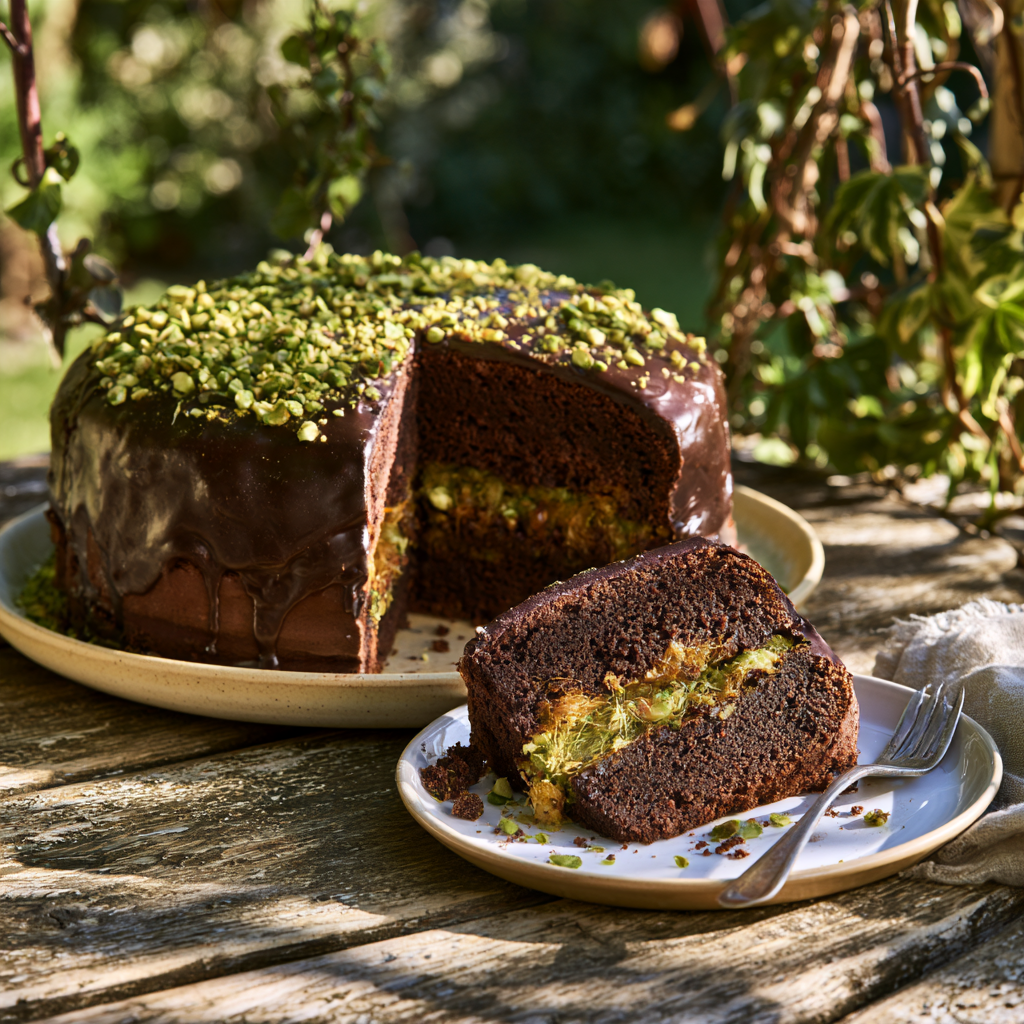
- Step 14: Decorate the Dubai Chocolate Cake. Once the ganache coating is in place, decorate the cake with approximately 20 g finely chopped unsalted pistachios. Sprinkle them lightly around the top edge or concentrate them in one section for a natural, homemade presentation. If desired, warm 1 tablespoon of sweetened pistachio cream just enough to make it easy to drizzle, then create a few simple lines or swirls across the top. For an additional crunchy detail, sprinkle a small amount of separately reserved, freshly toasted kataifi over the cake shortly before serving. Avoid adding too many decorations because the filling already provides a rich combination of chocolate, pistachio, and pastry. The aim is an attractive cake that clearly communicates its ingredients without becoming overly complicated or artificially styled.
- Step 15: Chill the Cake Before Slicing. Transfer the decorated Dubai chocolate cake to the refrigerator for approximately 30 minutes, or until the ganache has firmed enough for the layers to remain stable when sliced. Chilling helps the chocolate coating set and makes it easier to cut clean portions without shifting the pistachio filling. Avoid leaving the cake uncovered in the refrigerator for an extended period because the sponge may dry out and absorb refrigerator odors. Remember that kataifi gradually loses some of its crispness after being combined with a moist cake, so the filling is generally crunchiest when prepared and served reasonably close together. Before serving, allow the refrigerated cake to stand for approximately 15–20 minutes if room temperature and food safety conditions permit, so the chocolate ganache softens slightly and the flavors become more pronounced.
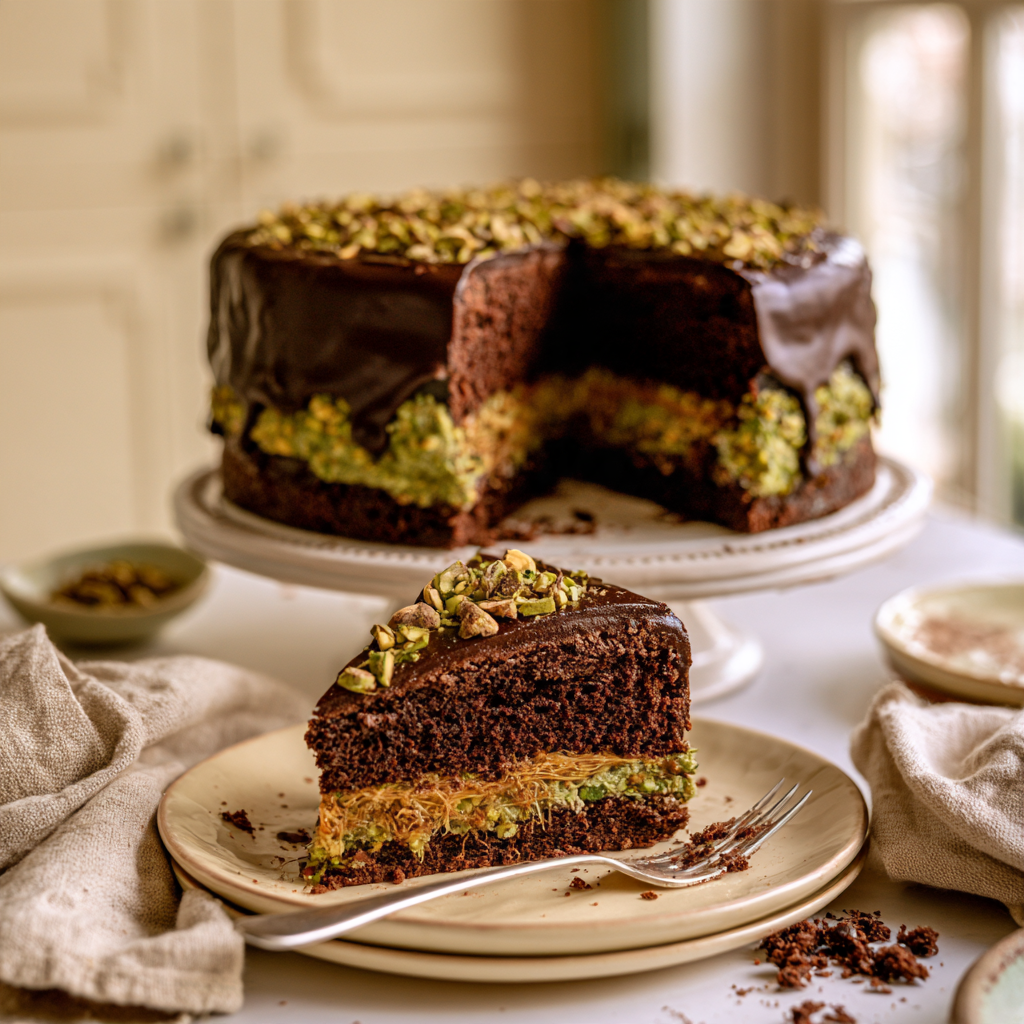
- Step 16: Slice, Serve, and Store the Dubai Chocolate Cake. Use a sharp knife to cut the finished cake into approximately 12 slices, wiping the blade clean between cuts for a neater presentation. Each portion should reveal two layers of moist chocolate sponge separated by a generous pistachio-kataifi filling, with a smooth chocolate ganache coating on the outside. Serve the cake with coffee, tea, or another preferred beverage to complement its rich chocolate flavor. Because the ganache contains fresh dairy, store leftover cake in a covered container in the refrigerator at 40°F (4°C) or below and aim to enjoy it within approximately 3–4 days, provided the ingredients were fresh and handled safely. Do not leave perishable cake at room temperature for more than two hours. Individual slices may be wrapped and frozen for approximately two months for best quality, although thawing may soften the crunchy kataifi filling. Thaw frozen portions in the refrigerator before serving.
Notes
- Origins of Dubai Chocolate Cake
- Health Benefits of Dubai Chocolate Cake
- 1. Pistachios Provide Healthy Unsaturated Fats
- 2. Pistachios Contribute Plant-Based Protein
- 3. Pistachios Supply Vitamin B6 and Important Minerals
- 4. Dark Chocolate Contains Naturally Occurring Cocoa Compounds
- 5. Choosing Dark Chocolate Can Help Balance Sweetness
- 6. Tahini Adds Unsaturated Fats and Nutty Flavor
- 7. Pistachios and Cocoa Contribute Different Types of Dietary Fiber
- 8. Eggs Add Protein, Choline, and Structure
- 9. Homemade Dubai Chocolate Cake Gives You Control Over Ingredients
- 10. Enjoying Homemade Dessert Can Be Part of a Balanced Eating Pattern
- Understanding the Nutrition of Dubai Chocolate Cake
- Dubai Chocolate Cake Recipe – Step by Step
Origins of Dubai Chocolate Cake
The Dubai Chocolate Cake Recipe has one of the most interesting origin stories in modern dessert culture. With its rich chocolate sponge, creamy pistachio filling, golden-crispy kataifi pastry, and smooth chocolate ganache, this indulgent cake brings together traditional Middle Eastern flavors and contemporary baking creativity. But unlike classic chocolate cakes that developed through generations of home baking, Dubai chocolate cake is a relatively new creation inspired by a viral confection that captured worldwide attention.
The story begins in Dubai, United Arab Emirates, where a chocolate bar filled with pistachio cream, tahini, and crunchy kunafa-inspired pastry transformed a familiar combination of Middle Eastern dessert ingredients into something completely different. Its distinctive green filling and satisfying crunch quickly became recognizable across social media, inspiring home bakers and pastry chefs to recreate those flavors in cookies, brownies, cheesecakes, cupcakes, and eventually layered chocolate cakes.
However, the history of Dubai chocolate cake reaches further back than the modern chocolate bar itself. Its defining ingredients have important connections to centuries-old pastry traditions, particularly knafeh, also known as kunafa, a beloved dessert enjoyed in many Middle Eastern communities.
Health Benefits of Dubai Chocolate Cake
| fiber, vitamin B6, potassium | Add nutrients and a distinctive nutty flavor | Sweetened pistachio cream may contain much less pistachio than pure nuts | |
| Dark Chocolate | Cocoa compounds, including flavanols, and some minerals | Adds cocoa-derived plant compounds and rich flavor | Benefits of high-flavanol cocoa cannot automatically be applied to chocolate cake |
| Unsweetened Cocoa Powder | Cocoa polyphenols and some dietary fiber | Provides intense chocolate flavor without added sugar in the powder itself | Actual flavanol content varies with processing |
| Tahini | Unsaturated fats, some protein, and minerals | Adds nutritional variety and balances sweetness | Energy-dense and contains sesame, a major allergen |
| Eggs | Protein, choline, and vitamin B12 | Contribute to cake structure and nutritional content | Their contribution per slice depends on the recipe |
| Milk or Cream | Protein, calcium, and varying amounts of fat | Provide richness and help create smooth ganache | Cream can add substantial saturated fat |
| Kataifi Pastry | Primarily carbohydrates from flour | Creates the dessert’s signature crispy texture | Usually made from refined wheat flour and often toasted in butter |
| Wheat Flour | Carbohydrates and some protein | Provides structure and dietary energy | Refined flour generally contains relatively little fiber |
| Chopped Pistachio Topping | Unsaturated fats, protein, fiber, and minerals | Adds crunch and some whole-nut nutrients | Adds calories and should be portioned according to preference |
| Homemade Preparation | Complete control over ingredient selection | Makes it easier to adjust sugar, portions, and chocolate type | Homemade doesn’t automatically mean lower-calorie |
Nutrition Note: The table describes the nutrients found in individual ingredients. It does not mean the completed cake provides clinically established health benefits or contains large amounts of every listed nutrient.
1. Pistachios Provide Healthy Unsaturated Fats
One of the most interesting nutritional characteristics of Dubai chocolate pistachio cake comes from its signature ingredient: pistachios.
Pistachios contain a combination of monounsaturated and polyunsaturated fats. These are generally considered more favorable dietary fats than saturated fats when used to replace them in a balanced eating pattern.
Unsaturated fats are found naturally in foods such as nuts, seeds, olive oil, and avocados.
Research on regular nut consumption has associated these foods with favorable cardiovascular health outcomes, particularly when they replace less nutritious foods.
However, there is an important distinction between eating whole pistachios and eating pistachio cream inside a rich chocolate cake.
A commercial pistachio cream may contain sugar, milk powder, oils, and other ingredients in addition to pistachios.
Its nutritional profile can therefore differ substantially from that of whole nuts.
For example, one ounce (approximately 28 grams) of plain pistachios provides around 13 grams of fat, most of which is unsaturated, along with protein and fiber.
A similar amount of sweetened pistachio spread may contain a different balance of fats and considerably more added sugar.
When preparing homemade Dubai chocolate cake, check the pistachio percentage on the ingredient label.
A spread with a higher proportion of real pistachios may provide a more pronounced nutty flavor, although the exact nutritional content still depends on the complete product formulation.
OoohDelish Tip: Choose a smooth pistachio cream that tastes distinctly of pistachios rather than relying only on a bright green color. Some products use additional colorings or flavorings, and appearance alone does not indicate quality.
2. Pistachios Contribute Plant-Based Protein
Another benefit of pistachios is their natural protein content.
Protein is an essential nutrient that contributes to the maintenance and repair of body tissues and supports many normal biological functions.
Whole pistachios provide approximately 6 grams of protein per 28-gram serving.
This makes them a useful plant-based protein source when eaten as part of a varied diet.
In a Dubai chocolate cake, some protein may come from pistachios, eggs, flour, milk, and chocolate ingredients.
However, a slice of cake generally contains much less pistachio than a full serving of plain nuts.
The finished dessert shouldn’t be considered a high-protein food simply because it contains pistachio cream.
The amount of protein depends on the quantity and composition of the filling, the chocolate sponge recipe, and the serving size.
For additional pistachio flavor and texture, you can decorate the cake with a small amount of chopped, unsalted pistachios.
This introduces recognizable pieces of the actual nut rather than relying entirely on sweetened pistachio spread.
The result is a pleasant combination of crunchy nuts, creamy filling, and rich chocolate.
3. Pistachios Supply Vitamin B6 and Important Minerals
Pistachios are also a source of several essential vitamins and minerals.
One particularly notable nutrient is vitamin B6, which plays a role in normal protein metabolism, nervous system function, and the formation of certain compounds used by the body.
Pistachios also contain potassium, phosphorus, copper, and other minerals.
These nutrients contribute to different physiological processes.
For example, potassium is involved in normal muscle contraction and nerve signaling, while phosphorus contributes to bone structure and energy metabolism.
Copper helps support normal iron metabolism and the formation of connective tissue.
However, the nutritional contribution of pistachios in a slice of Dubai chocolate cake depends on how much real pistachio is present.
A filling made with a substantial amount of pure pistachio paste will have a different nutrient profile from one made primarily with sugar and vegetable fat.
Neither should be judged solely by its name.
When choosing ingredients, reading the label helps you understand what you’re actually adding to the cake.
And while pistachios provide useful nutrients, foods such as vegetables, whole grains, legumes, dairy products, and other nuts remain important sources of vitamins and minerals in a balanced diet.
4. Dark Chocolate Contains Naturally Occurring Cocoa Compounds
Chocolate is the ingredient that brings this entire dessert together.
The cocoa powder in the sponge provides deep chocolate flavor, while melted chocolate gives the ganache its smooth, rich finish.
Cocoa also contains naturally occurring plant compounds called polyphenols, including a group known as flavanols.
Scientists have investigated cocoa flavanols for their potential effects on blood vessel function and cardiovascular health.
However, the evidence needs to be interpreted carefully.
Studies investigating specific quantities of cocoa flavanols cannot automatically be used to claim that ordinary chocolate cake improves heart health.
The amount of flavanols in chocolate varies considerably depending on cocoa processing, chocolate formulation, and the specific ingredients used.
Even dark chocolate with a relatively high cocoa percentage does not necessarily contain the same quantity of flavanols as specially prepared high-flavanol cocoa products.
Furthermore, chocolate ganache and cake batter typically contain additional sugar and fat.
Therefore, Dubai chocolate cake should not be promoted as a heart-healthy dessert or a treatment for any health condition simply because it contains cocoa.
The practical benefit of using good-quality chocolate is that it contributes a rich, satisfying flavor.
You can choose chocolate with a level of sweetness that balances the pistachio filling without making the finished cake excessively sweet.
For another homemade dessert highlighting the delicious richness of cocoa, explore our King Arthur Brownie Recipe, which features a different chocolate texture and flavor experience
5. Choosing Dark Chocolate Can Help Balance Sweetness
Although dark chocolate isn’t automatically healthier than every other type of chocolate, it can be a useful choice when making Dubai chocolate cake with pistachio cream.
Sweetened pistachio cream already contributes considerable sweetness.
If the sponge, ganache, and filling are all very sweet, the finished cake can become overwhelming.
Using semi-sweet or moderately dark chocolate in the ganache may help create a more balanced flavor.
For example, chocolate containing approximately 60–70% cocoa solids often provides a noticeably deeper cocoa taste than milk chocolate.
The exact sweetness varies by brand.
Dark chocolate may also contain less added sugar than a comparable milk chocolate product, although it can still be high in calories and saturated fat.
The percentage of cocoa alone doesn’t establish its complete nutritional quality.
For the best result, choose a chocolate you enjoy eating by itself and check its ingredient and nutrition labels.
A rich chocolate flavor can make the cake satisfying without requiring an extremely thick layer of sweet frosting.
OoohDelish Tip: If your pistachio cream is very sweet, consider using a slightly darker chocolate for the ganache. Taste the filling and chocolate separately before assembly so the finished cake has a pleasant balance.
6. Tahini Adds Unsaturated Fats and Nutty Flavor
Tahini is an optional but interesting ingredient in many Dubai-inspired chocolate fillings.
Made from ground sesame seeds, tahini contains mostly unsaturated fats, along with some protein and minerals.
Its flavor is slightly earthy and pleasantly bitter, making it a natural partner for sweetened pistachio cream.
In a Dubai chocolate cake, a small amount of tahini can help balance the sweetness of the filling.
It also adds another traditional Middle Eastern flavor element to the dessert.
Sesame seeds contain minerals such as calcium, magnesium, phosphorus, and copper, although the amounts in tahini vary by product and preparation.
However, tahini is relatively energy-dense because of its fat content.
The small amount used in a cake filling shouldn’t be expected to provide major nutritional benefits.
Its main role is flavor and texture.
There’s also an important allergy consideration: sesame is a major food allergen.
If you’re preparing Dubai chocolate cake for guests, make sure they know whether the filling contains tahini.
7. Pistachios and Cocoa Contribute Different Types of Dietary Fiber
Dietary fiber helps support normal digestive function and contributes to an overall nutritious eating pattern.
Whole pistachios naturally contain fiber, as does unsweetened cocoa powder.
A serving of approximately 28 grams of pistachios provides around 3 grams of fiber.
Cocoa powder also contains fiber, although the amount contributed by one slice of cake depends on how much powder is used in the batter.
These ingredients can contribute some fiber to the finished dessert.
However, most Dubai chocolate cakes also contain refined wheat flour, sweetened pistachio cream, and chocolate ganache.
The overall fiber content may therefore remain modest.
A cake containing pistachios and cocoa is not necessarily high in fiber.
If you want to increase the fiber content slightly, using a proportion of whole wheat pastry flour in the chocolate sponge may be an option.
Keep in mind that whole wheat flour absorbs moisture differently from all-purpose flour, and substantial substitutions can affect the cake’s softness.
For a tender chocolate layer cake, start with a small substitution rather than replacing all the flour.
Ultimately, Dubai chocolate cake is best appreciated as a dessert, not as a replacement for more substantial fiber sources such as fruits, vegetables, beans, and whole grains.
8. Eggs Add Protein, Choline, and Structure
Many homemade chocolate cake recipes use eggs.
Eggs perform an important role in baking because their proteins help the batter set and contribute to the structure of the finished sponge.
They can also help create a tender texture when combined with the correct balance of flour, fat, liquid, and leavening ingredients.
From a nutritional perspective, eggs provide protein and nutrients such as vitamin B12, selenium, and choline.
Choline plays an important role in normal cell function and nervous system development.
However, the amount of these nutrients in one cake serving depends on how many eggs the recipe uses and how many slices the cake produces.
If a cake uses three eggs and is divided into twelve portions, each slice contains only a fraction of an egg.
Therefore, the presence of eggs doesn’t make Dubai chocolate cake a particularly significant protein source.
Their most important contribution to this recipe is helping create a moist, well-structured chocolate sponge capable of supporting the generous pistachio filling.
9. Homemade Dubai Chocolate Cake Gives You Control Over Ingredients
One of the clearest practical advantages of preparing Dubai Chocolate Cake from scratch is knowing exactly what goes into your dessert.
When you make the cake yourself, you can choose the chocolate, pistachio cream, type of flour, and quantity of filling.
You can also decide whether to include tahini, how much ganache to use, and whether to decorate the cake with chopped pistachios.
This allows you to adapt the flavor and sweetness to your preferences.
For example, choosing unsweetened cocoa powder gives you greater control over the sugar added to the sponge.
You can also compare pistachio cream labels to find a product with a higher percentage of pistachios or less added sugar.
Homemade preparation doesn’t automatically make the dessert low in calories or nutritionally superior to a bakery version.
A generous homemade slice may contain substantial sugar and saturated fat.
The advantage is transparency and flexibility.
If you enjoy exploring the original dessert concept, our Dubai Chocolate Bar Recipe offers another way to appreciate chocolate-based treats inspired by Dubai’s confectionery scene.
10. Enjoying Homemade Dessert Can Be Part of a Balanced Eating Pattern
Food is about more than individual nutrients.
Preparing a cake for a birthday, sharing dessert with friends, or learning a new baking technique can be enjoyable parts of everyday life.
Dubai chocolate cake is particularly well suited to celebrations because its rich layers and distinctive filling make it feel special.
You don’t need to describe the cake as healthy to enjoy it.
For most people, an occasional slice of homemade cake can fit into a balanced eating pattern that also includes vegetables, fruits, whole grains, legumes, and other nutrient-rich foods.
The key is to consider the complete eating pattern rather than judging one dessert in isolation.
Because Dubai chocolate cake is rich, smaller slices are often satisfying.
Serving it with unsweetened tea, coffee, or another preferred drink can also help keep the overall dessert experience from becoming excessively sweet.
The most useful approach is to enjoy the dessert for its wonderful flavor and texture while being aware of its nutritional characteristics.
Understanding the Nutrition of Dubai Chocolate Cake
A Dubai Chocolate Cake Recipe generally contains several energy-dense ingredients, including sweetened pistachio cream, chocolate, butter, and ganache.
The exact nutritional composition depends on the recipe.
A thick slice from a tall celebration cake may contain substantially more calories, sugar, and fat than a smaller slice from a two-layer homemade cake.
Because ingredient quantities have not yet been finalized for this particular OoohDelish cake, assigning a precise calorie value would be misleading.
The table below explains what readers can reasonably expect.
| Nutritional Factor | What to Know |
|---|---|
| Calories | Depend on the cake size, chocolate, pistachio filling, ganache, and slice thickness |
| Carbohydrates | Come primarily from flour, sugar, chocolate, and sweetened pistachio cream |
| Added Sugar | Usually present in the sponge, pistachio cream, and chocolate coating |
| Total Fat | Comes from pistachios, chocolate, butter, oil, tahini, and dairy ingredients |
| Saturated Fat | Mainly contributed by butter, cream, chocolate, and certain prepared spreads |
| Unsaturated Fat | Supplied primarily by pistachios, sesame tahini, and some oils |
| Protein | Comes from flour, eggs, pistachios, milk, and other ingredients |
| Dietary Fiber | Contributed by pistachios and cocoa; amounts depend on the recipe |
| Potassium | Present in pistachios, cocoa, and some other ingredients |
| Iron | Present in cocoa, wheat flour, pistachios, and other components |
| Allergens | May include pistachios, sesame, wheat, milk, eggs, and other nuts |
Important: Precise nutritional values should be calculated from the final ingredient quantities and the actual number of servings. A nutrition calculator should not assume that all pistachio creams or chocolate brands contain the same amount of sugar or fat
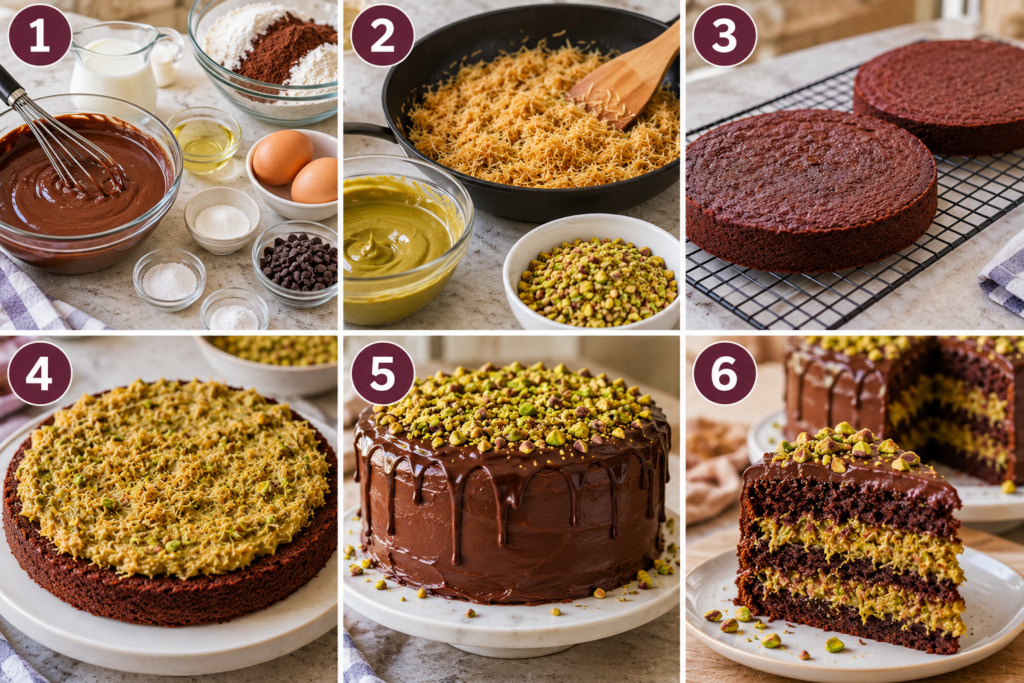
Dubai Chocolate Cake Recipe – Step by Step
Step 1: Prepare the Chocolate Cake Batter. In a large mixing bowl, combine flour, cocoa powder, sugar, baking powder, baking soda, and salt. Add the eggs, milk, vegetable oil, and vanilla extract. Mix until smooth, then gradually incorporate hot water or coffee to create a rich, silky chocolate batter.
Step 2: Make the Crispy Pistachio Kunafa Filling. Melt butter in a large skillet over medium heat. Add the shredded kataifi pastry and stir continuously until golden brown and crispy. Allow it to cool slightly, then mix with pistachio cream and a little tahini until evenly coated. Fold in chopped pistachios for extra crunch.
Step 3: Bake the Chocolate Cake Layers. Divide the chocolate batter evenly between two greased and lined round cake pans. Bake at 350°F (175°C) for approximately 25–35 minutes, or until a toothpick inserted into the center comes out clean. Let the cakes cool completely on a wire rack before assembling.
Step 4: Add the Pistachio Kunafa Filling. Place the first chocolate cake layer on a serving plate. Spread a generous, even layer of the crispy pistachio kunafa mixture over the surface, leaving a small border around the edges. Gently position the second cake layer on top without pressing too firmly.
Step 5: Cover with Chocolate Ganache. Prepare a smooth chocolate ganache using melted chocolate and warm heavy cream. Allow it to thicken slightly, then spread it over the top and sides of the assembled cake. Create decorative chocolate drips around the edges and generously sprinkle chopped pistachios over the top.
Step 6: Slice and Serve. Refrigerate the assembled Dubai chocolate cake briefly to help the ganache set. Using a sharp knife, cut into generous slices to reveal the moist chocolate cake layers and crunchy pistachio kunafa filling. Serve slightly chilled or at room temperature for the best combination of textures and flavors.
Frequently Asked Questions About Dubai Chocolate Cake Recipe
Want to create a beautiful Dubai chocolate cake with moist chocolate layers, creamy pistachio filling, crispy golden kataifi, and silky chocolate ganache? These helpful answers cover choosing the right ingredients, keeping the pistachio crunch fresh, fixing common baking problems, assembling neat cake layers, and storing your finished dessert. Discover the techniques behind this indulgent pistachio chocolate cake.
1. What is Dubai chocolate cake, and what makes it different?
Dubai chocolate cake is a modern chocolate dessert inspired by the popular pistachio-filled Dubai chocolate bar. It typically combines moist chocolate cake with creamy pistachio filling, toasted kataifi pastry, and rich chocolate ganache. What makes it distinctive is the contrast between soft cake, smooth chocolate, and a crunchy, nutty center. Unlike an ordinary chocolate layer cake, the filling provides an unexpected texture and flavor. Some versions are tall celebration cakes, while others use a single chocolate sponge topped with pistachio crunch and ganache.
2. Is Dubai chocolate cake inspired by the viral Dubai chocolate bar?
Yes! Dubai chocolate cake takes inspiration from the viral pistachio and kataifi chocolate bar created in Dubai. The original popular confection brought together chocolate, pistachio filling, and crispy shredded pastry. Home bakers adapted those flavors into cakes, brownies, cookies, and other desserts. In cake form, a moist chocolate sponge replaces or complements the chocolate shell, while the creamy-crunchy filling remains the signature feature. For another chocolate-inspired dessert, explore our Dubai Chocolate Bar Recipe .
3. What is kataifi pastry, and why is it used in Dubai chocolate cake?
Kataifi is a thin, shredded pastry made from a wheat-based dough. When toasted with butter, its fine strands become golden and crispy. In Dubai chocolate cake, toasted kataifi is combined with pistachio cream to create the signature crunchy filling. You can often find kataifi in Middle Eastern grocery stores, specialty food shops, or frozen pastry sections. It is also used in traditional desserts. For a different preparation featuring shredded pastry, explore our Traditional Knafeh Recipe .
4. Can I make Dubai chocolate cake without kataifi pastry?
Yes, but the texture will be different. Toasted kataifi provides the delicate, distinctive crunch associated with Dubai chocolate desserts. If you cannot find it, some recipes use crushed crispy cereal or another suitable crunchy ingredient. Finely sliced phyllo dough can be an alternative, although it may not produce the same fine strands or uniform texture. Toast your chosen substitute separately before adding it to pistachio cream. Avoid using soft, untoasted pastry, which can make the filling dense rather than crisp.
5. How do you toast kataifi for the perfect crunchy filling?
Begin by separating or chopping the kataifi strands into manageable pieces. Melt a little butter in a wide skillet over medium heat, then add the pastry. Stir frequently until the strands become evenly golden, crisp, and fragrant. Avoid leaving the pan unattended because the thin pastry can burn quickly. Transfer the toasted kataifi to a separate plate or bowl and allow it to cool before combining with pistachio cream. Mixing while very hot can affect the filling’s consistency.
6. How do you keep the pistachio kataifi filling crunchy inside the cake?
The secret is removing excess moisture and preventing prolonged contact with wet ingredients. Toast the kataifi thoroughly until crisp and let it cool before mixing with pistachio cream. Use a relatively thick filling rather than a watery sauce. Assemble the cake only after the chocolate sponge has cooled completely. A barrier of suitable frosting or chocolate can help separate the crunchy filling from moist cake. For maximum crunch, avoid assembling too far in advance, since refrigeration gradually softens the pastry.
7. What is the difference between pistachio cream and pistachio paste?
Pistachio cream is usually a sweetened, spreadable product that may contain sugar, milk ingredients, oils, and pistachios. Pistachio paste is often made primarily from ground pistachios and may contain little or no added sugar. They can have very different flavors and consistencies. Sweetened pistachio cream is commonly used in Dubai chocolate fillings because it blends easily with toasted kataifi. If using unsweetened pistachio paste, choose a recipe adjusted for its lower sweetness and potentially thicker texture.
8. Is tahini necessary for Dubai chocolate cake?
Tahini is optional in many Dubai chocolate cake recipes, although it contributes a pleasantly nutty, slightly earthy flavor. Made from ground sesame seeds, tahini can balance the sweetness of pistachio cream and chocolate. Some recipes incorporate a little tahini into the kataifi filling, while others rely entirely on pistachio spread. If your recipe lists tahini as optional, you may omit it. Remember that tahini contains sesame, an important allergen for sensitive guests.
9. What chocolate is best for Dubai chocolate cake and its ganache?
Good-quality semisweet or dark chocolate works beautifully because its deeper cocoa flavor balances the sweetness of pistachio cream. Milk chocolate creates a sweeter, creamier finish and can also work in a recipe designed for it. For ganache, use chocolate that melts smoothly and follow the specified chocolate-to-cream ratio. Different chocolate varieties require different proportions for the same consistency. If you enjoy rich homemade chocolate desserts, try our King Arthur Brownie Recipe .
10. How do you keep Dubai chocolate cake moist and soft?
For a moist chocolate cake, measure flour accurately and avoid overbaking the sponge. Ingredients such as oil, buttermilk, and cocoa powder are commonly used in tender chocolate cake formulas, but their proportions must remain balanced. Mix the batter according to the recipe and avoid excessive stirring after adding the flour. Start checking for doneness near the recommended baking time. Cool the cake completely before adding pistachio filling or ganache to prevent melting, sliding, and soggy layers.
11. How do you know when the chocolate cake layers are baked?
Chocolate cake layers are generally ready when the surface looks set, the center springs back lightly when touched, and a toothpick inserted into the cake comes out without wet batter. A few moist crumbs are usually acceptable for a tender cake. Exact cooking times depend on the batter, oven, pan dimensions, and thickness. Avoid using a fixed baking time from a different recipe. Let the sponge cool completely before slicing, layering, or frosting.
12. Why is my chocolate ganache grainy, oily, or too runny?
Ganache problems often result from incorrect chocolate-to-cream proportions, excessive heat, or incomplete mixing. For a smooth ganache, finely chop the chocolate and pour appropriately heated cream over it. Let the mixture stand briefly, then stir gently from the center outward until glossy. If the ganache is too thin, allow it to cool and thicken before pouring. Avoid overheating chocolate, and remember that milk and dark chocolate can require different amounts of cream.
13. How do you assemble Dubai chocolate cake without the layers sliding?
Make sure every chocolate cake layer is completely cool before assembling. Level uneven sponges if necessary and use frosting or ganache of an appropriately thick consistency. For a tall layer cake, pipe a border of frosting around each layer before adding the pistachio kataifi filling. This helps contain the filling and support the next cake layer. Chill between assembly stages when the recipe recommends it. Use a sharp knife and gentle pressure when slicing.
14. Can I make Dubai chocolate cake ahead of time?
Yes! Preparing the components separately is often the best make-ahead strategy. Bake the chocolate sponge in advance, cool it completely, then wrap and store it according to your recipe. Ganache can also be prepared ahead when its formula allows refrigerated storage. Toast the kataifi separately and protect it from moisture. For the crispiest filling, combine the kataifi with pistachio cream closer to assembly. Finish decorating after the cake layers have set.
15. How do you store and freeze Dubai chocolate cake?
Store Dubai chocolate cake with dairy-based ganache or cream filling in the refrigerator at 40°F (4°C) or below. Cover it to prevent drying and refrigerate promptly. For best quality, enjoy within approximately 3–4 days, although the kataifi may lose its crunch sooner. Plain, unfrosted chocolate cake layers generally freeze better than an assembled cake with crispy pastry. Wrap cooled cake layers tightly, freeze for up to 2–3 months for best quality, and thaw safely before decorating.
16. Can Dubai chocolate cake be gluten-free or nut-free, and how should you serve it?
Traditional Dubai-style chocolate cake is not usually gluten-free or nut-free. The cake typically contains wheat flour, kataifi contains wheat, and pistachio filling contains tree nuts. Tahini, if used, introduces sesame. A gluten-free variation requires a suitable cake formula and a verified gluten-free crunchy filling. For a nut allergy, choose a different filling and check all ingredient labels carefully. Serve modest slices with coffee or milk, or pair with our Heavenly Hash Brownies for a chocolate dessert platter.