

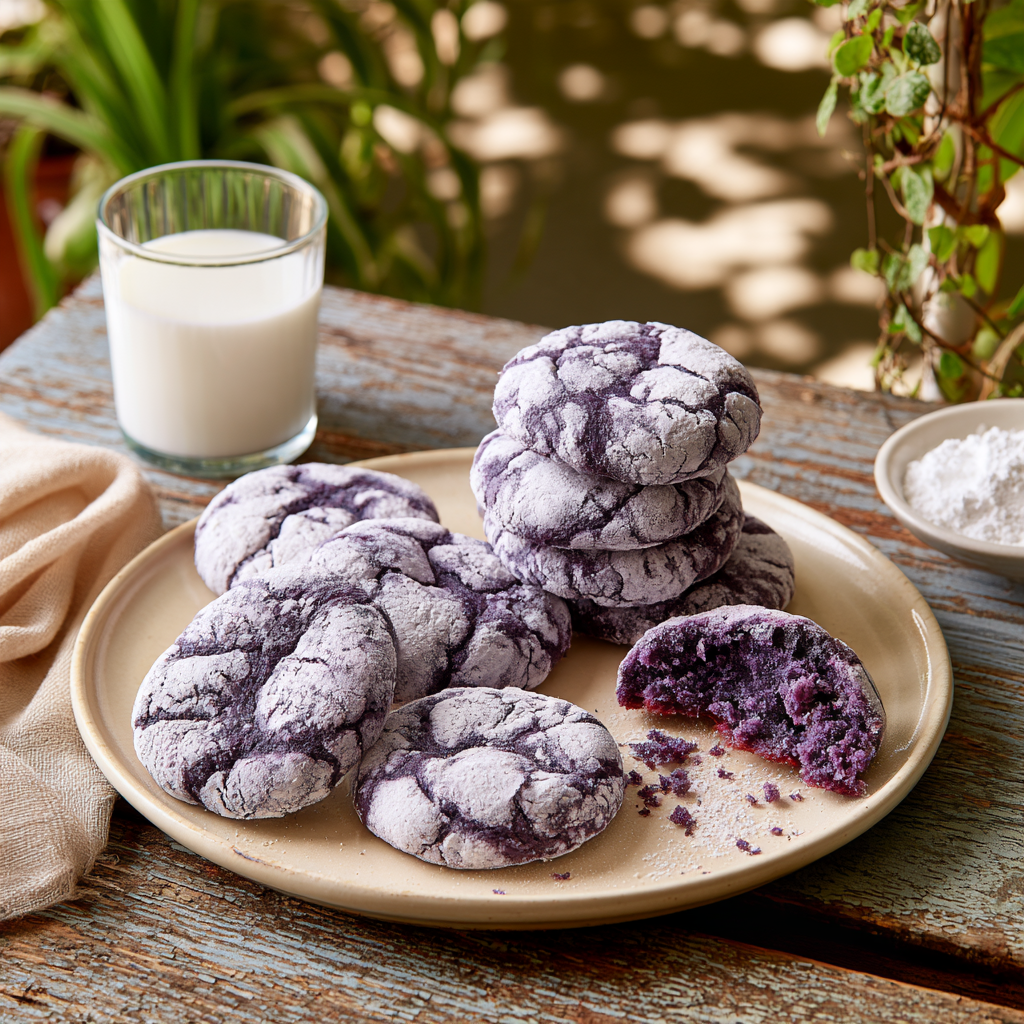
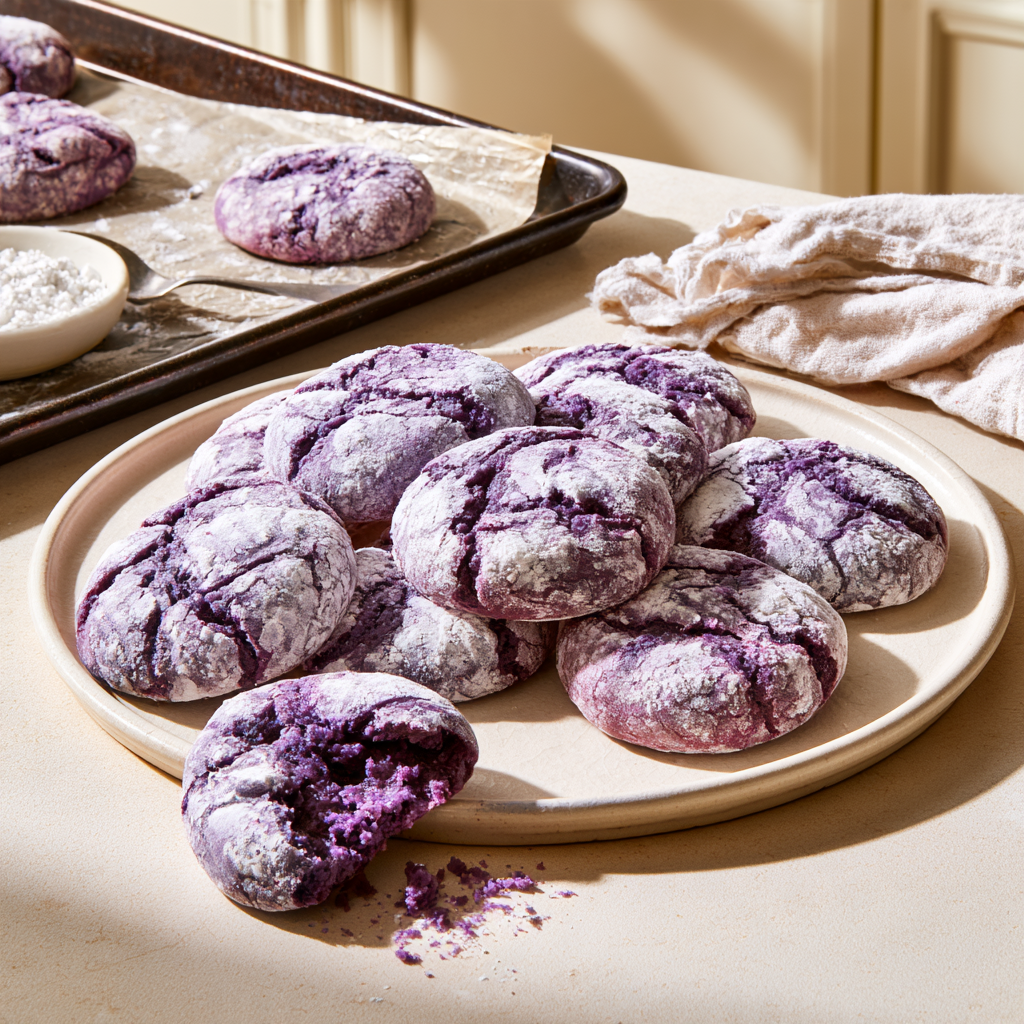
One bite into these gorgeous purple cookies, and you’ll understand why this Ube Crinkle Cookies Recipe deserves a spot in your favorite homemade desserts. Beneath their delicate, snowy powdered sugar coating is a soft, chewy center bursting with the distinctive flavor of Filipino ube. With their deep violet color, beautiful cracked surfaces, and slightly imperfect homemade appearance, these cookies look almost too pretty to eat, but they’re even better when you break one open!
Inspired by the beloved flavors of Filipino desserts, ube crinkle cookies feature purple yam, prized for its gently sweet, earthy, and subtly nutty flavor with vanilla-like notes. As the cookies bake, their sugary coating separates into beautiful irregular cracks, revealing the vibrant purple dough underneath. The secret to achieving that signature crinkle appearance is properly chilled dough, a generous powdered sugar coating, and careful baking that keeps the centers tender.
If you love cookies with irresistible textures, try our Snickerdoodle Cookies Without Cream of Tartar for a cinnamon-sugar classic or our Cornflake Cookie Recipe for a deliciously crunchy contrast. These purple treats also pair beautifully with a cold glass of milk, just like our Chocolate Chip Cookies Milk Recipe.
Perfect for Christmas cookie boxes, birthdays, afternoon snacks, and colorful dessert platters, this homemade Ube Crinkle Cookies Recipe brings a little Filipino-inspired magic to everyday baking. Whether you’re discovering ube for the first time or already love its unique flavor, you’ll learn how to create beautifully cracked cookies with soft centers, balanced sweetness, and a truly memorable homemade finish.
Ube Crinkle Cookies Recipe
Equipment
- Large mixing bowl
- Medium mixing bowl
- Electric hand mixer or stand mixer
- Rubber spatula
- Whisk
- Measuring cups and spoons
- Digital kitchen scale (recommended)
- Cookie scoop, approximately 1 1/2 tablespoons
- 2 Rimmed baking sheets
- Parchment paper
- 2 small bowls for sugar coatings
- Plastic wrap or reusable bowl cover
- Wire cooling rack
- Oven
Ingredients
- For the Purple Ube Cookie Dough:
- 1 3/4 cups 220 g all-purpose flour
- 1 1/4 teaspoons baking powder
- 1/4 teaspoon fine salt
- 1/2 cup 113 g unsalted butter, softened
- 1/2 cup 100 g granulated sugar
- 1/4 cup 50 g light brown sugar, packed
- 1 large egg room temperature
- 1/2 cup 120 g ube halaya (sweetened purple yam jam)
- 1 teaspoon pure vanilla extract
- 1 teaspoon ube extract optional but recommended for a stronger ube flavor
- For the Classic Crinkle Coating:
- 1/4 cup 50 g granulated sugar, optional for the first coating
- 2/3 cup 75 g powdered sugar (confectioners’ sugar), sifted if lumpy
Instructions
- Step 1: Cream the Butter, Sugars, and Ube. In a large mixing bowl, combine 1/2 cup (113 g) of softened unsalted butter, 1/2 cup (100 g) of granulated sugar, and 1/4 cup (50 g) of packed light brown sugar. Using an electric hand mixer or stand mixer, beat on medium speed for approximately 2–3 minutes, until the mixture becomes lighter, creamy, and well combined. Add the room-temperature egg and beat until fully incorporated. Next, add 1/2 cup (120 g) of smooth ube halaya, 1 teaspoon of vanilla extract, and 1 teaspoon of ube extract if using. Continue mixing on low to medium speed until the ingredients form a thick, fairly uniform purple mixture, scraping down the sides of the bowl with a rubber spatula when needed. Small streaks from the ube halaya are normal, but avoid leaving large unmixed lumps. The butter should be soft enough to cream but not melted, as excessively warm butter can cause the cookies to spread too much during baking.
- Step 2: Make and Chill the Purple Cookie Dough. In a separate medium bowl, whisk together 1 3/4 cups (220 g) of all-purpose flour, 1 1/4 teaspoons of baking powder, and 1/4 teaspoon of fine salt. Add the dry ingredients gradually to the purple ube mixture, using a rubber spatula to fold everything together until no visible dry flour remains. The dough should be thick, soft, and slightly sticky, with a rich purple appearance. Avoid excessive mixing, which can develop too much gluten and make the cookies tough rather than tender. Cover the bowl tightly with plastic wrap or a reusable lid and refrigerate for at least 60 minutes, or until the dough becomes firm enough to scoop and roll comfortably. If your ube halaya contains more moisture than expected, the dough may require an additional 30 minutes of chilling. Properly chilled dough is easier to shape and helps the finished cookies maintain their thick, soft centers.
- Step 3: Shape the Ube Cookies into Even Balls. About 15 minutes before removing the dough from the refrigerator, preheat your oven to 350°F (175°C) and position a rack in the center. Line two baking sheets with parchment paper. Remove the chilled purple dough from the refrigerator and divide it into approximately 20 evenly sized portions using a heaping 1 1/2-tablespoon cookie scoop, aiming for around 30–35 g per cookie. Gently roll each portion between your palms to create a smooth, round ball without compressing the dough excessively. Arrange the cookie balls on the prepared baking sheets, leaving approximately 2 inches between them to allow for spreading during baking. Aim for about 10 cookies per sheet, depending on its size. Keep the second tray refrigerated while the first tray is being prepared and baked so the remaining dough stays cool and maintains its shape.
- Step 4: Coat Generously with Powdered Sugar. Place the optional 1/4 cup of granulated sugar in one small bowl and the 2/3 cup of powdered sugar in another. For a more defined white crinkle coating, lightly roll each chilled dough ball in granulated sugar first, then transfer it to the powdered sugar and roll until the entire surface is covered in a generous, even white layer. The first sugar coating can help reduce how quickly moisture from the dough dissolves the powdered sugar, while the final coating creates the beautiful contrast against the purple interior. If you prefer to use only powdered sugar, simply skip the granulated sugar and coat each ball thoroughly in the powdered sugar. Do not flatten or press the dough balls after coating. Return them to the lined baking sheet and transfer the tray to the oven promptly, before the coating begins absorbing too much moisture.
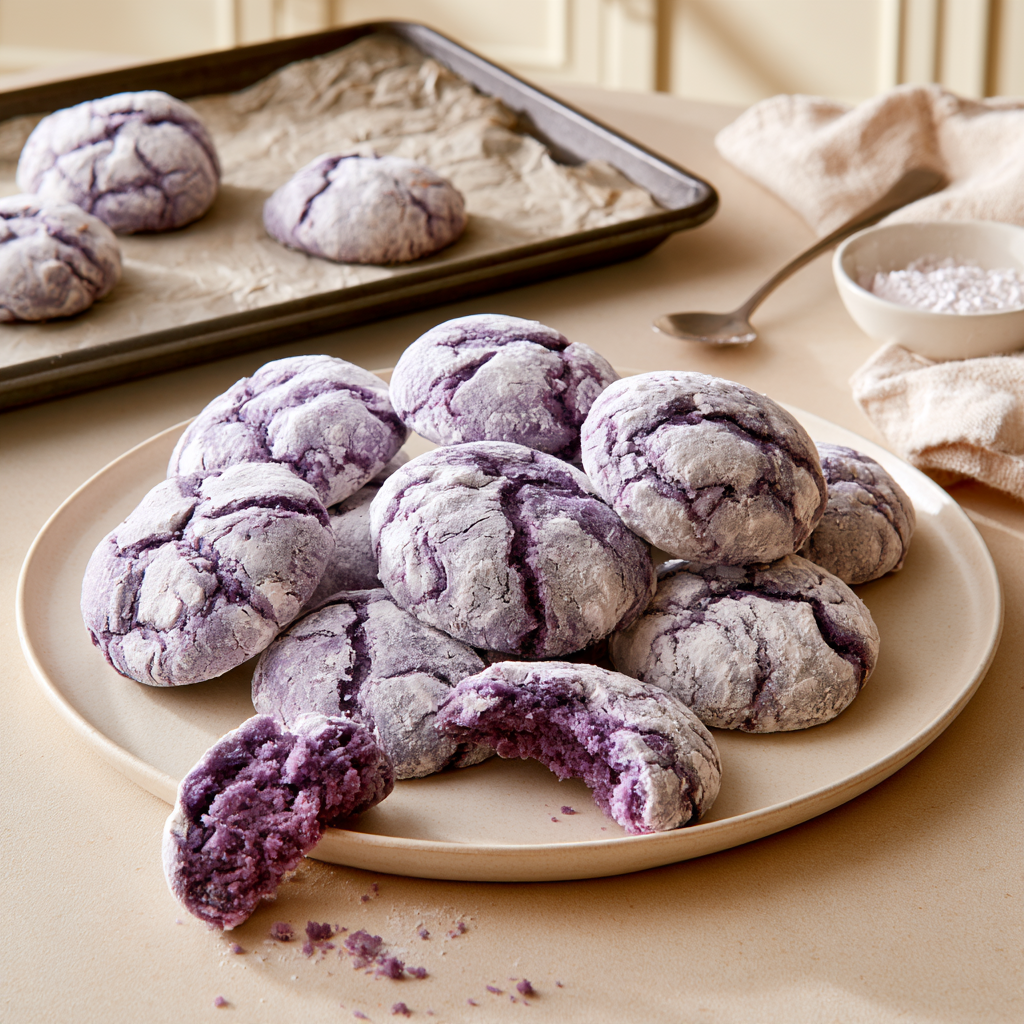
- Step 5: Bake Until Beautifully Cracked and Set. Place the first baking sheet on the center rack of the preheated oven and bake at 350°F (175°C) for approximately 10–12 minutes, beginning to check the cookies around the 10-minute mark. During baking, the dough should gently expand, creating irregular cracks in the white powdered sugar coating and revealing the purple surface underneath. The cookies are ready when their edges look set, their tops have developed visible cracks, and their centers are no longer shiny or visibly raw. They should still feel slightly soft in the middle because they will continue setting as they cool. Avoid baking until the entire cookie feels firm, which can result in a dry, cakey texture. Remove the first tray from the oven and bake the second batch following the same procedure, adjusting the timing slightly if your cookie portions are larger or smaller.
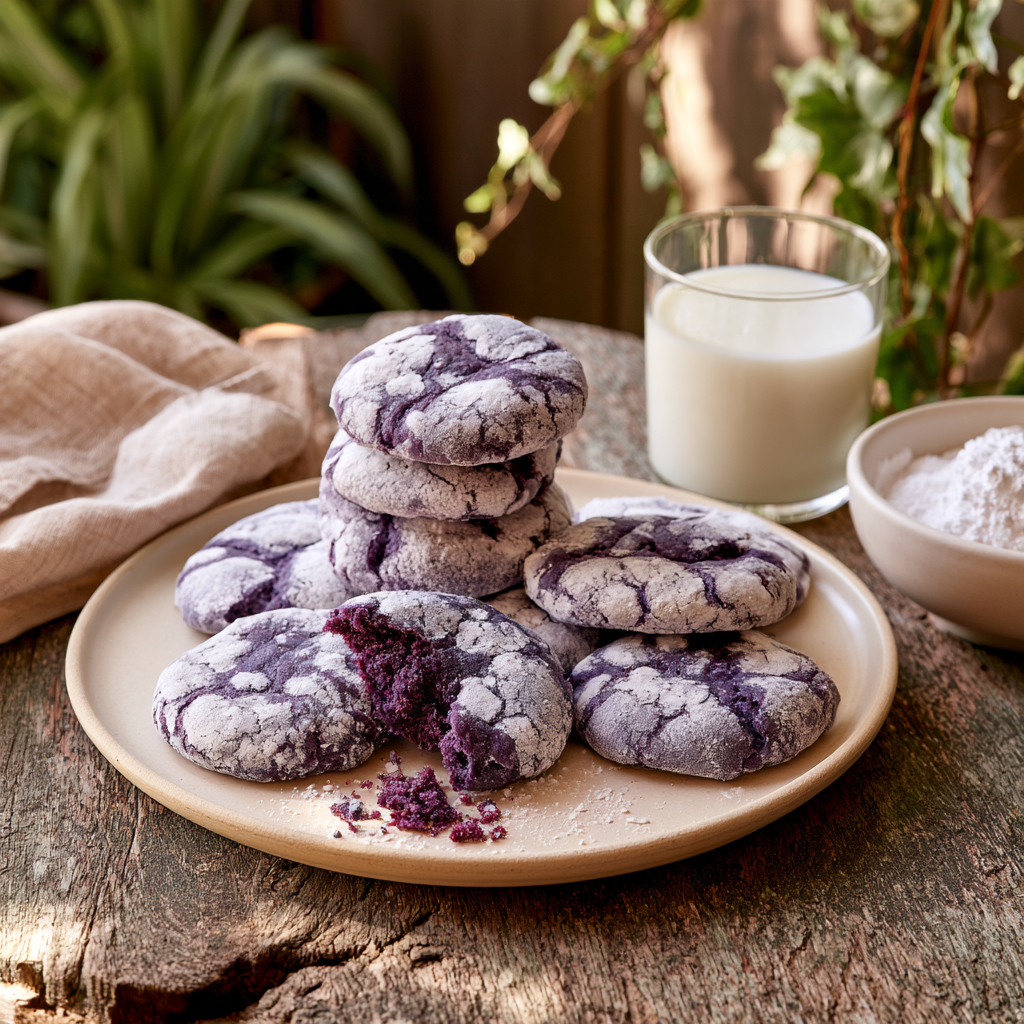
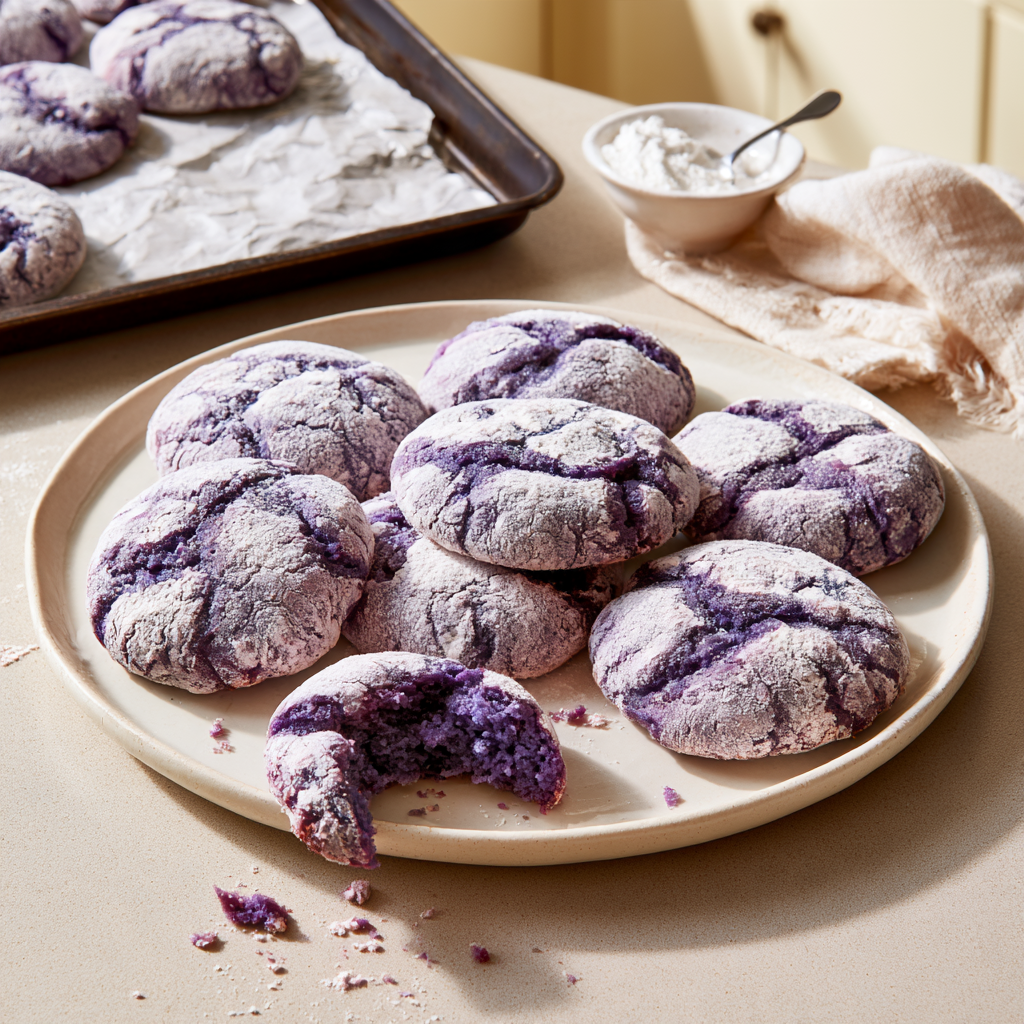
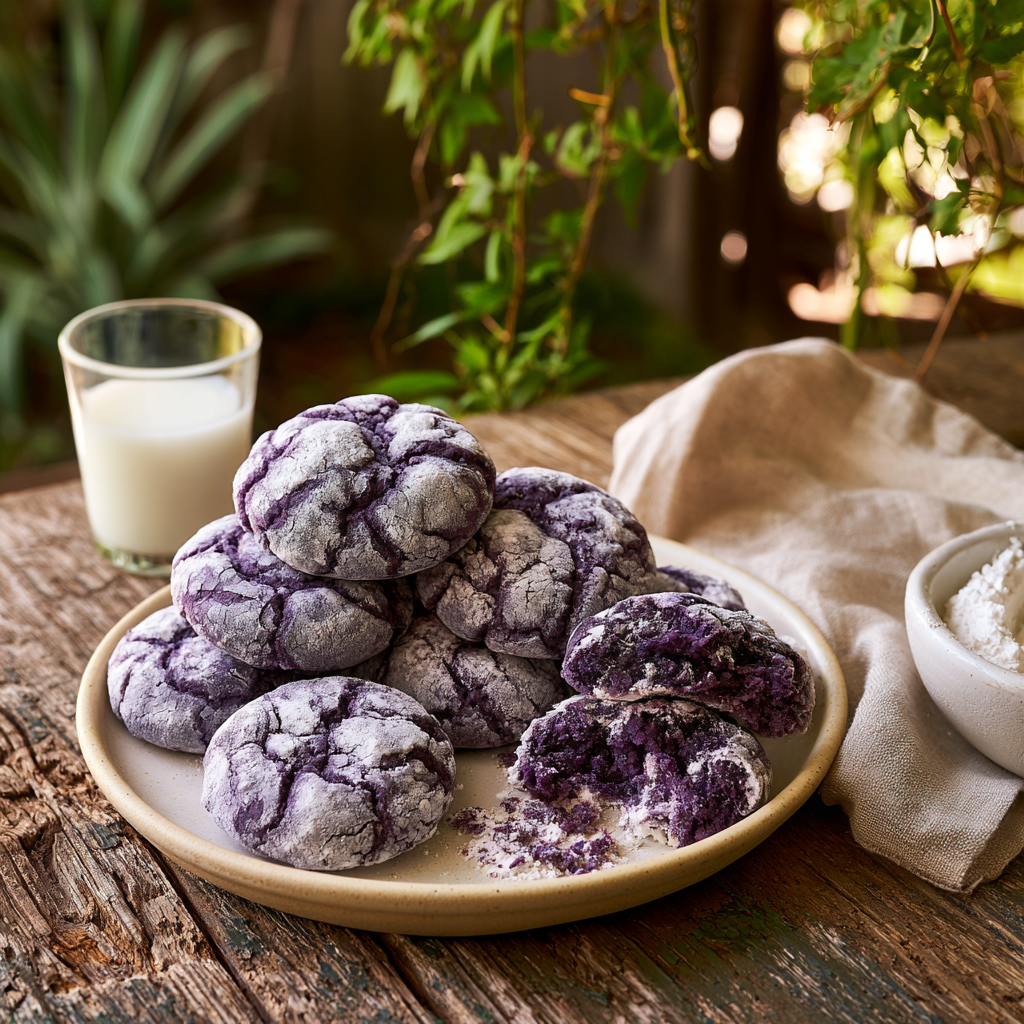
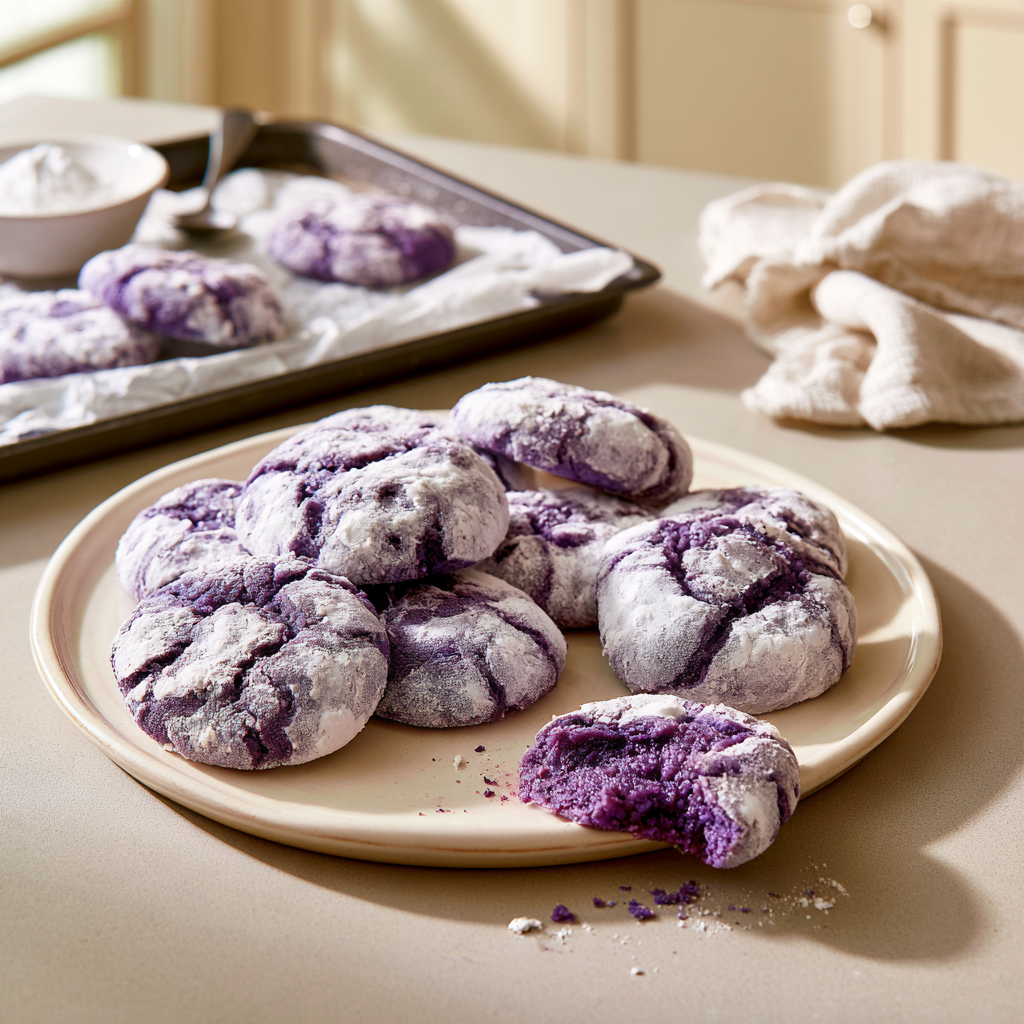
- Step 6: Cool, Serve, and Enjoy Your Homemade Ube Crinkle Cookies. Allow the freshly baked ube crinkle cookies to rest on their baking sheet for approximately 5 minutes so their delicate structure can firm up without becoming overbaked. Carefully transfer them to a wire cooling rack using a thin spatula and let them cool for at least another 5 minutes before serving, or completely before packing them for storage. As they cool, the exterior should become lightly set while the centers remain tender and chewy. Arrange the finished cookies on a simple serving plate to showcase their beautiful white-and-purple crinkle patterns. Break one cookie open to reveal its soft purple interior, and serve with cold milk, coffee, or tea. For the prettiest powdered sugar coating and most enjoyable texture, serve the cookies on the day they’re baked.
Notes
- Origins of Ube Crinkle Cookies Recipe: The Filipino Story Behind These Beautiful Purple Cookies
- 1. The Filipino Origins of Ube: A Purple Yam With Centuries of History
- 2. Ube Halaya: The Traditional Filipino Dessert That Inspired Modern Ube Baking
- 3. Where Did Crinkle Cookies Originally Come From?
- 4. How Filipino Bakers Created Ube Crinkle Cookies
- 5. Why Are Ube Crinkle Cookies Purple and White?
- 6. How Ube Crinkle Cookies Became a Modern Filipino Bakery Favorite
- 7. Traditional Chocolate Crinkles vs. Filipino Ube Crinkle Cookies
- 8. Why Ube Crinkle Cookies Are Popular for Holidays and Celebrations
- 9. The Modern Ube Crinkle Cookies Recipe: Keeping Tradition Alive Through Baking
- 10. From Filipino Culinary Heritage to Your Home Kitchen
- Health Benefits of Ube Crinkle Cookies Recipe: Nutrition, Antioxidants & Healthier Baking Tips
- Ube Crinkle Cookies: Ingredients and Potential Nutritional Benefits
- 1. Real Ube Contains Naturally Occurring Antioxidant Compounds
- 2. Purple Yam Can Contribute Dietary Fiber
- 3. Ube Provides Potassium and Other Minerals
- 4. Eggs Contribute Protein and Help Create the Perfect Texture
- 5. Homemade Ube Crinkle Cookies Let You Control the Ingredients
- 6. The Cookies Provide Carbohydrates for Energy
- Are Ube Crinkle Cookies Healthy?
- How to Make Ube Crinkle Cookies a Little Healthier Without Losing Their Soft Texture
- Ube Crinkle Cookies vs. Traditional Chocolate Crinkle Cookies
- Can You Eat Ube Crinkle Cookies While Watching Your Weight?
- OoohDelish Verdict: Are Ube Crinkle Cookies Good for You?
- How to Make Ube Crinkle Cookies Recipe in 6 Easy Steps
Origins of Ube Crinkle Cookies Recipe: The Filipino Story Behind These Beautiful Purple Cookies
Long before ube crinkle cookies became a favorite on holiday dessert trays and social media, their signature purple ingredient already held a special place in Filipino kitchens. Known for its beautiful violet color and delicately sweet, earthy flavor, ube has been used in the Philippines for generations, appearing in everything from traditional homemade sweets to elaborate celebration cakes.
The story behind the Ube Crinkle Cookies Recipe brings together two delicious baking traditions: the Philippines’ longstanding love of purple yam desserts and the classic powdered sugar-coated crinkle cookie.
Although ube crinkle cookies look like a modern bakery creation, their roots extend much further back. Understanding their history reveals why these soft, chewy purple cookies are more than just a colorful dessert, they represent an inventive combination of cultural tradition, familiar baking techniques, and the creativity of Filipino home bakers.
1. The Filipino Origins of Ube: A Purple Yam With Centuries of History
To understand where ube crinkle cookies originated, we first need to explore their most important ingredient: ube.
Pronounced oo-beh, ube is a purple yam scientifically known as Dioscorea alata. It belongs to the yam family and has a naturally starchy texture, a mild sweetness, and an earthy flavor often described as having subtle vanilla-like and nutty notes.
Ube has been cultivated and enjoyed in the Philippines for centuries. Archaeological discoveries indicate that yams were used in the Philippine archipelago thousands of years ago, long before the arrival of European colonizers.
Historically, root crops were important food sources in many Filipino communities. Depending on the region, they could be boiled, roasted, or prepared as part of everyday meals.
As Filipino culinary traditions developed, ube became especially valued for its ability to transform simple ingredients into flavorful, colorful desserts.
One important distinction is that ube is not the same as purple sweet potato or taro. Although these ingredients sometimes look similar, they come from different plants and have different flavors and culinary characteristics.
Real ube develops its beautiful color naturally, although the shade can range from pale lavender to deep violet depending on the variety and preparation.
That distinctive color would eventually become one of the defining characteristics of modern Filipino ube desserts.
2. Ube Halaya: The Traditional Filipino Dessert That Inspired Modern Ube Baking
One of the most important dishes in the history of ube desserts is ube halaya, also called halayang ube or purple yam jam.
This traditional Filipino sweet is made by cooking mashed or grated ube with ingredients such as coconut milk, sugar, butter, or condensed milk until it develops a thick, smooth consistency.
Ube halaya is known for its rich flavor, creamy texture, and beautiful purple appearance.
Over time, it became a familiar dessert at Filipino celebrations, family gatherings, and festive occasions.
It also became a versatile ingredient in other sweets, including cakes, pastries, ice cream, and halo-halo.
The exact origin of ube halaya is difficult to identify because Filipino cooking traditions evolved through generations of household preparation, regional adaptations, and changing ingredients.
However, its importance in Filipino dessert culture is undeniable.
For modern bakers, ube halaya provides something particularly useful: concentrated purple yam flavor in a form that can be incorporated into sweet doughs and batters.
This helps explain why many contemporary ube cookie recipes use ube halaya, sometimes combined with ube extract, to create a recognizable flavor and color.
The connection is important: Ube crinkle cookies are a relatively modern dessert, but the ingredient that gives them their identity belongs to a much older Filipino culinary tradition.
3. Where Did Crinkle Cookies Originally Come From?
The other half of the story begins with the classic chocolate crinkle cookie.
Chocolate crinkles became known in American home baking during the twentieth century. Their distinctive appearance comes from rolling chocolate cookie dough in powdered sugar before baking.
As the dough expands in the oven, the surface separates into irregular cracks, revealing the darker cookie underneath.
One of the best-known historical accounts credits Helen Fredell of St. Paul, Minnesota, with an early chocolate crinkle cookie recipe that appeared in a Betty Crocker cookbook during the 1950s.
The cookies became popular because they combined several appealing qualities: a soft, brownie-like interior, a lightly set exterior, and a striking powdered sugar finish.
Their appearance also made them particularly attractive for Christmas cookie trays and special occasions.
Unlike ordinary sugar cookies, which often have a relatively uniform golden appearance, crinkle cookies develop a naturally irregular pattern.
Every cookie looks slightly different.
Some display broad cracks across their surface, while others develop smaller, delicate fissures.
That beautiful unpredictability eventually became one of the features that made the crinkle technique so suitable for ube.
4. How Filipino Bakers Created Ube Crinkle Cookies
The origin of ube crinkle cookies is best understood as a meeting of two culinary traditions.
The crinkle cookie provided the baking method and characteristic powdered sugar coating, while Filipino ube supplied the distinctive flavor, color, and cultural identity.
Instead of preparing a chocolate-flavored dough, bakers began incorporating ube ingredients into soft cookie recipes.
The result was a cookie that retained the familiar cracked appearance of a traditional crinkle but featured a striking violet center.
The powdered sugar created an especially beautiful contrast against the purple dough.
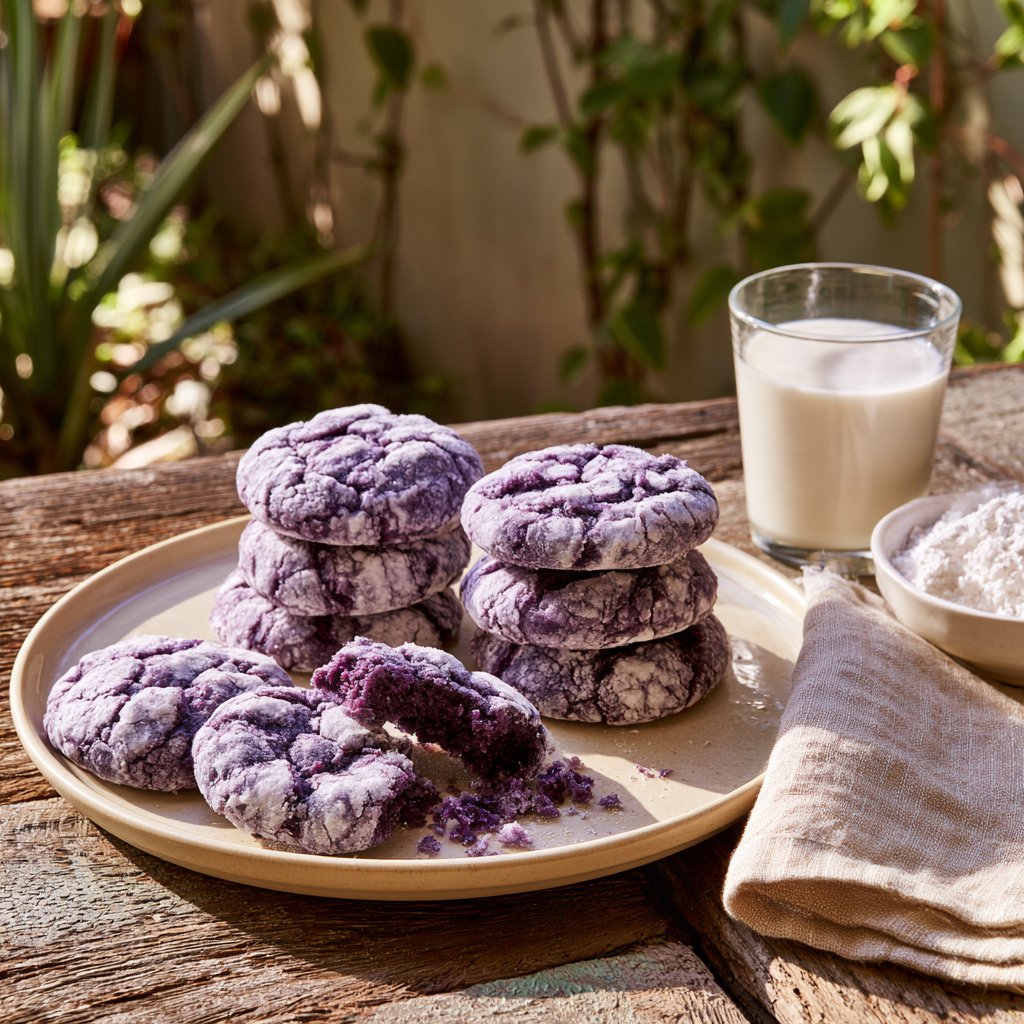
As the cookies expanded during baking, their surfaces separated into irregular white-and-purple patterns.
Inside, the cookies remained tender and chewy, with the gently sweet flavor associated with Filipino ube desserts.
There is no single widely documented inventor or verified first publication of ube crinkle cookies. Their development appears to be part of the broader evolution of modern Filipino baking, where familiar international techniques are adapted using traditional local flavors.
Rather than attributing the recipe to one particular baker or decade without reliable documentation, it is more accurate to describe ube crinkles as a Filipino-style adaptation of the classic crinkle cookie.
That combination of tradition and creativity is exactly what makes them special.
5. Why Are Ube Crinkle Cookies Purple and White?
One of the most fascinating aspects of an authentic Ube Crinkle Cookies Recipe is the appearance that develops during baking.
Before going into the oven, the cookie dough is usually rolled into small balls and generously coated with powdered sugar.
At this stage, the dough may look almost completely white on the outside.
But as the cookies bake, the ingredients begin changing.
The butter softens, gases produced by the leavening ingredients expand, and the cookie dough spreads and rises.
Meanwhile, the outer surface begins to set.
As the expanding interior pushes against that setting surface, cracks form, exposing the purple dough beneath the powdered sugar.
This produces the distinctive marbled appearance associated with ube crinkle cookies.
The process also explains why proper dough preparation matters.
Chilled dough is often easier to handle and can help control spreading, while an even powdered sugar coating produces a more noticeable contrast.
The final appearance depends on the recipe, dough temperature, sugar coating, and baking conditions.
No two cookies develop exactly the same crack pattern, which is part of their handmade charm.
For another traditional cookie with a distinctive sugar-coated exterior, explore our Snickerdoodle Cookies Without Cream of Tartar, where cinnamon sugar creates a completely different but equally delicious finish.
6. How Ube Crinkle Cookies Became a Modern Filipino Bakery Favorite
As Filipino baking continued to evolve, ube began appearing in an increasingly creative range of desserts.
Traditional preparations such as ube halaya remained important, while modern bakers experimented with ube cakes, cheesecakes, pastries, bread, and cookies.
Ube crinkle cookies fit naturally into this growing collection.
They are relatively easy to portion, convenient to share, and visually distinctive without requiring elaborate decoration.
Their soft texture and powdered sugar finish also make them appealing for special occasions.
Filipino bakeries, home bakers, and food creators have helped introduce these cookies to wider audiences, including people who may be discovering ube for the first time.
The growth of online recipe sharing has made it easier for bakers around the world to discover Filipino-inspired desserts and experiment with ingredients that were once more difficult to find outside Asian grocery stores.
Today, ube may be available in several forms, including frozen grated yam, ube halaya, powdered ube, and flavoring extracts.
These products have made it more practical to prepare ube desserts in kitchens far beyond the Philippines.
However, the ingredients are not always interchangeable. Ube halaya contributes moisture and sweetness, while concentrated extracts primarily add flavor and sometimes color.
Understanding these differences is essential for making cookies with a consistent texture and authentic ube character.
7. Traditional Chocolate Crinkles vs. Filipino Ube Crinkle Cookies
Although they share the same basic baking concept, these two cookies offer noticeably different flavors and appearances.
| Feature | Traditional Chocolate Crinkle Cookies | Filipino Ube Crinkle Cookies |
|---|---|---|
| Culinary background | American-style home baking | Filipino-inspired adaptation |
| Signature flavor | Chocolate and cocoa | Sweet, earthy purple yam with subtle nutty notes |
| Dough color | Dark brown | Lavender to deep violet |
| Exterior coating | Powdered sugar | Powdered sugar |
| Texture | Often soft and brownie-like | Typically soft, tender, and chewy |
| Signature appearance | White cracks revealing chocolate dough | White cracks revealing purple ube dough |
| Common occasions | Christmas, parties, cookie exchanges | Holidays, celebrations, gifts, and everyday snacks |
Both styles celebrate the beauty of homemade cookies, but ube crinkles introduce a flavor that feels distinctly Filipino.
If you enjoy exploring cookies with contrasting textures, our Cornflake Cookie Recipe provides a delightfully crunchy alternative to the soft, chewy texture of ube crinkles.
8. Why Ube Crinkle Cookies Are Popular for Holidays and Celebrations
The visual appeal of ube crinkle cookies makes them particularly suitable for celebrations.
Their purple-and-white appearance stands out on dessert platters without requiring frosting, decorative sprinkles, or complicated finishing techniques.
A batch can be arranged on a simple plate, packed into a cookie box, or offered as a homemade gift.
They are especially attractive alongside traditional chocolate crinkles because the contrasting colors create a beautiful assortment.
Their small size also makes them convenient for sharing at birthdays, family gatherings, and holiday parties.
Beyond appearance, their flavor offers something different from the familiar combinations of chocolate, cinnamon, and vanilla.
For people discovering Filipino desserts, ube crinkles provide an approachable introduction to purple yam.
They’re familiar enough to resemble a classic homemade cookie but distinctive enough to feel memorable.
A glass of cold milk is a particularly enjoyable pairing. You can find more serving inspiration in our Chocolate Chip Cookies Milk Recipe, which celebrates another comforting homemade cookie tradition.
9. The Modern Ube Crinkle Cookies Recipe: Keeping Tradition Alive Through Baking
Today, home bakers continue experimenting with ube crinkle cookies while preserving the elements that make them recognizable.
Some recipes feature ube halaya for a deeper yam flavor, while others use ube extract or a combination of ingredients.
A few variations include white chocolate, coconut, or other complementary flavors.
However, the classic version doesn’t need elaborate additions.
Its appeal comes from a simple combination: flavorful purple dough, a delicate powdered sugar coating, a tender center, and the beautiful cracks that develop naturally in the oven.
For OoohDelish, the most appealing approach is to preserve that homemade character.
The cookies don’t need to be perfectly round or identical. Slightly uneven edges, differently sized cracks, and a few crumbs on the serving plate make them feel inviting and achievable.
A good Ube Crinkle Cookies Recipe should deliver genuine ube flavor, balanced sweetness, and a soft texture, not simply a dramatic purple appearance.
That distinction is what turns a visually interesting cookie into a dessert people want to bake again.
10. From Filipino Culinary Heritage to Your Home Kitchen
The history of ube crinkle cookies tells a story of how traditional ingredients can inspire entirely new desserts.
Ube’s place in Filipino food culture extends back centuries, while the crinkle cookie technique became familiar through twentieth-century American baking.
Together, they produced a distinctive modern treat that celebrates both traditions.
Although no single documented invention date defines the ube crinkle cookie, its cultural influences are clear.
The rich purple yam flavor comes from Filipino culinary heritage, and the beautiful powdered sugar cracks reflect the creativity of modern cookie baking.
Every homemade batch brings those influences together in an approachable dessert.
Whether you’re baking them for a holiday celebration, sharing them with friends, or discovering ube for the first time, these cookies offer much more than their striking appearance.
They bring a little piece of Filipino-inspired baking tradition to the table, one beautifully cracked purple cookie at a time.
OoohDelish Baking Tip: For beautifully defined ube crinkle cookies, start with properly chilled dough, roll each portion generously in powdered sugar, and bake just until the edges are set. The goal is a naturally cracked exterior surrounding a tender, moist purple center, not an overly dry or perfectly uniform cookie.
Health Benefits of Ube Crinkle Cookies Recipe: Nutrition, Antioxidants & Healthier Baking Tips
With their gorgeous purple centers, delicate powdered sugar coating, and irresistibly soft texture, Ube Crinkle Cookies are one of those desserts that look as wonderful as they taste. But beyond their beautiful appearance, you might wonder whether these Filipino-inspired cookies offer any nutritional benefits.
The answer begins with their signature ingredient: ube, a purple yam traditionally used in Filipino desserts. Real ube contains dietary fiber, naturally occurring minerals, and plant pigments called anthocyanins. These compounds have attracted scientific interest because of their antioxidant properties.
However, it’s important to distinguish the nutritional qualities of whole purple yam from those of a finished cookie. A typical Ube Crinkle Cookies Recipe also contains flour, sugar, butter or oil, and a generous powdered sugar coating. Some recipes rely heavily on sweetened ube halaya or ube extract, which can significantly change the nutritional profile.
At OoohDelish, we believe delicious desserts should be enjoyed with accurate information. Let’s explore what ube contributes, what happens when it’s incorporated into cookies, and how to make this beautiful Filipino treat a little more balanced without sacrificing its signature flavor and texture.
Ube Crinkle Cookies: Ingredients and Potential Nutritional Benefits
| Ingredient | Nutritional Contribution | What It Means for Your Cookies |
|---|---|---|
| Real Purple Yam (Ube) | Contains carbohydrates, dietary fiber, potassium, and naturally occurring plant compounds. | Contributes authentic ube flavor and some nutrients when included in meaningful amounts. |
| Anthocyanins in Purple Ube | Naturally occurring pigments studied for antioxidant activity. | Contribute to ube’s purple color, although their concentration varies with processing and baking. |
| Ube Halaya | Contains purple yam but is commonly prepared with added sugar and rich ingredients. | Provides concentrated flavor and moisture, but may increase the cookies’ sugar and calorie content. |
| Eggs | Supply protein, choline, and several micronutrients. | Help bind the dough and create structure while contributing modest nutrition per cookie. |
| All-Purpose Flour | Primarily provides carbohydrates, with some protein and micronutrients. | Creates the soft cookie structure but generally contains less fiber than whole-grain flour. |
| Butter | Supplies fat and small amounts of fat-soluble vitamins. | Adds richness and tenderness, but also contributes saturated fat and calories. |
| Powdered Sugar | Provides added sugar and energy. | Creates the beautiful white crinkle coating but contributes little nutritional value. |
| Optional Nuts | Can contribute unsaturated fats, fiber, and some protein. | Offer a more nutrient-dense addition when used in suitable variations. |
1. Real Ube Contains Naturally Occurring Antioxidant Compounds
One of the most interesting nutritional characteristics of purple yam is its collection of natural plant pigments.
These pigments include anthocyanins, a group of compounds responsible for the red, blue, and purple colors found in many plants.
Researchers have identified anthocyanins and other phenolic compounds in purple varieties of Dioscorea alata, the yam species commonly known as ube.
Laboratory studies have demonstrated antioxidant activity in some of these compounds. Antioxidants are studied for their ability to interact with processes involving oxidative stress.
However, laboratory antioxidant activity does not establish that eating ube cookies prevents disease, reduces inflammation, or provides a measurable medical benefit.
The amount of these compounds in finished cookies depends on the variety of yam, how the ube is processed, the quantity used, and the baking conditions.
OoohDelish Nutrition Tip: For authentic ube character, choose a recipe that contains real purple yam or ube halaya rather than relying entirely on coloring and flavoring extract. Remember that ube halaya is usually sweetened, so its ingredients matter too.
2. Purple Yam Can Contribute Dietary Fiber
Whole purple yam naturally contains dietary fiber.
Fiber plays an important role in normal digestive function and contributes to overall dietary quality.
However, the nutritional impact of ube depends on how much actual yam is present in your cookies.
For example, a cookie made with a substantial amount of real ube may contain more yam-derived fiber than one flavored with only a few drops of ube extract.
Nevertheless, a typical ube crinkle cookie is still mainly a sweet baked dessert, not a high-fiber food.
Refined flour, sugar, and butter often make up much of the dough, while the amount of ube per cookie may be relatively small.
If you’re interested in increasing fiber, you can experiment with replacing a modest portion of the all-purpose flour with whole-wheat pastry flour. Just remember that this may change the texture and appearance of the finished cookies.
For another homemade dessert that incorporates fruit directly into the recipe, explore our Double Apple Cake, which uses apples and applesauce to create a moist, flavorful cake.
3. Ube Provides Potassium and Other Minerals
Purple yam is a naturally occurring source of minerals, including potassium.
Potassium is an essential mineral that contributes to normal muscle and nerve function and helps the body maintain appropriate fluid balance.
Whole ube also contains varying amounts of other minerals, such as magnesium.
However, ube crinkle cookies should not automatically be described as a significant source of potassium or magnesium.
The amount in a serving depends on the quantity of real yam used, the preparation method, and the final cookie size.
Recipes made primarily with ube extract may provide very little of the mineral content associated with whole purple yam.
For this reason, it’s more accurate to describe real ube as a nutrient-containing ingredient than to claim that the finished dessert supplies substantial amounts of minerals.
4. Eggs Contribute Protein and Help Create the Perfect Texture
Many homemade ube crinkle cookie recipes contain eggs.
In addition to helping bind the ingredients, eggs supply protein, choline, and other essential nutrients.
Protein is necessary for normal growth and tissue maintenance, while choline contributes to healthy cellular and nervous system function.
From a baking perspective, eggs also play a valuable structural role.
They help create the tender, cohesive centers that make these cookies so enjoyable.
However, the protein from one or two eggs is distributed throughout the entire batch.
A single cookie generally supplies only a modest amount of protein and shouldn’t be considered a high-protein snack.
Pairing a cookie with plain milk or unsweetened soy milk can provide additional protein as part of a balanced snack.
For another soft, sweet homemade treat with a different texture, try our Snickerdoodle Cookies Without Cream of Tartar.
5. Homemade Ube Crinkle Cookies Let You Control the Ingredients
One of the most practical advantages of preparing your own Ube Crinkle Cookies Recipe is knowing exactly what goes into the dough.
You can choose the type of butter, the amount of added sugar, and the ube ingredients used.
This is particularly useful because commercially prepared ube products vary considerably.
Some ube halaya products contain substantial amounts of added sugar, while certain ube extracts include coloring agents or additional flavorings.
There’s nothing inherently wrong with choosing an extract for a particular recipe, but it’s important to understand what it contributes.
Ube extract primarily provides flavor and sometimes color; it is not nutritionally equivalent to whole purple yam.
When baking at home, you can also decide how generously to coat the cookies in powdered sugar.
However, the sugar coating isn’t merely decorative. It creates the recognizable white-and-purple crinkle effect, so reducing it significantly may affect the final appearance.
A carefully balanced recipe is more reliable than making numerous substitutions without considering how they affect the dough.
6. The Cookies Provide Carbohydrates for Energy
Like most baked cookies, ube crinkles contain carbohydrates.
Some come from the natural starches in purple yam, while others come from flour, granulated sugar, sweetened ube halaya, and powdered sugar.
Carbohydrates provide energy for the body, but that alone doesn’t make a dessert especially nutritious.
The important distinction is between carbohydrate-rich foods that also provide substantial fiber, protein, and micronutrients and sweet treats whose calories largely come from refined flour and added sugars.
Ube crinkle cookies generally fall into the second category.
They can still be enjoyed as part of a varied eating pattern, but they shouldn’t replace more nutrient-dense everyday foods.
Are Ube Crinkle Cookies Healthy?
Ube Crinkle Cookies can fit into a balanced diet, but they are best enjoyed as a dessert rather than a health food.
Even though purple yam contains beneficial nutrients and plant compounds, the nutritional profile of the finished cookies depends on the complete recipe.
Here is how to evaluate them realistically.
| Nutritional Factor | What You Should Know |
|---|---|
| Calories | Depend on cookie size and the quantities of flour, butter, sugar, and ube halaya. |
| Carbohydrates | Usually come from flour, sugar, and purple yam ingredients. |
| Added Sugar | May come from the dough, sweetened ube halaya, and powdered sugar coating. |
| Fat | Usually comes from butter, oil, or other rich ingredients. |
| Protein | Eggs and flour provide modest amounts. |
| Dietary Fiber | Depends largely on the quantity of real ube and the flour used. |
| Potassium | May be present when real purple yam is used, but the amount per cookie is variable. |
| Anthocyanins | May be present in real purple ube; amounts depend on the yam and preparation. |
| Portion Size | Larger cookies contain more of the recipe’s total calories and nutrients. |
A reliable nutrition label should be calculated using the exact ingredients, batch yield, and cookie size. Without a finalized formula, specific calorie or sugar estimates would be misleading.
How to Make Ube Crinkle Cookies a Little Healthier Without Losing Their Soft Texture
Making healthier adjustments doesn’t mean turning your favorite cookies into something completely different.
The goal is to preserve the authentic ube flavor, soft chewy center, and beautiful powdered sugar cracks while making sensible ingredient choices.
- Use genuine ube ingredients. Real purple yam or a suitable ube halaya provides authentic flavor and may contribute nutrients not found in a flavor-only extract.
- Check the sugar content of ube halaya. If using a sweetened product, account for the sugar it adds before adjusting the dough’s sweetness.
- Try a modest sugar reduction. Slightly reducing the sugar in a compatible dough may work, but large reductions can affect spreading, moisture, and the crinkle pattern.
- Experiment with whole-wheat pastry flour. Replacing a small portion of all-purpose flour can increase fiber, although the cookies may become slightly denser.
- Keep the powdered sugar coating balanced. Use enough to create attractive cracks without building unnecessarily thick layers of loose sugar.
- Make smaller, evenly portioned cookies. A cookie scoop helps produce consistent sizes and more predictable baking times.
- Enjoy them with nutritious accompaniments. A cookie served with unsweetened milk, plain yogurt, or fresh fruit can be part of a more varied snack.
OoohDelish Baking Tip: If the signature white crinkle coating is important to you, don’t drastically reduce the powdered sugar. Instead, focus on moderate portions and sensible adjustments to the dough itself.
Ube Crinkle Cookies vs. Traditional Chocolate Crinkle Cookies
Both desserts use a similar baking technique, but their flavors and ingredients are different.
| Feature | Ube Crinkle Cookies | Chocolate Crinkle Cookies |
|---|---|---|
| Signature Ingredient | Purple yam, ube halaya, or ube extract | Cocoa powder or chocolate |
| Main Flavor | Sweet, earthy, subtly nutty | Rich chocolate |
| Natural Plant Compounds | Anthocyanins may be present when real purple yam is used | Cocoa naturally contains flavanols and other polyphenols |
| Typical Texture | Soft, tender, and chewy | Soft, often brownie-like |
| Added Sugar | Commonly present in dough and coating | Commonly present in dough and coating |
| Dietary Fiber | Depends on real ube and flour quantities | Depends on cocoa, flour, and other ingredients |
| Overall Nutrition | Recipe-dependent | Recipe-dependent |
Neither version is automatically healthier.
A chocolate crinkle cookie made with less sugar may have a different nutritional profile from an ube cookie made with generous amounts of sweetened ube halaya.
Likewise, a recipe featuring real purple yam may differ from one made almost entirely with artificial flavoring and coloring.
The most meaningful comparison comes from the complete ingredients and serving sizes, not the color or name of the cookie.
Can You Eat Ube Crinkle Cookies While Watching Your Weight?
Yes. Enjoying an occasional ube crinkle cookie can be compatible with a weight-management plan when it fits your overall eating pattern.
The key considerations are portion size, total calorie intake, and the nutritional quality of your diet as a whole.
Because these cookies typically contain added sugar and refined flour, they can contribute a meaningful amount of carbohydrates and calories, especially when several are eaten together.
If you are monitoring blood glucose, remember that purple yam doesn’t cancel out the carbohydrates or added sugar in a cookie.
A smaller portion may be easier to accommodate than several large cookies.
For serving, try placing one or two cookies on a small plate with a glass of unsweetened milk rather than eating directly from a large batch.
The objective is to enjoy a delicious homemade dessert without treating it as either a miracle health food or something that must be avoided entirely.
OoohDelish Verdict: Are Ube Crinkle Cookies Good for You?
At OoohDelish, we love Ube Crinkle Cookies for their connection to Filipino dessert traditions, their distinctive ube flavor, and their beautifully soft, chewy texture.
Real purple yam contains dietary fiber, minerals, and naturally occurring plant compounds, including anthocyanins. Those qualities make ube an interesting ingredient from a nutritional perspective.
However, the finished cookies are still sweet treats.
Their powdered sugar coating, refined flour, butter, and potentially sweetened ube halaya contribute to their overall sugar and calorie content.
Our recommendation: Choose quality ube ingredients, avoid unnecessary sweetness where the recipe allows, and enjoy homemade ube crinkle cookies in portions that suit your needs.
The greatest appeal of this Ube Crinkle Cookies Recipe isn’t a promise of extraordinary health benefits. It’s the opportunity to enjoy a memorable Filipino-inspired dessert with authentic flavor, a beautiful homemade appearance, and an irresistibly tender purple center.
And sometimes, sharing a plate of freshly baked cookies with the people you love is reason enough to bake them.
How to Make Ube Crinkle Cookies Recipe in 6 Easy Steps
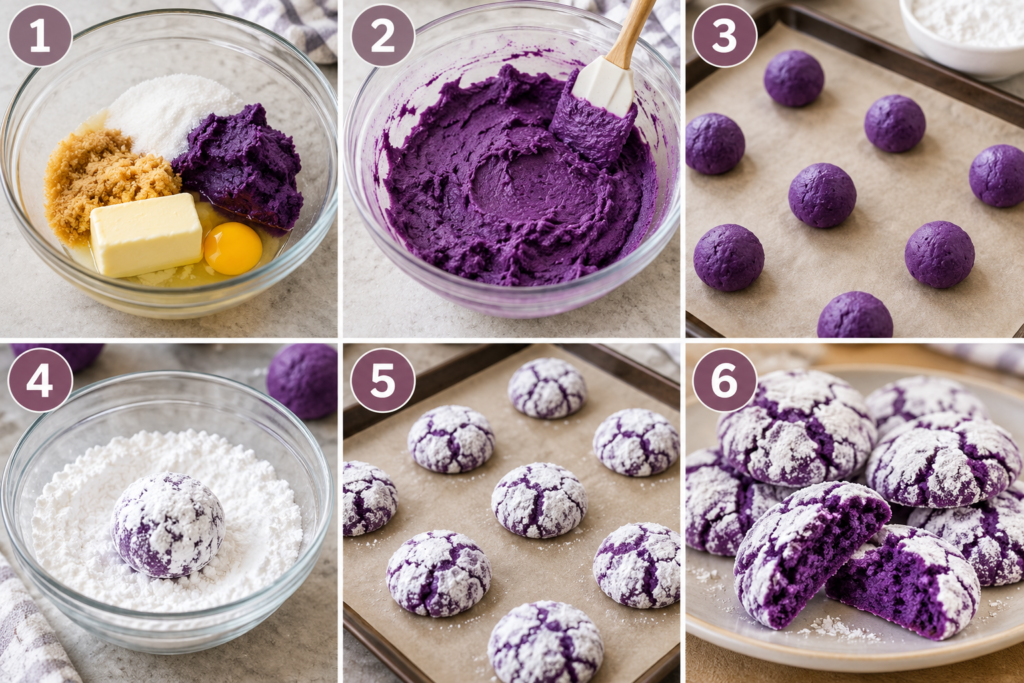
Making this Ube Crinkle Cookies Recipe is easier than you might think! Follow these six simple steps to create beautifully purple Filipino cookies with a delicate powdered sugar coating, gorgeous cracks, and irresistibly soft, chewy centers.
Step 1: Combine the Wet Ingredients. In a large mixing bowl, cream the softened butter with granulated sugar and brown sugar until smooth and fluffy. Add the egg, ube halaya, and ube extract if using, then mix until everything is well combined. The mixture should develop a rich purple color and a smooth, creamy consistency.
Step 2: Prepare the Purple Ube Cookie Dough. In a separate bowl, whisk together the flour, baking powder, and salt. Gradually fold the dry ingredients into the wet mixture until a thick, soft purple dough forms. Avoid overmixing, as this can make the cookies tough. Cover the bowl and refrigerate the dough until firm enough to scoop and roll without sticking excessively.
Step 3: Shape the Cookies into Balls. Once the dough is properly chilled, use a cookie scoop or tablespoon to divide it into evenly sized portions. Gently roll each portion between your palms to form smooth, round balls. Arrange them on a parchment-lined baking sheet, leaving approximately 2 inches between each cookie to allow for spreading during baking.
Step 4: Coat Generously with Powdered Sugar. Place powdered sugar in a shallow bowl and roll each purple dough ball until completely covered with a thick, even white coating. Don’t shake off too much sugar! This generous coating creates the beautiful contrast between the snowy exterior and deep purple cracks. Return the coated balls to the prepared baking sheet.
Step 5: Bake Until Beautifully Crinkled. Preheat your oven to 350°F (175°C) and bake the cookies for approximately 10–12 minutes, depending on their size and your recipe’s dough consistency. As they bake, the cookies will gently spread, and their powdered sugar coating will crack to reveal the vibrant purple centers. Remove them when the edges are set and the centers are soft but no longer visibly raw. Avoid overbaking to preserve their chewy texture.
Step 6: Cool, Serve, and Enjoy! Allow the freshly baked ube crinkle cookies to rest on the baking sheet for about 5 minutes before transferring them to a wire rack. As they cool, their structure will firm up while the centers remain wonderfully soft and tender. Arrange them on a serving plate, break one open to reveal its beautiful purple interior, and enjoy with a cold glass of milk or your favorite warm beverage.
OoohDelish Baking Tip: For the most attractive crinkle pattern, thoroughly chill the dough before shaping, use a generous powdered sugar coating, and avoid flattening the cookie balls before baking. The secret to perfect ube crinkle cookies is a beautifully cracked exterior with a tender, moist center.
Frequently Asked Questions About Ube Crinkle Cookies Recipe
Want beautifully cracked purple cookies with soft, chewy centers every time? These answers explain how to use ube halaya, achieve the perfect powdered sugar coating, prevent excessive spreading, and keep homemade Filipino ube crinkle cookies wonderfully tender and flavorful.
1. What are ube crinkle cookies?
Ube crinkle cookies are Filipino-inspired purple yam cookies with soft centers and a distinctive cracked powdered sugar coating. Their flavor is gently sweet, earthy, and subtly nutty, often with vanilla-like notes. The dough usually contains ube halaya, sometimes enhanced with ube extract. As the cookies bake, their white coating separates into irregular cracks that reveal the purple dough. The result is a beautiful homemade cookie that’s especially popular for holidays and celebrations.
2. Is ube the same as taro or purple sweet potato?
No. Ube is a purple yam from the species Dioscorea alata, while taro and purple sweet potatoes come from different plants. All three can be used in sweet dishes, but their flavors, starch content, and moisture levels differ. Ube is prized for its distinctive earthy sweetness and purple color. Substituting taro or purple sweet potato may produce a tasty cookie, but it won’t have exactly the same flavor or texture as an authentic ube crinkle cookie.
3. What is ube halaya, and why is it used in cookies?
Ube halaya is a traditional Filipino purple yam dessert made by cooking mashed ube with sugar and rich ingredients such as coconut milk, condensed milk, or butter. Its thick consistency makes it useful for adding ube flavor and moisture to cookie dough. Because halaya is usually sweetened, the amount used affects the cookie’s overall sweetness and consistency. Choose a smooth, good-quality product and follow your recipe’s measurements rather than adding extra halaya without adjusting the dough.
4. Can I use fresh or frozen ube instead of ube halaya?
You can prepare homemade ube halaya from properly cooked fresh or frozen purple yam, then use it in a recipe designed for that ingredient. However, plain cooked ube is not a direct one-to-one replacement for sweetened ube halaya. Halaya contains added sugar and other ingredients that influence moisture, sweetness, and cookie spread. If substituting plain mashed ube, you’ll need a separately adjusted recipe to achieve consistent results. Never add raw yam directly to the cookie dough.
5. Do I need ube extract to make ube crinkle cookies?
Not always. If your ube halaya has a pronounced purple yam flavor, you may be able to make delicious cookies without additional extract. However, ube extract can strengthen the flavor and sometimes deepen the purple color. Different extracts vary considerably in strength and ingredients, so begin with the amount specified in your recipe. Adding too much can produce an overpowering or artificial taste. Remember that extract contributes flavor, not the nutritional qualities of whole purple yam.
6. Can I make ube crinkle cookies without food coloring?
Yes! Real purple yam naturally contains pigments that can give cookies a lovely lavender-to-violet appearance. The final shade depends on the yam variety, the ube halaya used, and the other ingredients. Some commercial ube extracts contain added coloring, so check the label if you want to avoid it. Bright neon purple isn’t necessary for delicious ube cookies. A softer, naturally purple interior can look equally beautiful beneath the powdered sugar coating.
7. Why do you need to chill ube crinkle cookie dough?
Chilling firms the fat and makes the soft, sticky ube dough easier to scoop and roll. It can also help control excessive spreading during baking. Refrigerate the dough until it’s firm enough to shape without sticking heavily to your hands. Depending on your recipe, this may take an hour or longer. Follow your recipe’s specific chilling instructions, because the moisture content of ube halaya can vary. Avoid adding excessive flour just to make warm dough easier to handle.
8. Why are ube crinkle cookies rolled in powdered sugar?
Powdered sugar creates the signature white coating that makes ube crinkle cookies so recognizable. As the dough spreads and rises, the outer surface begins to set while the interior continues expanding. This produces irregular cracks that reveal the purple dough underneath. Coat each chilled dough ball generously, covering all sides before baking. A thin or patchy coating may disappear into the surface, making the crinkle pattern less noticeable.
9. How do I stop powdered sugar from melting into the cookies?
Powdered sugar can dissolve when it absorbs moisture from the cookie dough. Begin with properly chilled dough and apply a generous coating just before baking. For extra definition, some bakers roll the dough lightly in granulated sugar before coating it with powdered sugar. This can help keep the white exterior more visible during baking. Avoid letting coated dough balls sit at room temperature for a long time before placing them in the oven.
10. Why didn’t my ube crinkle cookies crack?
Cookies may develop very few cracks if the dough doesn’t spread or rise enough, the leavening ingredient is no longer effective, or the sugar coating is too thin. An inaccurate flour measurement can also make the dough excessively stiff. Use fresh baking powder as specified, measure flour carefully, and coat the chilled dough balls generously. Don’t flatten the cookies before baking unless your recipe specifically instructs you to do so.
11. How do you keep ube crinkle cookies soft and chewy?
The secret is maintaining the correct balance of flour, fat, sugar, and ube halaya. Measure ingredients accurately and avoid overmixing after adding the flour. Bake until the edges are set and the centers are no longer visibly raw, then allow the cookies to rest briefly on the baking sheet. Overbaking can make ube crinkles dry and cakey. For another delicious soft cookie variation, explore our Snickerdoodle Cookies Without Cream of Tartar .
12. Why are my ube crinkle cookies dry, flat, or hard?
Dry or hard cookies often result from too much flour, overmixing, or excessive baking time. Flat cookies may indicate overly warm butter, insufficient chilling, or an imbalance between fat and flour. Measure the flour by weight when possible, follow the chilling instructions, and use a cool baking sheet. If the dough contains ube halaya, avoid changing its quantity casually because it affects both moisture and sweetness.
13. How long do you bake ube crinkle cookies at 350°F?
For small-to-medium ube crinkle cookies, a starting guideline is 350°F (175°C) for approximately 10–12 minutes. Larger or thicker cookies may need longer, depending on the dough formulation. Watch for set edges, defined cracks, and centers that no longer look wet. Let the cookies cool on the tray for about five minutes before transferring them to a rack. Always prioritize your recipe’s tested baking time over a general guideline.
14. Can I make ube crinkle cookie dough ahead and freeze it?
Yes! Ube crinkle cookie dough can often be prepared ahead of time. Refrigerate it in a covered container and follow your recipe’s recommended chilling period. For freezing, portion the dough into balls and freeze them on a lined tray until firm. Transfer to an airtight freezer-safe container and use within approximately two to three months for best quality. Apply the powdered sugar coating just before baking, not before freezing, and allow extra baking time if needed.
15. How should I store homemade ube crinkle cookies?
Allow the baked cookies to cool completely, then store them in an airtight container in a cool, dry kitchen. For best texture, enjoy plain ube crinkle cookies within approximately three to four days. The powdered sugar coating may soften or absorb moisture over time, especially in humid conditions. For longer storage, freeze completely cooled cookies in a suitable sealed container for up to two to three months for best quality. Thaw before serving.
16. Can I make egg-free or gluten-free ube crinkle cookies?
Both variations are possible, but they require careful recipe adjustments. Eggs help bind ube crinkle dough, while wheat flour provides structure. Simply removing eggs or replacing flour without adjusting the other ingredients may produce cookies that spread too much or crumble. Choose a tested egg-free or gluten-free formulation for reliable results. For more insight into baking cookies without eggs, see our No Egg Cookies Recipe . Serve your finished ube cookies with cold milk, as suggested in our Chocolate Chip Cookies Milk guide.